The Child of Horisaka Sahei Tied to a Rice Bale
Summary
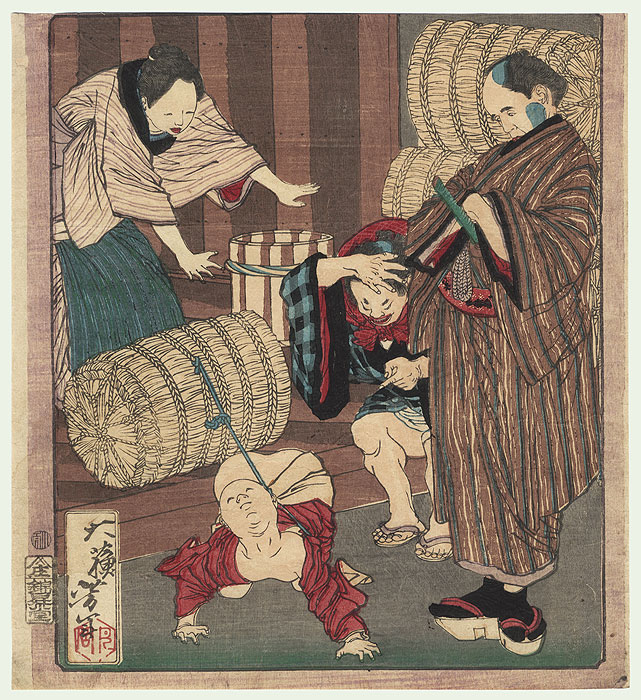
Inside a storehouse filled with tightly wrapped rice bales, a small child is shown tethered to one of the bales and forced into a low, awkward posture near the floor. Three adults and another child or youth occupy the surrounding space. A standing man in a striped robe carries a sheathed sword and looks down toward the restrained child, while a second young figure crouches beside him with one hand raised defensively. At left, an adult reaches toward a wooden tub. The scene visualizes a reported episode involving Horisaka Sahei's child and presents the binding as punishment, abuse, coercion, or public discipline, though the complete prose report has not yet been translated.
Visual Description
The composition depicts a cramped wooden warehouse or merchant storeroom. Large straw-wrapped rice bales dominate the left foreground and upper-right background, their tightly spiraled bindings echoing the rope used on the child. At the bottom center, a young child wears a red outer garment and pale trousers. The child's torso is bent sharply downward, both hands press against the floor, and the head tilts sideways toward the viewer. A thin blue-green rope extends upward from the child toward a knot or attachment point on the nearest rice bale, making the child's body appear tethered to the heavy bundle. The exact attachment to the child's body is partly obscured, but the line appears to pass near the neck, head, or upper back. At right, a tall man in a brown striped robe stands in wooden sandals. He carries a green-sheathed sword and looks toward a second crouching child or youth. The crouching figure wears a dark robe with blue checks and a red collar, raises one arm over the head, and clutches the other hand near the chest, suggesting fear, pain, or an attempt to shield the face. At upper left, an adult in a pale striped garment bends toward a cylindrical wooden tub with both hands extended. The rough plank walls, bales, tub, rope, and subdued brown-green palette emphasize a laboring or commercial environment rather than a theatrical stage.
History and Context
Historical Context
Horisaka Sahei and his child have not been securely identified outside the newspaper-print title. The complete report may describe a family dispute, disciplinary punishment, criminal abuse, neglect, or an unusual local incident. Until the prose is transcribed and matched to the corresponding newspaper account, the identities, ages, relationships, and outcome should remain provisional.
Print History
The Postal News belongs to the wave of nishiki-e shinbun produced in the 1870s as commercial publishers combined newspaper reportage with the visual drama of color woodblock printing. Yoshitoshi's designs frequently transformed crimes, rescues, accidents, family conflicts, strange events, and exemplary acts into concentrated narrative scenes. The present sheet is No. 508 in the series and was published by Kinshōdō.
Cultural Context
Nishiki-e newspapers were aimed at broad audiences who might encounter current events through images as much as through dense written reports. The prints often emphasized moral shock, unusual punishment, domestic conflict, violence, or social disorder. This image places the restrained child among rice bales, tools, armed adults, and merchant labor, turning a private incident into a public object of scrutiny.
Series Context
The Postal News ran through numerous numbered subjects in 1875 and 1876. Each sheet generally combined a prose text block with a large illustration and standardized title treatment. The number refers to the newspaper item or adapted report rather than to a sequential narrative series.
Known Variants
The supplied image is cropped to the illustrated field and omits the large upper text block found in the LACMA impression. Complete impressions may preserve additional margins, publisher details, writer attribution, and the full prose report. Color, trimming, paper tone, and registration vary among surviving examples.
Collection History
A complete impression is held by the Los Angeles County Museum of Art as accession M.84.31.169 in the Herbert R. Cole Collection. Waseda University Library holds another impression under call number Bunko 10 08305 0009. From the collection of Zetsu Nawa.
Relevance to Kinbaku
The print is directly relevant to the broader history of rope restraint because it shows a child physically tethered to a heavy rice bale in an apparently coercive or punitive situation. It expands the archive beyond theatrical torture and adult captivity by documenting restraint within a reported domestic, commercial, or disciplinary context.
Historical Connections
The image shows rope functioning as a practical means of limiting movement by attaching a vulnerable body to a large, immovable object. Unlike elaborate kabuki bindings or supernatural suspensions, the restraint appears crude, immediate, and embedded in everyday material culture. This makes the print useful for studying how ordinary rope, cargo bindings, and disciplinary control could intersect in Meiji visual reporting.
Iconographic Connections
The tether visually links the child's body to the rice bale, while the tightly wound straw packaging repeats the motif of binding throughout the scene. The child's low posture, hands on the floor, twisted neck, exposed vulnerability, and the nearby armed adult establish a clear hierarchy of force. The rope is sparse rather than decorative, but it determines the child's position and movement.
Interpretive Cautions
The exact rope attachment is difficult to see and should not be reconstructed as a formal tying technique. The original report has not been translated, so the reason for the punishment, identity of the adults, and degree of injury remain unknown. The image is an illustrated-news dramatization rather than photographic evidence. Because the restrained subject is a child, the work should be cataloged as coercive violence and historical restraint, never as erotic kinbaku.
Research Value
The print is valuable for widening the historical field from famous torture scenes to everyday disciplinary restraint, child vulnerability, and reported social abuse. It also permits study of the visual relationship between cargo rope and bodily control, showing how the same material used to secure goods could be represented as securing a person.
Themes
Subjects and Keywords
Sources
- Los Angeles County Museum of Art: Tsukioka Yoshitoshi, The Child of Horisaka Sahei Tied to a Rice Bale, accession M.84.31.169 — Confirms the artist, English title, April 1875 date, Meiji-period classification, color woodblock medium, dimensions, and Herbert R. Cole Collection provenance.
- Waseda University Library: Yūbin Hōchi Shinbun, No. 508, call number Bunko 10 08305 0009 — Confirms the Japanese series title and number, Yoshitoshi attribution, Kinshōdō publication, nishiki-e newspaper format, approximate dimensions, and the writer attribution Kisyū Gyōjin or Kisyū Ryōjin as cataloged.
- Google Arts & Culture with Los Angeles County Museum of Art: The Child of Horisaka Sahei Tied to a Rice Bale — Confirms the title, artist, April 1875 date, physical dimensions, medium, and identification as The Postal News, No. 508.
- Yoshitoshi.net: The Postal News, No. 508: The child of Horisaka Sahei tied to a rice bale — Places the print within Yoshitoshi's Postal News series and confirms its catalog title and issue number.
- JP Woodblocks: No. 508, The Child of Horisaka Sahei Tied to a Rice Bale — Confirms the artist, series, issue number, catalog title, and placement within the Postal News sequence.
- Yamada Shoten: Yūbin Hōchi Shinbun, No. 508 — Confirms Yoshitoshi, the Japanese title, newspaper genre, child subject, woodblock technique, and an alternate catalog date of 1874.
- Fuji Arts: Tsukioka Yoshitoshi print, inventory 612286 — Provides the supplied comparison image and dealer attribution to Yoshitoshi.