The Case of the Bound Jizō
Summary
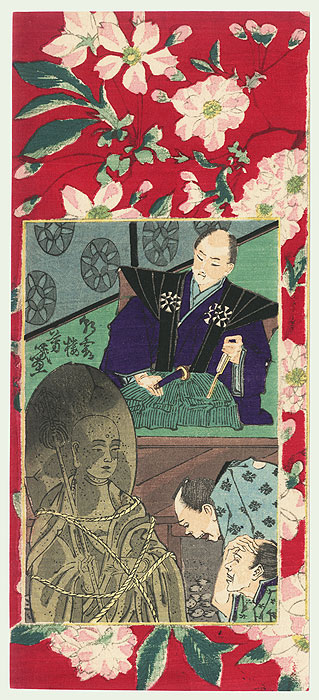
The print illustrates the comic legal legend of the Bound Jizō. In the upper scene, Magistrate Ōoka Echizen sits formally in judgment while two men kneel before him. In the lower scene, a large stone image of Jizō is wrapped repeatedly with rope around its torso, shoulders, arms, and pedestal as two men examine or present it. The absurd spectacle of arresting and binding a religious statue supplied the mechanism through which Ōoka exposed the real thieves in the popular tale.
Visual Description
A dense border of pink and white cherry blossoms against a brilliant red ground encloses two stacked narrative scenes. In the upper scene, a seated magistrate wears a formal black robe with white crests and green striped hakama. He holds a narrow baton, brush, or judicial implement in one hand and looks downward from a raised platform. Two men kneel below him, one bowing deeply while the other looks upward. Behind the magistrate are circular decorative motifs resembling family crests or architectural panels. In the lower scene, a gray-green stone Jizō statue dominates the foreground. Numerous pale ropes pass diagonally and horizontally across the statue's chest, shoulders, abdomen, arms, and lower body, forming a conspicuous web of restraint. The statue retains a calm frontal expression despite its comic arrest. Two adult men crouch at the right and look toward the bound image, one bending forward and the other raising his face in surprise or discussion. The floral frame contrasts the beauty of seasonal decoration with the improbable judicial treatment of a sacred image. Yoshiiku's signature and seal appear within the composition, though the small inscription is difficult to read from the supplied reproduction.
History and Context
Historical Context
Ōoka Tadasuke, commonly called Ōoka Echizen, was an eighteenth-century Tokugawa official who served as Edo's South Magistrate under Shogun Tokugawa Yoshimune. He became the hero of a large body of popular stories known as Ōoka seidan, or Ōoka judgments, in which ingenious rulings uncover criminals and protect ordinary people. Many of these cases are literary or oral inventions rather than verifiable episodes from his career. Jizō is a Buddhist bodhisattva associated especially with children, travelers, the dead, and people in vulnerable states.
Print History
Yoshiiku worked across actor prints, warrior imagery, satire, illustrated fiction, educational books, newspapers, and humorous popular subjects. The compact sequential design and ornamental framing suggest that this object may have been aimed at a broad popular or family audience rather than functioning as a conventional single-scene actor print. The exact publisher, original title, and relationship to any book, game, or educational series remain unknown.
Cultural Context
In the best-known version of the tale, a merchant's employee falls asleep near a temple while guarding a cart loaded with cloth. When the cart and cloth are stolen, Ōoka orders the nearby Jizō statue arrested for failing to prevent or report the crime. Crowds gather to witness the absurd trial and enter the court without permission. Ōoka fines each spectator by requiring a piece of cloth. Among the submitted cloth appears material matching the stolen goods, allowing the authorities to trace and arrest the thieves. The bound statue is then released and becomes associated with protection from theft and the fulfillment of petitions.
Series Context
No series has been securely identified. The floral border and stacked episodes may indicate an illustrated tale, educational anthology, children's print, album leaf, or decorative panel belonging to a larger group of famous stories.
Known Variants
The supplied image may be trimmed or separated from a larger printed object. Other impressions could preserve margins containing a title, publisher, date, or series inscription. No alternate state or matching complete publication has been confirmed.
Collection History
The dealer listing does not provide a descriptive title or detailed scholarly cataloging. From the collection of Zetsu Nawa.
Relevance to Kinbaku
The print is highly useful for expanding the history of Japanese rope imagery beyond human punishment and erotic restraint. Its central subject is a sacred stone body transformed by rope into a prisoner, witness, ritual object, and focus of popular attention. The image demonstrates how binding could signify arrest, accusation, petition, magical efficacy, and comic legal authority.
Historical Connections
The Bound Jizō tradition illustrates that rope in Japanese culture could act upon more than human bodies. Binding the statue could represent formal arrest within the legal tale, but later devotional custom also used rope as a physical petition: worshippers tied the image while making a request and removed rope after the request was fulfilled. This broadens the cultural history relevant to kinbaku by showing rope as a material language of obligation, delay, containment, accusation, and release.
Iconographic Connections
The statue is immobilized by numerous crossing and encircling lines that visually resemble dense torso restraint. The ropes transform a calm, upright religious figure into the center of a legal and ritual spectacle. The contrast between the serene expression and extensive binding creates tension similar to later images in which rope alters the social meaning of a body without changing its facial expression.
Interpretive Cautions
The object being restrained is a stone statue, not a living person. The ropes do not document a method of human capture, penal tying, or erotic kinbaku. The image should therefore be discussed as religious, legal, comic, and folkloric rope iconography. The historical Ōoka Tadasuke should also be distinguished from the legendary judge of popular storytelling. The surviving devotional custom may combine more than one explanatory tradition, and the famous courtroom story should not automatically be treated as documented fact.
Research Value
The work is particularly valuable because it disrupts a narrow genealogy based only on tortured or eroticized bodies. It shows rope operating at the intersection of law, religion, folklore, material ritual, humor, and popular print culture. In a Kinbaku Research Platform gallery, it can serve as a conceptual hinge between practical restraint imagery and wider Japanese beliefs about binding, unbinding, obligation, and control.
Themes
Subjects and Keywords
Sources
- Fuji Arts: Utagawa Yoshiiku print, inventory 555969 — Provides the supplied comparison image and attributes the print to Yoshiiku, but does not furnish a descriptive scholarly title, exact date, publisher, or narrative identification.
- Narihira-san Nanzō-in, official Shibarare Jizō website: History and practice of Shibarare Jizō — Documents the rope-bound Jizō tradition, the statue's association with petitions and fulfillment of wishes, the custom of binding and unbinding it, and the Ōoka Echizen origin story.
- National Diet Library Collaborative Reference Database: Reference entry on the Shibarare Jizō at Nanzō-in — Summarizes the legend in which a merchant's cloth is stolen, Ōoka orders the Jizō bound and brought to court, spectators are fined with cloth, and the stolen goods lead to the arrest of a band of thieves.
- Princeton University, Cotsen Children's Library: Discussion of The Case of the Bound Jizō within Japanese popular storytelling and visual culture — Confirms the enduring popularity of the Bound Jizō story and describes its central episode as Ōoka Echizen ordering a stone Jizō tied and brought into custody to expose the true culprit.
- Ota Memorial Museum of Art: Ochiai Yoshiiku artist and exhibition overview — Provides authoritative biographical context for Yoshiiku and documents his work across humorous prints, actor prints, beauties, warrior subjects, Yokohama imagery, newspapers, and other forms of late-Edo and Meiji popular illustration.
- City of Chigasaki: Ōoka Echizen no Kami Tadasuke — Provides municipal historical context for Ōoka Tadasuke's service as an Edo magistrate and his later reputation for celebrated judgments.