Struggle in the Snow
Summary
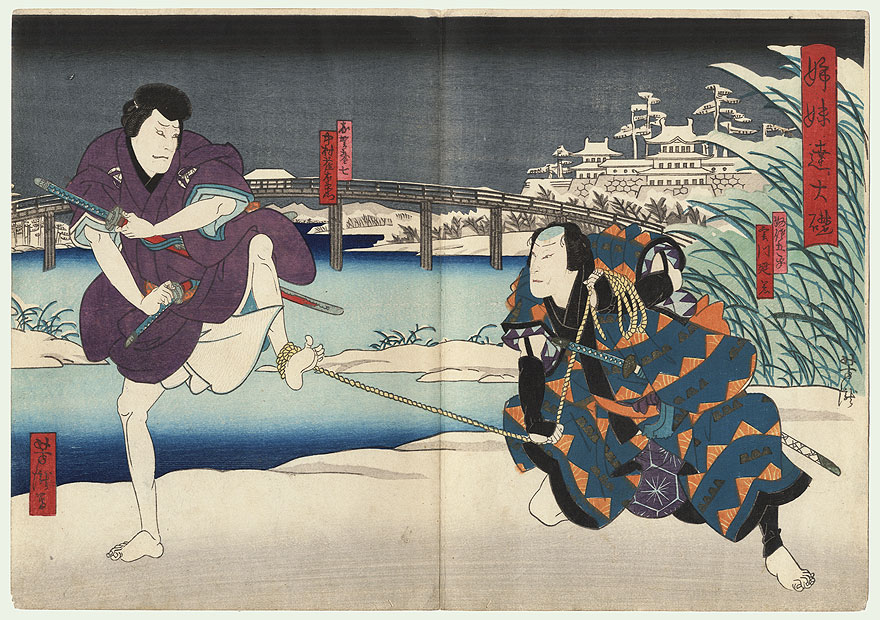
Two kabuki actors portraying armed men confront one another in deep snow outside a castle. The standing figure at left grips a drawn or partly drawn sword while raising one leg, around whose ankle a rope has been tied. The crouching figure at right pulls the rope taut while watching his opponent and keeping a sword at his side. The restraint converts the sword fight into a contest of balance and control, with the right-hand figure using the tether to impede or topple the standing man.
Visual Description
The diptych forms a continuous wintry landscape beneath a nearly black sky. Snow covers the ground, reeds, distant buildings, bridge, and the roofs of a large white castle at upper right. The left actor wears a dark purple robe over a white undergarment. His bare legs and feet are exposed, and his raised right ankle is encircled by a thick yellow-brown rope. He holds a sword across his body with both hands, turning the blade or scabbard toward the man opposite him. His wide stance and lifted leg suggest that the rope has abruptly interrupted his movement. The right actor crouches low in a brightly patterned blue, orange, brown, and black robe. He grips the rope with both hands and pulls it diagonally across the foreground. A sword remains at his waist, and his posture is stable and deliberate. The rope creates the principal compositional line between the figures. A long wooden bridge crosses the middle distance, while reeds at the right frame the snow-covered castle. Red cartouches identify the theatrical title, roles, and actors. Yoshitaki's signature appears near the lower-right edge.
History and Context
Historical Context
The print portrays kabuki roles rather than historical portraits of the actors themselves. Nakamura Fukusuke and Jitsukawa Enjaku were prominent nineteenth-century performers associated with the Osaka stage. The exact role names and dramatic relationship between the characters remain unresolved because the cartouches have not yet been fully transcribed.
Print History
Utagawa Yoshitaki was the most prolific Osaka print designer of the later nineteenth century and specialized in kabuki actor imagery. He produced numerous chūban diptychs and triptychs commemorating current performances. This print belongs to that commercial theatrical culture and was likely issued in conjunction with a specific Osaka production. Its dark sky, extensive snow printing, continuous landscape, and strongly coordinated actor poses indicate a comparatively elaborate or deluxe production.
Cultural Context
Kamigata actor prints were closely tied to local performance culture and the enthusiasm of theater audiences. They preserved actors' likenesses, costumes, climactic gestures, and memorable scenic effects. A device such as the rope around the ankle would have been instantly legible as stage action, allowing the right-hand character to control an armed opponent without engaging him blade to blade. The castle and snow transform the struggle into a dramatic spectacle of danger, balance, and tactical cunning.
Series Context
No numbered series has been identified. The object appears to be an independent actor diptych connected to a particular play and performance. The large title cartouche and smaller actor-role labels follow the conventions of Osaka theatrical prints.
Known Variants
Other impressions may show differences in snow pigment, dark background saturation, color registration, metallic or deluxe printing effects, trimming, and the spacing between the two sheets. No alternate design state has been confirmed.
Collection History
A dealer record describes the work as Struggle in the Snow, and an aggregated Japanese-print record catalogs a corresponding image as Battle in the Snow. From the collection of Zetsu Nawa.
Relevance to Kinbaku
The diptych is directly relevant to the visual history of restraint because one character controls another through a rope tied around the ankle. The restraint is tactical rather than erotic: it disrupts movement, compromises balance, and allows the crouching figure to dominate an armed opponent from a distance.
Historical Connections
The image documents rope restraint as a familiar element of nineteenth-century kabuki action and commercial actor imagery. Rather than encircling the torso or wrists, the rope targets a single ankle and functions as an improvised snare or tether. It shows that audiences could recognize rope as a means of controlling mobility and reversing an apparent advantage in combat. This is part of the broader visual archive of Japanese restraint, but it does not establish a direct lineage to modern erotic kinbaku.
Iconographic Connections
The restraint is made visually explicit by the thick yellow rope, its loop around the raised ankle, and the diagonal line connecting captive and controller. The standing figure's exposed leg, unstable one-footed pose, and occupied hands emphasize vulnerability. The crouching figure's low center of gravity and two-handed grip emphasize control. Later kinbaku imagery similarly uses taut rope lines to articulate relationships of force, balance, and dependency, although the purpose and context here are theatrical combat.
Interpretive Cautions
The scene should not be described as erotic bondage. Both figures are armed male kabuki characters engaged in a violent confrontation. The rope arrangement may reflect stage choreography and the need for immediate visual clarity rather than a practical arrest method. The exact narrative meaning cannot be established until the play and roles are securely identified.
Research Value
The print is valuable because it presents a comparatively uncommon form of restraint focused on the ankle rather than the upper body. It illustrates how rope could control locomotion, create a dramatic diagonal across a multi-sheet composition, and turn balance itself into the subject of a kabuki struggle. It may be compared with theatrical snares, arrest scenes, prisoner imagery, and later depictions of leg restraint.
Themes
Subjects and Keywords
Sources
- Fuji Arts: Utagawa Yoshitaki, Struggle in the Snow, inventory 482141 — Provides the supplied comparison record, artist attribution, English catalog title, and identification of the object as a nineteenth-century Yoshitaki print.
- Ukiyo-e.org: Utagawa Yoshitaki, Battle in the Snow - Kabuki — Identifies Yoshitaki as the artist, catalogs the work as a kabuki snow battle, and identifies the performers as Nakamura Fukusuke and Jitsukawa Enjaku.
- Toshidama Gallery: Utagawa Yoshitaki, Fight in the Snow — Provides the 1862 date and describes the object as a deluxe chūban diptych.
- Japanese Gallery: Utagawa Yoshitaki artist biography — Provides biographical context for Yoshitaki and confirms his specialization in Osaka kabuki actor prints.