Rescuing a Courtesan
Summary
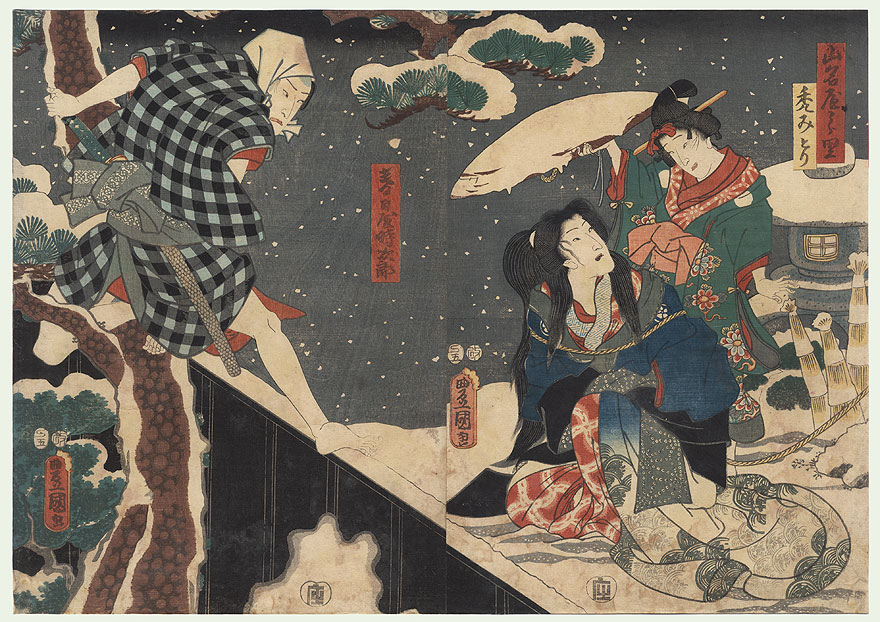
A dramatic kabuki rescue unfolds at night in falling snow. On the right, a courtesan kneels or collapses on a snow-covered roof or raised platform with a thick rope passing around her upper torso and arms. A second woman stands behind her, supporting her shoulders and apparently attempting to loosen or manage the restraint. At the left, a male character climbs from below, grasping a pine trunk while stepping onto the edge of the roof. The scene suspends the action at the moment of intervention, combining captivity, bodily exhaustion, secrecy, and imminent rescue.
Visual Description
The triptych forms a continuous winter night scene beneath a dark gray-black sky scattered with angular flakes of snow. Snow-covered pine branches frame the upper portion, while a large pine trunk rises along the left sheet. The male figure at left wears a black-and-gray checked outer garment over patterned clothing. His head is wrapped in a pale cloth, suggesting disguise, concealment, travel, or night work. A sword remains at his waist. He grips the pine trunk with his left hand and reaches one bare foot onto the snowy roof, his bent posture emphasizing stealth and physical effort. On the right, the captive courtesan wears layered blue, red, white, and richly patterned robes. Her long black hair hangs loose, her eyes are closed or lowered, and her head tilts backward in apparent exhaustion or pain. A thick rope crosses the front of her upper body and extends toward the right edge, visibly restricting her arms and torso. Behind her, another woman in a green robe decorated with flowers and a red collar supports the captive under the shoulders. She holds a small object or rope end near the captive's head and looks downward with concentrated concern. Snow-covered architectural surfaces, bamboo or reed fencing, a round lantern or windowed structure, and dark roof planes establish an elevated exterior beside a building. Red vertical cartouches identify the roles and actors. Toyokuni signatures with seals appear near the lower portions of the sheets.
History and Context
Historical Context
The depicted figures are kabuki characters rather than portraits of historical individuals in ordinary life. The captive appears to be a courtesan named Hanazato, but her complete role identity, the assisting woman, and the male rescuer remain unresolved. Their biographies and relationships should not be reconstructed until the cartouches are fully transcribed and matched to a performance record.
Print History
Kunisada was the dominant designer of kabuki actor prints in mid-nineteenth-century Edo. By 1857 he was signing as Toyokuni and producing large numbers of triptychs tied to current theatrical productions. Such prints transformed climactic stage moments into broad compositions that allowed figures on separate sheets to interact through architecture, gaze, gesture, weapons, and rope. The present work appears to preserve a rescue scene in which a captive courtesan is reached by allies during a winter night.
Cultural Context
Kabuki frequently dramatized courtesans as figures caught between contractual confinement, romantic loyalty, criminal intrigue, household authority, and attempted escape. Rescue and abduction scenes offered opportunities for suspense, secret movement, disguise, swordplay, and stage machinery. Snow heightened the emotional atmosphere by suggesting cold, isolation, danger, and fleeting footprints or movement under cover of night.
Series Context
No numbered print series has been identified. The triptych was probably issued as an independent actor composition associated with a specific production. The red role cartouches and actor labels are typical of contemporary yakusha-e.
Known Variants
Individual sheets may survive separately, and complete triptychs may differ in color strength, trimming, registration, snow pigment, and preservation. The supplied image appears to preserve all three sheets, though the vertical joins and central folds are visible.
Collection History
From the collection of Zetsu Nawa.
Relevance to Kinbaku
The triptych is directly relevant to the visual history of rope restraint because the courtesan's upper body is visibly bound and the rope is central to the rescue narrative. The image predates modern erotic kinbaku and represents theatrical captivity, but it demonstrates how rope could organize a scene of vulnerability, bodily support, danger, and intervention.
Historical Connections
The image shows rope restraint functioning as a readily understood sign of captivity in mainstream late-Edo theatrical imagery. The courtesan's binding establishes the urgency of the scene and distinguishes her from the assisting woman and approaching rescuer. This contributes to the visual archive of restrained bodies that preceded modern kinbaku illustration, although no direct technical lineage can be established from this print alone.
Iconographic Connections
The captive's long disordered hair, lowered or unconscious posture, layered garments, rope across the upper torso, arms held close to the body, and dependence on another figure anticipate visual devices later prominent in bondage and seme imagery. The supporting woman introduces a rescue or caretaking relationship rather than a simple captor-captive pairing. The male figure's approach from a separate sheet turns the rope-bound body into the emotional center of a wider narrative.
Interpretive Cautions
The work is a kabuki actor print and not documentary evidence of an actual courtesan's treatment. The rope arrangement may have been simplified for stage visibility and print composition. The scene appears coercive and non-consensual, but its precise narrative cannot be determined without identifying the play. Although the exposed vulnerability of the captive may appear erotically suggestive to modern viewers, the print should be cataloged primarily as theatrical rescue and captivity imagery rather than modern erotic kinbaku.
Research Value
The triptych is useful for studying the relationship between rope restraint, rescue plots, courtesan narratives, and kabuki staging. It also provides an important comparison with images focused solely on punishment or torture: here, restraint becomes the condition that motivates intervention, physical support, and attempted liberation.
Themes
Subjects and Keywords
Sources
- Fuji Arts: Utagawa Kunisada, Rescuing a Courtesan, 1857, inventory 609386 — Provides the supplied comparison image, artist attribution, English catalog title, 1857 date, and identification of the object as a complete nineteenth-century triptych.
- Art Institute of Chicago: Utagawa Kunisada I, also known as Toyokuni III — Confirms the artist's identity and the equivalence of the names Utagawa Kunisada I and Toyokuni III.
- Kunisada Project: Utagawa Kunisada, artist and signature research database — Provides comparative documentation of Kunisada's signatures, actor prints, production chronology, and late works signed Toyokuni.