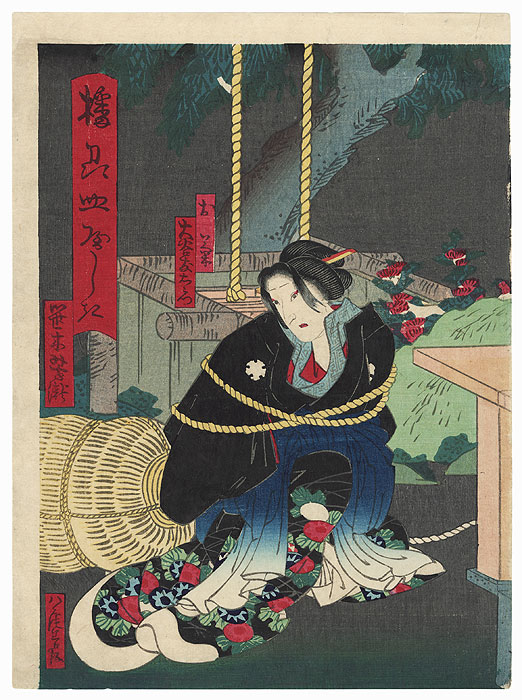
Ōtani Tomoemon as the Bound Okiku
Summary
The kabuki actor Ōtani Tomoemon portrays Okiku kneeling beside a well or garden structure during her punishment in Banshū Sarayashiki. Thick rope circles her upper torso and arms, while additional rope lines rise vertically behind her and extend toward the right edge. Her black outer robe has opened to reveal blue, white, and brightly flowered garments. Loose hair, an anxious expression, and the constricted kneeling posture convey fear and exhaustion. The surrounding pine tree, flowers, timber structures, and large coil or bundle of rope establish the physical setting of captivity before Okiku's death and transformation into a ghost.
Visual Description
Okiku occupies the lower center of the composition, kneeling on dark ground with both legs folded beneath her. She wears a black outer robe marked by a pale floral crest, a blue lower garment, white underlayers, and a richly patterned floral textile spread around her feet. Her head turns slightly toward the viewer's left. Her eyebrows are raised, her mouth is slightly open, and her long black hair has loosened around her face and shoulders. Several turns of thick yellow rope pass around her chest and upper arms, apparently pinning her arms close to or behind her body. One rope line descends from above behind her left shoulder, another hangs vertically behind her right side, and a further line runs across the lower-right portion of the scene. A large cylindrical coil or straw-wrapped bundle sits immediately behind her at left, visually echoing the rope encircling her body. Behind her are horizontal wooden rails or well timbers, a large pine trunk, dark foliage, and clusters of red flowers. A pale wooden or stone structure enters from the right edge. The broad red cartouche at upper left carries the play title, with smaller red labels near the figure identifying the role and actor. Yoshitaki's signature appears near the lower-left corner.
History and Context
Historical Context
Okiku is the victim at the center of the Sarayashiki group of ghost legends. In Banshū Sarayashiki, she serves within a samurai household and becomes entangled in a political conspiracy involving a set of valuable plates. The antagonist hides or removes one plate, accuses her of its loss, and attempts to force her cooperation or submission. When she refuses, she is beaten, bound, suspended or repeatedly lowered near a well, attacked with a sword, and cast into the water. Her ghost subsequently returns and counts the plates, stopping at nine before crying out.
Print History
Utagawa Yoshitaki was among the most prolific designers of Osaka actor prints during the second half of the nineteenth century. He produced hundreds of chūban yakusha-e representing contemporary kabuki performers in recognizable roles. The compact format and close concentration on a single actor allowed viewers to collect theatrical characters while retaining the larger drama through role, actor, and play cartouches.
Cultural Context
Banshū Sarayashiki developed through puppet theater, kabuki, storytelling, local legend, and visual art. The narrative combines household hierarchy, political conspiracy, sexual or personal coercion, wrongful accusation, torture, murder, and supernatural revenge. Okiku became one of Japan's most recognizable female ghosts and a recurring subject in actor prints and supernatural imagery.
Series Context
The work appears to commemorate a kabuki production of Banshū Sarayashiki rather than belonging to a formally titled print series. Osaka actor prints were often issued as individual chūban sheets or as components of diptychs and triptychs representing several performers from the same production.
Known Variants
Other impressions may differ in the saturation of the black robe, red cartouches, blue garments, and green foliage. Trimming may remove publisher, date, or companion-sheet information. No securely documented alternate state has been located.
Collection History
Related commercial records identify Yoshitaki designs showing Ōtani Tomoemon as Okiku and scenes involving Okiku, Tetsuzan, and Hisakichi. From the collection of Zetsu Nawa.
Relevance to Kinbaku
The print is directly relevant to the visual history of Japanese rope restraint. Okiku's upper body is encircled by prominent rope, additional lines connect her to the surrounding structure, and her immobilized posture forms the central subject. The scene belongs to coercive kabuki torture rather than modern consensual kinbaku, but it preserves a powerful nineteenth-century image of rope, female vulnerability, theatrical suffering, and impending suspension.
Historical Connections
The image documents the visibility of rope restraint within mainstream Osaka kabuki culture during the Meiji period. Binding marks Okiku as a captive and prepares her body for further torment at the well. Prints of this subject helped circulate a durable visual vocabulary in which rope, loose hair, patterned clothing, helpless posture, and threatened suspension conveyed the suffering of a beautiful female victim.
Iconographic Connections
The yellow rope strongly contrasts with Okiku's black robe and crosses the body in broad horizontal bands. Vertical ropes above and behind her imply suspension, hauling, or lowering. Her loosened hair, pale face, kneeling posture, floral garments, lowered shoulders, and isolation create a visual formula later recognizable in seme and kinbaku illustration. The surrounding coil or bundle makes rope itself a major material presence rather than a minor narrative accessory.
Interpretive Cautions
The scene depicts non-consensual theatrical torture and murder. It should not be described as consensual bondage or as evidence of a safe restraint system. The exact path of the rope around Okiku's arms and back is partly concealed, and the configuration may reflect stage convention and visual shorthand. The performer is a male kabuki actor portraying a woman. Resemblance to later kinbaku imagery does not establish a direct or uninterrupted technical lineage.
Research Value
The print is useful for comparing Osaka and Edo representations of Okiku, especially differences between full narrative triptychs, isolated actor portraits, ghost images, and close views of the bound body. It also contributes evidence for the persistence of well-suspension imagery, female-role performance, and rope-centered semeba in nineteenth-century kabuki print culture.
Themes
Subjects and Keywords
Sources
- Fuji Arts: Utagawa Yoshitaki, Ōtani Tomoemon as Okiku, inventory 1184841 — Provides the supplied comparison image and confirms the artist, actor, role, and Meiji-era classification.
- Ukiyo-e.org, aggregating Artelino: Utagawa Yoshitaki, Kidnapper - Kabuki — Documents a related Yoshitaki design dated circa the 1870s and identifies Ōtani Tomoemon as Okiku in a kabuki scene involving Hisakichi.
- Ukiyo-e.org, aggregating Artelino: Utagawa Yoshitaki, Haunt and Haunted - Kabuki — Documents a related Yoshitaki Banshū Sarayashiki print dated circa the 1870s, identifying Ōtani Tomoemon as Okiku and Jitsukawa Enjaku as Tetsuzan.
- British Museum: Utagawa Yoshitaki biographical authority record — Confirms Yoshitaki's identity as an Osaka painter and print designer active during the nineteenth century.
- University of Oregon, Jordan Schnitzer Museum of Art research pages: Utagawa Yoshitaki, 1841–1899 — Provides biographical and signature information and documents Yoshitaki's extensive production of Osaka chūban actor prints.
- Hyogo Prefectural Museum of History: Banshū Sarayashiki and the Well of Okiku at Himeji — Provides regional historical and folkloric context for Okiku, Banshū Sarayashiki, Himeji, the missing plates, her death, and the haunting associated with the well.
- Kabuki21: Banshū Sarayashiki — Provides kabuki history and a narrative summary of the play, including Okiku's persecution, the political conspiracy, and her association with the well.