Onoe Kikugorō V as Okiku
Summary
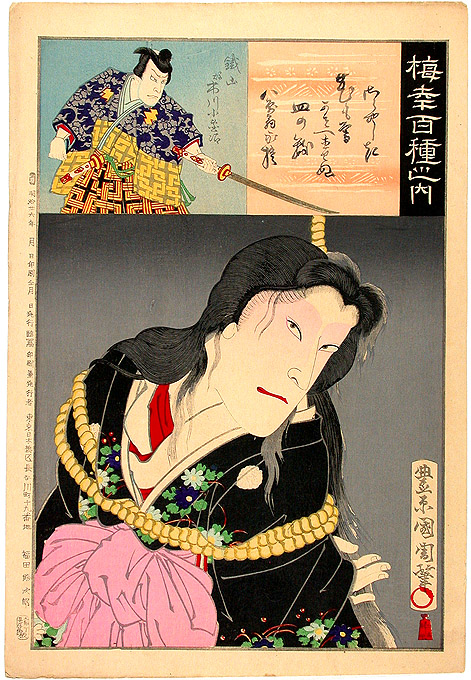
Onoe Kikugorō V appears in the female role of Okiku, the persecuted servant of the Sarayashiki legend. A thick rope passes around her upper arms and torso, holding her arms behind her body. Her black floral robe has fallen open at the chest, and a pink sash gathers across her lower torso. In the smaller upper scene, a samurai identified with Tetsuzan extends a sword toward the rope from which Okiku is suspended or lowered, referring to the episode in which she is tortured at the well before her death.
Visual Description
The print is divided into a large lower actor portrait and a narrow upper narrative register. In the foreground, Okiku is shown from approximately the waist upward against a deep gray-black background. She wears a black robe decorated with small blue, green, white, and red flowers. A red inner collar frames the exposed upper chest, while a large pink sash or gathered garment fills the lower-left foreground. Thick yellow rope wraps across both upper arms and the chest, visibly pinning the arms behind the body. A vertical rope rises from behind her hair toward the upper register, linking the portrait to the torture scene above. Her long black hair falls loose over both shoulders. Her pale face turns slightly to the right, with narrowed eyes and red lips conveying pain, apprehension, or exhausted resignation. In the upper scene, a male actor in a richly patterned blue, yellow, and red costume stands with a sword extended horizontally toward the suspension rope. A pale pink inscription panel containing verse or commentary separates him from the black series-title cartouche at upper right. The contrast between the brilliantly patterned costumes and dark background gives the bound figure a sculptural, theatrical presence.
History and Context
Historical Context
Okiku is the persecuted servant at the center of the Sarayashiki, or Dish Mansion, legend. In its many literary and theatrical versions, she is accused of losing or breaking one of a set of valuable plates. Some versions describe the loss as accidental, while others make it part of a plot by a samurai whose advances she rejects. She is tortured, killed, and thrown into a well. Her ghost subsequently emerges or can be heard counting the plates to nine before crying out and beginning again. The antagonist is commonly named Aoyama Tessan or Tetsuzan, although names and circumstances vary among regional, kabuki, puppet-theater, and modern adaptations.
Print History
Kunichika designed One Hundred Roles of Baikō near the end of his career as a monumental survey of roles associated with his friend Onoe Kikugorō V. Published by Fukuda Kumajirō in 1893 and 1894, the series used fine paper and elaborate printing effects, including embossing and mica. The large lower portraits celebrate Kikugorō's distinctive physiognomy and dramatic characterization, while the upper register supplies narrative context or a supporting performer.
Cultural Context
The Sarayashiki legend was one of Japan's best-known ghost stories and circulated through oral tradition, puppet theater, kabuki, prose fiction, woodblock prints, and later film. Its themes include abuse of household authority, sexual coercion, false accusation, torture, wrongful death, and supernatural revenge. Kabuki versions emphasized both Okiku's physical ordeal and her transformation into a ghost associated with the well.
Series Context
Baikō was the poetry name of Onoe Kikugorō V. The series commemorates one hundred parts connected with him or the Onoe acting lineage. The standardized design combines a large principal portrait, a small dramatic scene at the top, a literary inscription, the black series cartouche, and Kunichika's vertical signature. The Okiku sheet uses the descending rope to connect the supporting scene visually with the bound portrait below.
Known Variants
Surviving impressions may differ in the depth of the black and gray backgrounds, mica effects, blind embossing, trimming, registration, paper tone, and color saturation. The matching dealer record notes deep embossing and strong shading in an early impression. No alternate compositional state has been confirmed.
Collection History
The supplied image matches a print formerly cataloged by Toshidama Gallery. Institutional records for the series are held by the Waseda University Theatre Museum and the Walters Art Museum.
Relevance to Kinbaku
The print is directly relevant to the visual history of Japanese rope restraint. Okiku is bound across the upper arms and torso, her arms are forced behind her, and a vertical rope associates her body with suspension or repeated lowering into the well. The work depicts theatrical torture rather than modern consensual kinbaku, but its isolated portrait of a beautiful bound woman creates a powerful visual conjunction of rope, vulnerability, bodily display, and psychological suffering.
Historical Connections
The print shows rope restraint as a familiar element of mainstream Meiji kabuki imagery. Okiku's binding immediately communicates captivity and abuse of authority, while the vertical rope refers to the physical mechanism of her torture at the well. Images of this kind contributed to the theatrical and visual archive later available to artists and writers concerned with seme and kinbaku, although the print does not document an uninterrupted technical tradition.
Iconographic Connections
The thick rope crosses patterned clothing in prominent horizontal bands, fixes the upper arms to the torso, draws the shoulders backward, and contrasts strongly with the black robe. Loose hair, exposed chest, restrained hands, a pained expression, and the implied suspension line are elements later common in Japanese bondage illustration. The absence of a visible aggressor in the main portrait concentrates attention on the captive's body and emotional state.
Interpretive Cautions
The image represents a kabuki actor portraying a fictionalized torture victim. It is not evidence of a consensual erotic encounter or a technically documented historical tying method. The rope configuration is partly concealed and was designed for immediate theatrical and pictorial legibility. Although the exposed chest and close portrait may appear erotically suggestive to modern viewers, the original context is wrongful punishment, tragic drama, and ghost legend.
Research Value
The sheet is useful for studying how a narrative torture scene could be transformed into an iconic actor portrait centered on the bound body. It also demonstrates Kunichika's use of rope as a structural device linking separate registers of the composition. Comparison with earlier Sarayashiki prints, Kunisada's semeba portraits, Yoshitoshi's restraint imagery, and twentieth-century kinbaku illustration may clarify the persistence and alteration of this visual formula.
Themes
Subjects and Keywords
Sources
- Toshidama Gallery: Toyohara Kunichika, One Hundred Roles of Baikō: Okiku — Provides a matching image and confirms the artist, Onoe Kikugorō V as Okiku, series title, 1893 date, vertical ōban format, publisher Fukuda Kumajirō, elaborate printing, and the interpretation of the upper scene as Tetsuzan threatening the suspension rope with his sword.
- Waseda University Theatre Museum via Ukiyo-e.org: Toyohara Kunichika, Baikō hyakushu no uchi, record 406-0045 — Confirms Toyohara Kunichika as artist and documents an institutional impression from One Hundred Roles of Baikō.
- The Walters Art Museum: Toyohara Kunichika, Baikō hyakushu no uchi, accession 95.502 — Confirms Kunichika's authorship, 1894 series dating, pigments on mulberry paper, the signature Toyohara Kunichika hitsu, and Ichikawa Udanji I as the actor shown in the upper register of the cataloged sheet.
- Wikimedia Commons: One Hundred Roles of Baikō by Toyohara Kunichika — Confirms the series title, publisher Fukuda Kumajirō, 1893–1894 publication span, and its focus on roles associated with Onoe Kikugorō V and the Onoe family.
- Ota Memorial Museum of Art: Toyohara Kunichika exhibition checklist — Provides museum documentation for Kunichika's late actor prints and confirms that designs from One Hundred Roles of Baikō were printed and published in 1893.