One Man with Two Women
Summary
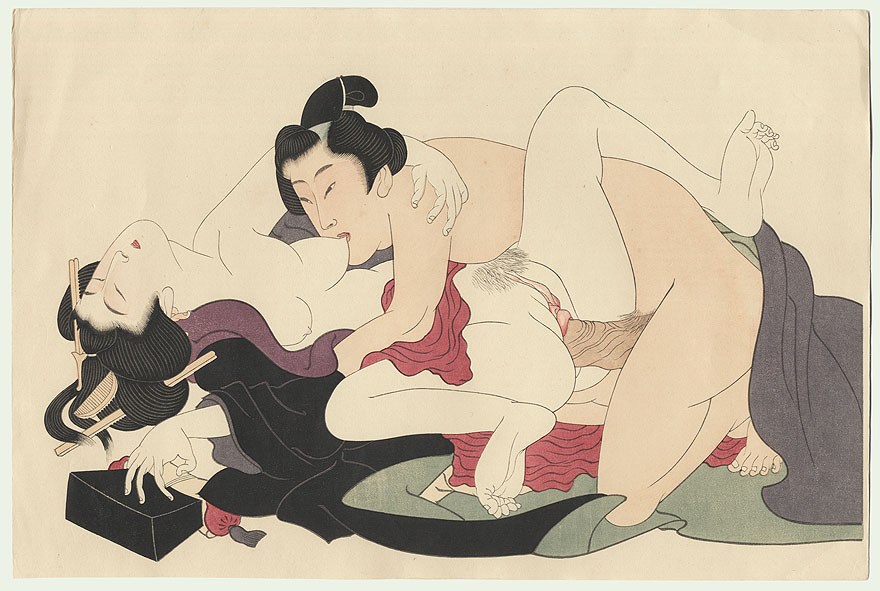
A man engages sexually with two adult women on layered bedding. One woman reclines at the left while the man bends over her and kisses or mouths her chest. A second woman occupies the foreground and right side, leaning across the couple while participating in the sexual activity. Their robes have fallen open and gathered around their bodies, framing the explicit anatomy at the center of the composition.
Visual Description
The composition is tightly cropped around three intertwined adult bodies against an almost empty pale background. At left, a woman reclines on black and purple garments with her head tilted backward and eyes closed. Her elaborate coiffure is held with several hairpins, and one hand rests loosely near a rectangular black lacquer box. Her upper torso is exposed. At the center, a man with a traditional topknot bends across her body, placing his mouth against her breast or chest while supporting himself with one arm. His torso and lower body are largely nude. A second woman lies or kneels across the foreground, her bent legs extending toward the right and upper edge. A red robe gathers beneath her torso, while dark purple and green textiles frame her legs. The genital area is rendered prominently and at exaggerated scale in accordance with established shunga conventions. The three bodies overlap densely, making their exact sexual configuration difficult to reconstruct from the supplied image alone. There is no architectural setting, landscape, rope, weapon, or visible observer. The empty ground directs attention entirely toward bodies, hands, faces, hair, and displaced clothing.
History and Context
Historical Context
The participants are anonymous erotic types rather than identifiable historical individuals. Costume, hairstyles, and the absence of narrative inscriptions do not provide enough evidence to determine whether they represent townspeople, courtesans, entertainers, servants, or fictional characters.
Print History
Hokusai designed major erotic books including Ehon tsuhi no hinagata in 1812, Kinoe no komatsu in 1814, and other shunga publications. His erotic work commonly used close cropping, intertwined bodies, enlarged genitalia, expressive faces, partially retained clothing, and handwritten dialogue. The supplied object is cataloged commercially as after Hokusai, however, and has not been matched securely to one of those documented publications. It may be a later reprint, recut, adaptation, or stylistic pastiche.
Cultural Context
Shunga represented a wide range of sexual combinations, social roles, comic situations, fantasies, and private encounters. Scenes involving more than two participants formed part of this repertoire. Clothing often remained partly in place because patterned textiles helped identify social types, enriched the composition, and framed the exposed sexual anatomy. Anatomical enlargement and physically compressed positions were visual conventions rather than literal records of bodies in space.
Series Context
No original series or erotic book has been identified. The sheet may have been removed from a later album or issued independently as a reproduction of an older composition.
Known Variants
Other impressions, recuts, facsimiles, or digitally altered versions may exist. Without a matching institutional record, it is not possible to determine whether the supplied sheet reproduces a documented Hokusai composition, combines elements from several designs, or is a modern pastiche.
Collection History
No earlier provenance, institutional accession, original album, or documented publication history has been established. From the collection of Zetsu Nawa.
Relevance to Kinbaku
The image contains no rope, binding, immobilization, suspension, coercive posture, or punitive apparatus. Its relevance to kinbaku research is comparative: it documents explicit Japanese erotic imagery organized through bodily entanglement and layered textiles without restraint.
Historical Connections
Modern kinbaku developed within a much broader visual culture that already included explicit sexuality, unconventional sexual arrangements, exaggerated anatomy, patterned clothing, and bodies composed for close visual inspection. This print helps establish that broader erotic background, but it provides no evidence of rope practice or erotic restraint.
Iconographic Connections
The tightly intertwined bodies, exposed flesh framed by elaborate garments, close cropping, and visual emphasis on the central sexual action resemble compositional strategies later used in some erotic photography and illustration. These are general erotic conventions rather than specific bondage motifs.
Interpretive Cautions
The work should not be classified as kinbaku or bondage. No participant is visibly tied, restrained, threatened, or forced. The absence of accompanying dialogue makes the precise interpersonal narrative uncertain. The commercial attribution after Hokusai is provisional and should not be converted into a confirmed authorship claim.
Research Value
The print can function as a control example within the Kinbaku Research Platform. Comparison with explicit rope images helps distinguish features inherited from shunga generally, such as enlarged anatomy, patterned textiles, close framing, and complex bodily arrangements, from features specific to restraint, suspension, domination, punishment, or seme.
Themes
Subjects and Keywords
Sources
- Fuji Arts: After Hokusai, Ōban Color Shunga Design, inventory 614341 — Provides the supplied comparison image and commercial attribution as after Hokusai. It does not establish an original title, date, series, publisher, or documented source composition.
- The British Museum: Katsushika Hokusai, Ehon tsuhi no hinagata, Picture-book Models of Couples, museum number OA+,0.141.1-11 — Confirms Hokusai's documented production of a ten-scene erotic illustrated book around 1812 and provides authoritative context for his shunga practice.
- The British Museum: Katsushika Hokusai, lovers with an unraveled obi from Ehon tsuhi no hinagata, museum number 1972,0724,0.18 — Provides a securely cataloged comparison for Hokusai's erotic treatment of intertwined lovers, partially retained clothing, bedding, and enlarged anatomy.
- The British Museum: Katsushika Hokusai, Kinoe no komatsu, museum number OA+,0.109 — Documents Hokusai's 1814 erotic book Kinoe no komatsu and confirms his use of explicit sexuality, compressed bodies, and printed dialogue in shunga.
- The British Museum: Shunga collection term and scope note — Defines shunga as explicitly erotic Japanese paintings, prints, and book illustrations produced mainly during the Edo period and commonly associated with ukiyo-e artists including Hokusai.
- National Gallery of Victoria: Interpreting Shunga Scroll: Sex and Desire between Women in Edo's Floating World — Provides scholarly context for interpreting multi-participant and female-female sexuality in Japanese erotic art while cautioning against imposing modern identity categories without supporting textual context.