Muraoka of the Konoe Clan Bound with Rope
Summary
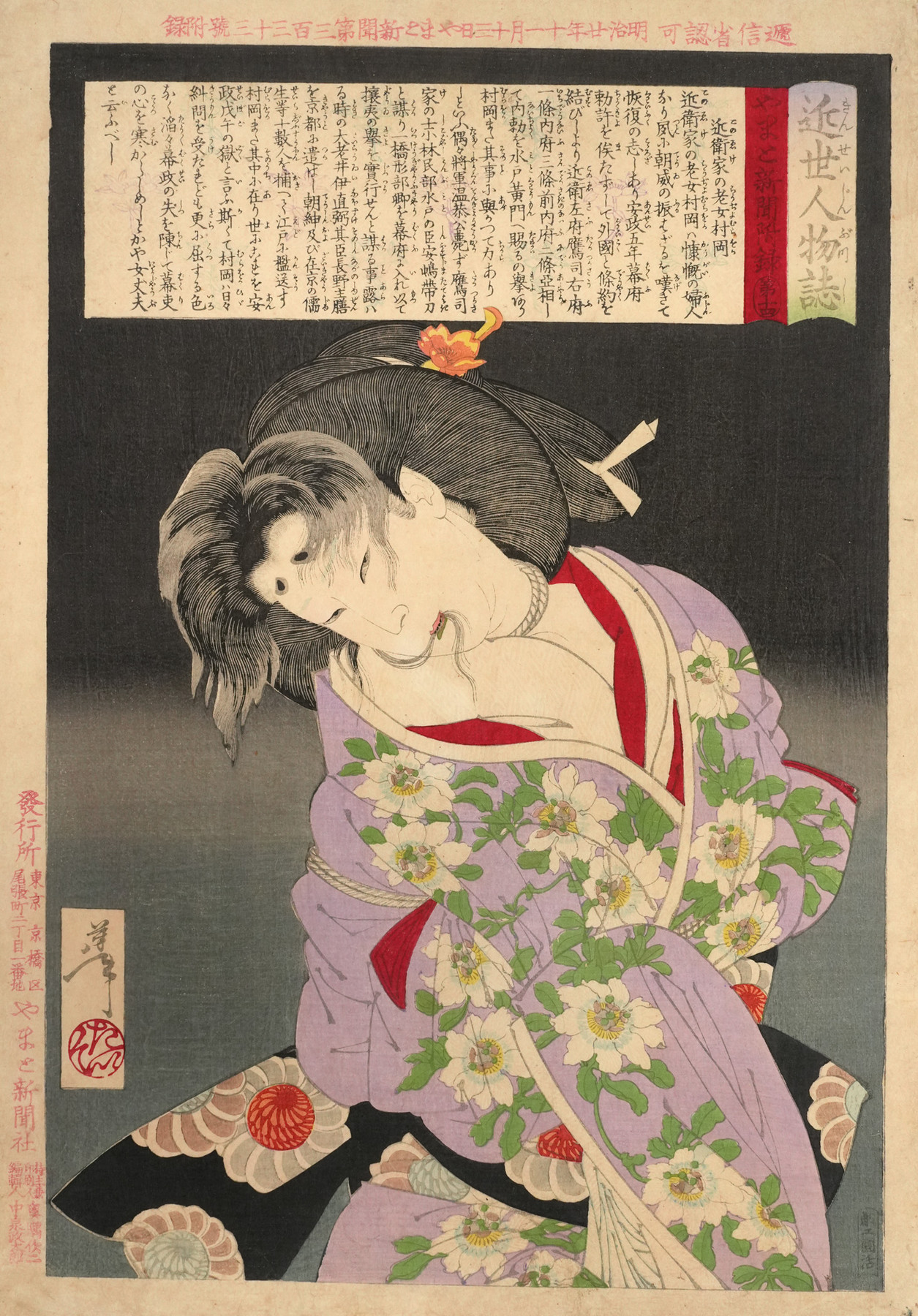
The print portrays Muraoka, the senior lady-in-waiting of the Konoe household, after her arrest during the Ansei Purge. Her arms are drawn behind her body and her torso is encircled by rope. Yoshitoshi presents the historical episode as a concentrated image of political persecution, endurance, and feminine composure. Rather than depicting an ordinary documentary scene, the image transforms Muraoka's suffering into a dramatic, visually seductive portrait of loyalty under punishment.
Visual Description
Muraoka fills almost the entire sheet against a deep black ground. She bends forward and to the side, her head tilted downward, with loosened hair falling across her face. A rope passes around her upper body and kimono, while her arms appear restrained behind her. Her pale lavender kimono is densely patterned with white flowers and green foliage, contrasting with the black background and red accents at her collar and sash. The elegant clothing, exposed neck, disordered hair, and constrained pose create tension between refinement and physical subjection. Above her is a large prose text block identifying and recounting the episode. The title cartouche at upper right reads 近世人物誌, and the red strip identifies it as a Yamato Shinbun supplement.
History and Context
Historical Context
Muraoka no Tsubone, whose personal name was Tsuzaki Noriko (1786–1873), was a senior woman of the Konoe household and an imperial loyalist active during the political struggles at the end of the Tokugawa shogunate. She served Konoe Tadahiro and acted as an intermediary for loyalist figures. During the Ansei Purge of 1858, she was arrested for assisting opponents of the shogunate and was subjected to interrogation and harsh treatment despite being more than seventy years old.
Print History
The print was issued in 1887 as number 14 in Yoshitoshi's Kinsei jinbutsushi series, distributed as a supplement to the Yamato Shinbun. The series used color woodblock printing and newspaper biography to memorialize notable recent figures. It belongs to a late-Meiji hybrid form in which ukiyo-e design, mass journalism, historical biography, and moral exemplarity were fused on a single sheet.
Cultural Context
By 1887, Muraoka's persecution could be recast through the political values of the restored imperial state. Her arrest under the shogunate becomes evidence of loyalty, courage, and sacrifice. Yoshitoshi's image is therefore not neutral reportage. It participates in the construction of a heroic memory of the Restoration while also using the visual language of beauty prints, theatrical suffering, and sensational newspaper illustration.
Series Context
Kinsei jinbutsushi presented biographies of people from the recent past through portraits and explanatory text. This sheet combines a recognizable historical person with a climactic episode, making the body itself the emotional center of the biography.
Known Variants
Multiple impressions are held in museum, library, and private collections. Color balance, trimming, registration, and wear may vary between impressions. No separate compositional state has been confirmed in this analysis.
Collection History
A comparison impression is held by the Los Angeles County Museum of Art in the Herbert R. Cole Collection. From the collection of Zetsu Nawa.
Relevance to Kinbaku
This is a highly relevant pre-twentieth-century image for the visual history of Japanese rope restraint, but it should not be treated as a direct depiction of modern kinbaku technique. Its importance lies in the way rope, feminine beauty, political suffering, and eroticized vulnerability are compressed into a single popular image.
Historical Connections
The print predates the formation of modern erotic kinbaku as a named performance and publishing culture. It nevertheless documents a late-nineteenth-century visual vocabulary in which a bound female body could signify punishment, loyalty, danger, beauty, and emotional intensity simultaneously. Such images formed part of the broader cultural reservoir later available to artists, illustrators, theatre, popular fiction, and eventually SM publishing.
Iconographic Connections
Features later familiar in kinbaku imagery are already present: rope visibly crossing the clothed torso, arms forced behind the body, an off-balance posture, exposed neck, loosened hair, and a contrast between ornate dress and coercive restraint. The print's erotic force comes less from nudity than from the collision of elegance, helplessness, and controlled bodily display.
Interpretive Cautions
The image is a retrospective, stylized portrait produced almost thirty years after the depicted arrest. It is not reliable evidence for the precise ropes, knots, procedures, or bodily treatment used during Muraoka's detention. The restraint is visually legible but technically schematic. Its relationship to kinbaku is iconographic and genealogical rather than proof of an unbroken technical lineage. The youthful, sensual presentation also appears to transform an elderly historical woman into an idealized figure, so the print reveals Meiji visual culture as much as it records Muraoka's life.
Research Value
For kinbaku readers, the sheet is especially useful for studying how rope could function before modern SM magazines as a visual technology of narrative: it identifies the captive, frames her moral character, heightens bodily vulnerability, and invites the viewer to look. It helps explain why later kinbaku imagery could draw simultaneously on punishment scenes, historical drama, bijin-ga, newspaper sensationalism, and fantasies of endurance.