Minamoto no Yorimitsu and His Retainers Enter Mount Ōe
Summary
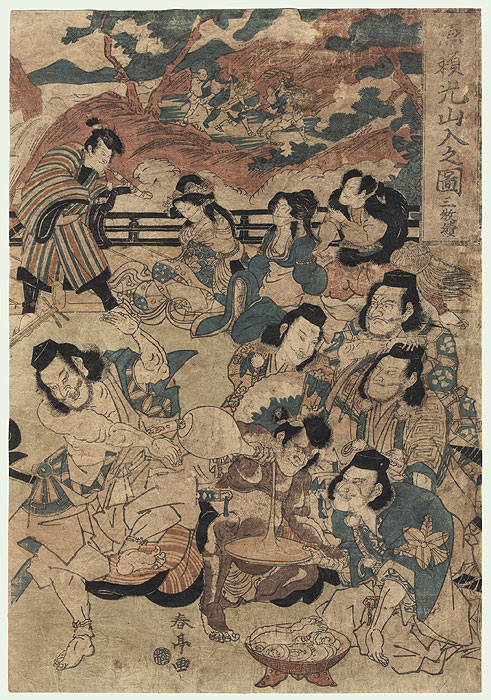
This surviving sheet from a triptych depicts the dangerous banquet at Shuten-dōji's mountain stronghold. A striped-robed figure at upper left, probably one of Yorimitsu's disguised party, gestures or performs before a group of women and demonic attendants. The lower half is crowded with grotesque figures drinking, eating, handling vessels, and preparing human flesh. The image contrasts apparently festive hospitality with captivity, cannibalism, and imminent violence.
Visual Description
The crowded vertical composition is divided informally into an upper zone of women, attendants, and performance and a lower zone dominated by grotesque male figures and food. At upper left, a man in a boldly striped robe leans forward with one arm extended, as though dancing, gesturing, or entertaining the gathering. Several women sit behind him near a railing. One lowers her head beneath a dark band or headdress, while others raise their hands or huddle together. Their subdued postures contrast with the animated men below. In the lower foreground, a muscular figure at left grips a vessel or utensil while another crouching figure bends over a broad bowl. Several large-faced men cluster tightly around them, drinking, observing, or handling food. A raised platter at the bottom contains pieces of flesh or food rendered with disturbing anatomical ambiguity. A pale recumbent body or bodily fragment appears near the left-center foreground, contributing to the scene's cannibalistic atmosphere. Behind the banquet, reddish mountain slopes, pine trees, and a small traveling party establish the remote setting. The vertical title cartouche occupies the upper-right margin, and Shuntei's signature and seal appear near the lower center.
History and Context
Historical Context
Minamoto no Yorimitsu, also known as Raikō, was a historical Heian-period warrior who became the central hero of numerous legends involving supernatural enemies. In the Shuten-dōji narrative, young women vanish from the capital and are traced to a demon stronghold on Mount Ōe. Yorimitsu and his retainers disguise themselves as mountain ascetics, gain entry to the demon's residence, and accept his hospitality. They encourage Shuten-dōji and his followers to drink divinely supplied intoxicating or poisonous sake before revealing their weapons and attacking. The severed head of Shuten-dōji later attempts to bite Yorimitsu, who is protected by layered helmets.
Print History
Katsukawa Shuntei was among the important early nineteenth-century designers of warrior prints. His dynamic compositions helped establish the large-scale musha-e tradition later developed by Utagawa Kuniyoshi and his followers. This triptych predates the great boom in Kuniyoshi's heroic warrior imagery and demonstrates Shuntei's interest in crowded narrative scenes, grotesque supernatural figures, and continuous multi-sheet landscapes.
Cultural Context
The Shuten-dōji story circulated through medieval picture scrolls, otogizōshi, Noh, kabuki, illustrated books, popular storytelling, and commercial prints. Its appeal combined heroic deception, supernatural combat, abducted women, intoxicating drink, cannibalism, divine assistance, and spectacular violence. The banquet episode is crucial because the heroes must temporarily participate in the demon household's hospitality while concealing their true purpose.
Series Context
The work is an independent triptych rather than part of a numbered series. The complete composition depicts Yorimitsu and his retainers drinking, dancing, or otherwise entertaining Shuten-dōji and his followers before the attack.
Known Variants
Individual sheets may survive separately, and complete triptychs may differ in trimming, color saturation, registration, paper tone, and alignment. The supplied reproduction appears to show one sheet rather than the entire three-sheet composition. Hara Shobo records individual sheet dimensions of approximately 38.4 by 26.5 centimeters.
Collection History
From the collection of Zetsu Nawa. From the collection of Zetsu Nawa.
Relevance to Kinbaku
The print is useful primarily as context for the visual history of captivity rather than as a clear technical image of rope restraint. It places abducted women within a demon household where human bodies are controlled, consumed, and transformed into spectacle. No unequivocal rope binding can be securely identified in this particular sheet.
Historical Connections
The Shuten-dōji legend contributed to a broad cultural repertoire of abducted women, enclosed mountain strongholds, heroic rescue, and bodily danger. Such narratives formed part of the theatrical and literary environment in which more explicit images of binding, torture, and rescue were later produced. The connection to kinbaku is therefore narrative and cultural rather than technical.
Iconographic Connections
The women are shown as a subdued group separated from the animated male and demonic banquet participants. The crowded scene establishes unequal control through posture, enclosure, surveillance, and implied threat. The apparent treatment of human bodies as food heightens the captives' vulnerability and transforms bodily possession into the central horror of the demon household.
Interpretive Cautions
The supplied sheet does not show a clearly readable rope configuration securing a captive. Bands, garment ties, and overlapping limbs should not be misidentified as bondage. The image should therefore not be cataloged as direct evidence of historical tying practice. Its relevance lies in abduction, captivity, threatened bodily violation, and rescue narrative. The scene is supernatural folklore rather than a documentary representation of crime or imprisonment.
Research Value
The print broadens a kinbaku-related collection by showing the narrative world surrounding restraint: abduction precedes binding, captivity motivates rescue, and bodily control can be communicated without prominently displayed rope. It also supplies an early nineteenth-century precedent for the combination of beautiful captives, grotesque aggressors, remote architecture, and heroic intervention.
Themes
Subjects and Keywords
Sources
- Ritsumeikan University via Ukiyo-e.org: Katsukawa Shuntei, Minamoto no Yorimitsu yama-iri no zu, triptych — Confirms the artist, Japanese title, triptych format, and 1818 date.
- Hara Shobo: Katsukawa Shuntei, Minamoto no Yorimitsu yama-iri no zu, web ID 29784 — Confirms the artist, title, circa 1818 date, three-sheet ōban format, and approximate dimensions of 38.4 by 26.5 centimeters per sheet.
- Yamada Shoten: Shuntei, Minamotono Yorimitsu Meeting with Shuten-doji, item 54380 — Confirms the artist, Japanese title, English catalog identification, woodblock technique, and circa 1818 date.
- Keikodo Gallery: Katsukawa Shuntei, Minamoto no Yorimitsu and his retainers drinking sake with Shuten-dōji at Mount Ōe — Identifies the banquet episode, Yorimitsu's retainers, Shuten-dōji, Mount Ōe, triptych format, and circa 1818 date.
- Ota Memorial Museum of Art: Explanation of Shuten-dōji imagery including Katsukawa Shuntei's Minamoto no Yorimitsu yama-iri no zu — Explains that the print shows Yorimitsu's party dancing to deceive Shuten-dōji and his oni before administering the divine intoxicating sake.
- Fuji Arts: Katsukawa Shuntei, Minamoto no Yorimitsu and Shuten-dōji, inventory 490820 — Provides the supplied comparison image and modern sales record for the work.