Lovers Making Love under the Full Moon
Summary
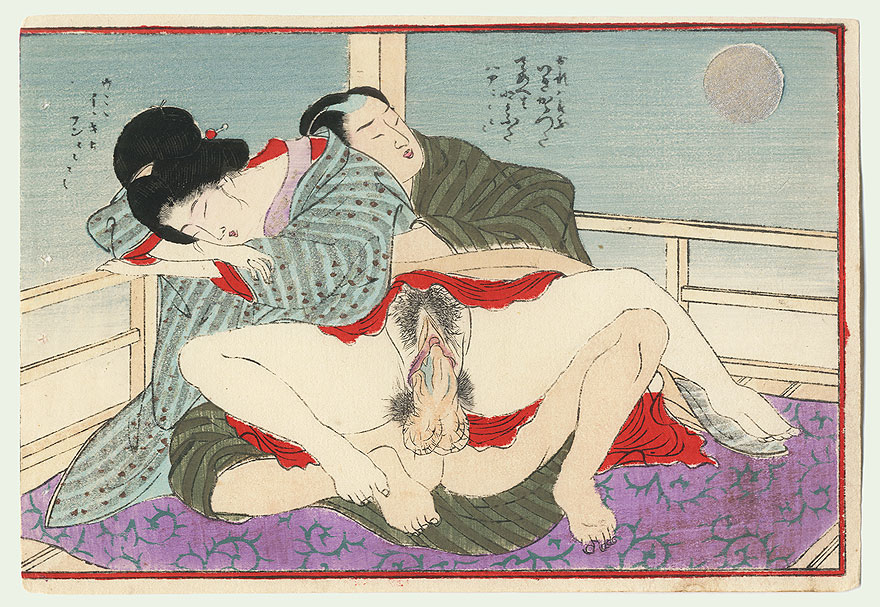
A heterosexual couple engages in explicit intercourse on a purple patterned mattress beside an open veranda under a full moon. The woman sits astride or leans over the reclining man while he supports her body and touches her genital area. Their robes remain partly wrapped around their shoulders and lower bodies, creating strong bands of pale blue, green, red, and purple around their exposed anatomy. Handwritten dialogue above the figures accompanies the encounter.
Visual Description
The couple occupies nearly the entire horizontal composition. A woman in a pale blue-gray robe patterned with small red and dark motifs leans forward across the reclining man. Her robe has opened and gathered around her back and arms, while a vivid red undergarment frames her exposed lower body. Her head turns downward and to the left, resting near her folded arm against the wooden railing. Her black hair is arranged in a formal coiffure with a small red ornament. Beneath her, a man in a dark green striped robe reclines against the veranda or room edge. His head tilts backward, his eyes are partly closed, and one arm circles the woman's body. The couple's genitalia are rendered at exaggerated scale in the conventional shunga manner, making penetration and manual stimulation visually explicit. Their intertwined legs form a broad oval at the center and right of the image. A purple textile with green vine or floral patterns covers the floor beneath them. A pale blue sky or night field appears beyond the railing, dominated by a large round moon rendered with a softly reflective surface that may include mica. Small handwritten dialogue appears near the heads of both participants. A thin red-and-black border encloses the image. No visible rope, knots, weapons, force, or third-party observer appears.
History and Context
Historical Context
The participants are unidentified social or literary types rather than securely documented historical individuals. Their hairstyles, robes, bedding, and private interior place them within an idealized late-nineteenth-century erotic setting.
Print History
Tomioka Eisen was a Meiji-period painter and woodblock-print designer known for images of beautiful women, literary frontispieces, magazine illustrations, and erotic works. Scholarship on late-Meiji shunga has associated Eisen with a shift from the humorous and narratively elaborate erotic imagery of earlier ukiyo-e toward more direct, anatomically emphatic sexual representation. Anonymous workshops and later publishers also copied, adapted, or reissued compositions associated with well-known artists, making unsigned attributions difficult. The supplied print is therefore best cataloged as after or in the style of Tomioka Eisen unless a matching album, wrapper, signature, or institutional record can confirm authorship.
Cultural Context
Shunga remained in production during the Meiji period despite censorship, modernization, photography, changing sexual discourse, and new commercial publishing systems. Late examples often preserved traditional conventions such as enlarged genitalia, partially clothed bodies, written dialogue, seasonal settings, and intimate interiors while adopting new pigments, metallic effects, smoother drawing, and more direct erotic presentation. The moonlit veranda links the sexual encounter to a long shunga tradition of pairing lovemaking with seasonal or atmospheric imagery.
Series Context
No series has been identified. The work may have belonged to a multi-sheet erotic album, with each leaf presenting a different couple, position, social type, or setting. The absence of title, signature, and publisher information is common in illicit or privately circulated shunga.
Known Variants
The dealer description identifies the print as deluxe and mica-embellished, suggesting that other impressions may differ in reflective pigments, paper quality, registration, color saturation, and surface sheen. Later recuts, reproductions, or facsimiles may also exist. No securely matched alternate impression has been located.
Collection History
No prior collector, original album, institutional accession, or documented publication history has been established. From the collection of Zetsu Nawa.
Relevance to Kinbaku
The print has no direct rope or restraint content. Its value to kinbaku research is comparative: it documents explicit late-Meiji sexuality without binding, punishment, coercion, or captivity, helping distinguish the broader history of Japanese erotic imagery from the more specific emergence of erotic rope restraint.
Historical Connections
Modern kinbaku emerged within a visual culture that already possessed a long and varied repertoire of erotic bodies, sexual positions, private interiors, erotic dialogue, theatrical costume, and close observation of pleasure. This print demonstrates that explicit sexual imagery did not require rope or domination to organize the viewer's attention. It therefore helps separate the general inheritance of shunga from the later, narrower history of eroticized restraint.
Iconographic Connections
Elements later shared with some kinbaku photography and illustration include patterned textiles, partially opened robes, highly composed bodily arrangements, close framing, exposed flesh against elaborate fabric, and an intimate setting shaped for spectatorship. However, there are no visible ropes, knots, binding postures, immobilization, suspension, captor-captive hierarchy, or signs of physical coercion.
Interpretive Cautions
The attribution to Tomioka Eisen is not confirmed by a visible signature or authoritative matching record. The modern title is descriptive and not an original printed title. Although the scene appears mutually participatory, the untranslated dialogue may modify the narrative tone and should be examined before making strong claims about consent or characterization. The work should not be described as kinbaku, bondage, torture, or restraint imagery.
Research Value
The print functions as an important control object within a kinbaku-oriented gallery. Comparing it with images of Okiku, Urazato, inverted suspension, bound prisoners, and punitive semeba clarifies which features belong broadly to Japanese erotic art and which arise specifically from rope, coercion, or theatrical suffering. It is also valuable for studying the changing style of Meiji shunga, female sexual positioning, reflective printing effects, and the persistence of moonlit seasonal settings.
Themes
Subjects and Keywords
Sources
- Fuji Arts: After Tomioka Eisen, Deluxe Mica-Embellished Shunga Print, circa 1900, inventory 570568 — Provides the supplied comparison image, attribution as after Tomioka Eisen, circa 1900 date, shunga classification, and description of deluxe mica embellishment.
- National Museum of Asian Art, Smithsonian Institution: Yakumo no chigiri, attributed to Tomioka Eisen, object FSC-GR-780.14 — Provides an institutional example of a Meiji-era erotic woodblock album attributed to Tomioka Eisen, dated circa 1897, with unspecified publisher.
- National Institute for the Humanities, International Research Center for Japanese Studies: Rosina Buckland, Shunga in the Meiji Era: The End of a Tradition?, Japan Review 26 — Provides scholarly context for Meiji-period shunga, Tomioka Eisen's role in late erotic print production, changes in explicitness, censorship, modern publishing, and the transition from Edo-period traditions.
- The British Museum: Tomioka Eisen biographical authority record — Confirms Tomioka Eisen's Japanese name, career as an ukiyo-e and Nihonga artist, training under Kobayashi Eitaku, and specialization in depictions of women.
- The Metropolitan Museum of Art: Tomioka Eisen, Print, object JP3196 — Confirms Eisen's dates, Meiji-period activity, woodblock-print medium, and use of ink and color on paper around the turn of the twentieth century.
- Ukiyo-e.org, aggregating Artelino: Tomioka Eisen, Under the Moon — Provides a comparison for moonlit imagery attributed to Tomioka Eisen and dates the work broadly to circa 1900–1910s, though it is not confirmed as the same design.
- The British Museum: Shunga depicting lovers on a veranda in autumn with a full moon, museum object OA,0.112 — Provides institutional context for the established shunga convention of combining sexual activity on a veranda with seasonal landscape and lunar imagery.