Kumagaya Tōjūrō
Summary
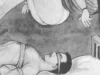
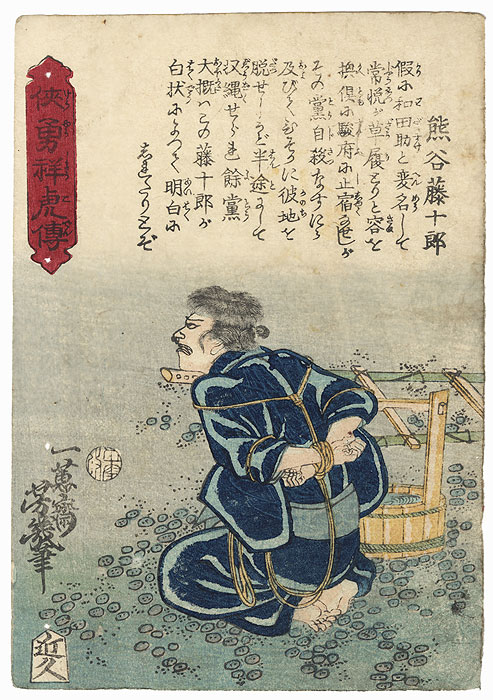
The print depicts Kumagaya Tōjūrō kneeling on stony ground beside a wooden well or water structure. His wrists are tied behind his back, a rope encircles his torso, and a long coil falls across his lap and down toward his feet. He turns his head sharply upward with his mouth open, conveying alarm, pain, protest, or exhausted resistance. The accompanying prose identifies him and recounts the criminal or violent circumstances that led to his capture. Rather than showing the moment of a killing, this sheet concentrates on arrest, immobilization, exposure, and the psychological drama of a prisoner awaiting an uncertain fate.
Visual Description
A single male figure occupies the lower half of the vertical sheet. He wears a dark blue, boldly striped or paneled garment over lighter underclothes. His bare feet are tucked beneath him in an unstable kneeling position. Several turns of tan rope cross his chest and upper arms, while his wrists are closely bound behind his back. A separate or continuing length of rope hangs in a loose loop between his arms, waist, and knees. The restraint forces his shoulders backward while his torso leans forward, producing a posture of constrained tension. His hair is disordered, his brows are sharply drawn, and his open mouth intensifies the impression of distress. To the right stands a wooden well frame or bucket structure. Pebbles and irregular stones cover the foreground, while the background is rendered in pale gray-blue with minimal spatial detail. A large prose inscription fills the upper field. The red cartouche at upper left gives the series title. The artist signature and seal appear at lower left, and a small publisher or production mark appears near the lower edge.
History and Context
Historical Context
The supplied print identifies its subject as Kumagaya Tōjūrō, but a secure independent biographical record for him has not yet been located. The prose appears to present him as a criminal or violent offender who used an assumed identity, fled or concealed himself, and was subsequently captured. Until the inscription is fully transcribed and compared with contemporary crime literature, the exact historical basis of the story should remain provisional.
Print History
Eimei nijūhasshūku was a collaborative late-Edo series by Ochiai Yoshiiku and Tsukioka Yoshitoshi. Each artist designed fourteen sheets. The series is usually discussed as a major example of chimidoro-e or muzan-e, sensational prints concerned with murder, cruelty, crime, and bodily violence. Some sheets display explicit bloodshed, while others, including this image, build tension through captivity, anticipation, or the aftermath of criminal violence. The designs combine large-format figure imagery with extensive prose, creating an intersection between illustrated crime narrative, popular literature, theatrical presentation, and commercial print culture.
Cultural Context
The series appeared during the politically unsettled final years of the Tokugawa shogunate, when publishers and artists cultivated audiences for dramatic accounts of vendettas, notorious criminals, executions, kabuki plots, and violent historical episodes. The use of famous or semi-famous names did not necessarily mean that every scene was documentary. Historical events, oral accounts, fiction, theatre, and sensational embellishment could be woven together. The print therefore belongs to a culture of popular crime representation rather than to a neutral record of penal procedure.
Series Context
The title Eimei nijūhasshūku plays on the presentation of notable people and memorable verses while focusing on notorious killings and violent lives. Yoshiiku and Yoshitoshi, both pupils of Utagawa Kuniyoshi, produced complementary groups of designs. The series became one of the best-known bodies of late-Edo violent imagery and an important precursor to Yoshiiku's later work in illustrated news prints.
Known Variants
Other impressions may differ in color saturation, paper tone, trimming, registration, and the preservation of margins. No distinct alternate compositional state has been confirmed from the supplied image.
Collection History
From the collection of Zetsu Nawa.
Relevance to Kinbaku
The print is directly relevant to the visual history of Japanese rope restraint because binding is not incidental background detail but the central mechanism through which the subject's capture, vulnerability, and loss of agency are communicated. It predates modern erotic kinbaku and should not be described as a modern bondage image, yet it preserves a powerful nineteenth-century vocabulary of the bound body.
Historical Connections
The image demonstrates that highly legible rope restraint was already an established component of commercial crime and punishment imagery before the emergence of twentieth-century erotic kinbaku publishing. Rope signifies successful capture, state or communal authority, and the prisoner's transition from dangerous actor to controlled body. Such prints contributed to a broader visual archive that later illustrators, theatre artists, storytellers, and SM publishers could encounter, even though no direct chain of technical transmission has been demonstrated.
Iconographic Connections
Several features later common in kinbaku imagery are visible: wrists bound behind the back, rope crossing the upper torso and arms, multiple visible wraps, a long trailing coil, a forced kneeling posture, backward shoulder tension, disordered clothing and hair, and a facial expression that makes physical and psychological distress visible. The body is arranged for the viewer's inspection, with the ropes functioning as both narrative evidence and strong graphic lines across the clothing.
Interpretive Cautions
The print should not be used as a technical manual or as proof that the depicted configuration accurately records a standardized Edo-period arrest method. The rope arrangement is simplified for visual clarity, and the image may derive from fiction, kabuki, oral storytelling, or a sensationalized crime account. There is no explicit erotic activity or nudity. Any erotic response belongs to later reception and interpretation rather than to a securely documented original purpose. The relationship to modern kinbaku is therefore visual, narrative, and genealogical, not evidence of an uninterrupted formal practice.
Research Value
For kinbaku research, the sheet is valuable because it shows how restraint could organize an entire narrative image without explicit torture or blood. The prisoner's posture, ropes, expression, and surrounding text work together to produce suspense. It offers evidence that the bound body already carried layered meanings of danger, humiliation, moral judgment, helplessness, spectacle, and anticipated violence in late-Edo popular print culture.
Themes
Subjects and Keywords
Sources
- Ota Memorial Museum of Art: Ochiai Yoshiiku — Artist biography and identification of Twenty-Eight Famous Murders with Verse as a collaborative series by Yoshiiku and Yoshitoshi.
- Niigata Prefectural Museum of Modern Art: Yoshitoshi: A Genius Ukiyo-e Artist Who Lived Through a Turbulent Age, exhibition checklist — Series chronology, vertical ōban format, division of designs between Yoshitoshi and Yoshiiku, and publication by Sanoya Tomigorō.
- Art Institute of Chicago: Utagawa Yoshiiku — Artist identity, dates, and alternate artist names including Ikkeisai Yoshiiku and Ochiai Yoshiiku.
- Ota Memorial Museum of Art: Ochiai Yoshiiku retrospective materials — Yoshiiku's importance to the history of violent prints and illustrated newspaper imagery.