Kabuki Villain with a Bound Woman
Summary
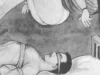
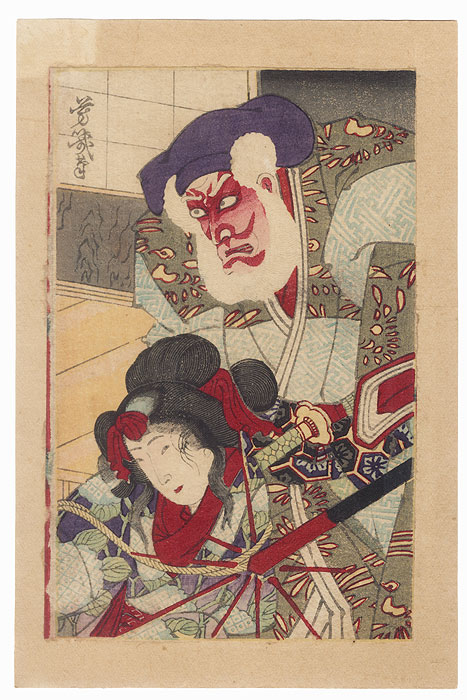
A large male character with vivid red kabuki makeup looms behind a young woman whose torso and arms are crossed by rope. He wears an elaborately patterned robe and grips a weapon or sword near his waist. A dark blade or scabbard cuts diagonally across the lower foreground. The woman's head is lowered, her eyes are closed, and her disordered hair and compressed posture suggest distress, exhaustion, or unconsciousness. The close framing turns the scene into an intense image of captivity and threatened violence.
Visual Description
The composition is tightly cropped around two figures in an interior. The male figure occupies the upper and right portions of the image. His face is broad and heavily modeled with red kumadori-like lines around the eyes, nose, cheeks, and mouth. White hair or a white cloth frames the sides of his head beneath a large dark-purple cap or headdress. He wears a pale blue robe densely patterned with red, white, and dark geometric and leaf-like forms. A sword hilt or weapon grip appears at his waist, partly concealed by the woman and the crowded costume. The woman occupies the lower-left foreground. She wears a pale patterned robe with red and purple collars. Her black hair is arranged in a partially loosened coiffure with red ornaments. Her eyes are closed and her head inclines downward. A pale rope passes horizontally and diagonally across her chest and upper arms, apparently holding her arms close to or behind her body. Several rope strands converge near the center of the composition. A long black-and-red sword, scabbard, pole, or theatrical weapon crosses diagonally from lower right toward the woman's torso. Behind the figures are pale sliding panels and a small framed landscape or decorative panel. A vertical signature appears near the upper-left interior wall, but the small reproduction does not permit a complete independent reading.
History and Context
Historical Context
The characters and narrative have not been identified. The woman's restraint and the man's theatrical makeup suggest a scene from kabuki, illustrated fiction, kōdan storytelling, or another popular narrative involving capture, punishment, abduction, interrogation, or threatened assault.
Print History
Yoshiiku worked across actor portraiture, illustrated books, sensational crime prints, warrior imagery, newspaper illustrations, beauty prints, and scenes of theatrical violence. His career crossed the late Edo and Meiji periods, and he frequently adapted dramatic subjects into compact, emotionally concentrated compositions. The supplied work may be a detached page from a book or album rather than a conventional full ōban actor print.
Cultural Context
Late nineteenth-century Japanese popular imagery circulated scenes of captivity, coercion, murder, rescue, revenge, and supernatural danger through kabuki prints, illustrated fiction, newspaper prints, and inexpensive books. Rope made a character's loss of freedom immediately visible, while distinctive makeup, costume, and weapons allowed viewers to recognize dramatic types even when explanatory text was minimal.
Series Context
No series or publication has been identified. The unusually narrow proportions, absence of large actor cartouches, and close framing may indicate a book illustration, album leaf, kuchi-e-like frontispiece, or later excerpt from a larger printed object.
Known Variants
No matching impression or alternate state has been located. Other examples may preserve wider margins, text, page numbers, publisher information, or a companion image that would clarify the narrative.
Collection History
From the collection of Zetsu Nawa.
Relevance to Kinbaku
The print is directly relevant to the visual history of Japanese rope restraint because the woman is visibly bound across the chest and upper arms while an armed male figure dominates the scene. It belongs to a theatrical or narrative vocabulary of coercive captivity rather than modern consensual kinbaku.
Historical Connections
The image shows that rope remained a readily legible sign of captivity in Meiji popular print culture. Rather than presenting a complete arrest or punishment procedure, the composition isolates the emotional relationship between a restrained woman and a physically dominant armed man. Such concentrated scenes formed part of the broader visual archive later available to seme and kinbaku illustrators.
Iconographic Connections
The woman's lowered head, closed eyes, loose hair, patterned clothing, compressed shoulders, and prominent chest rope create an image of controlled vulnerability. The male figure's looming scale, fierce makeup, weapon, and position behind her establish a sharp hierarchy of power. The diagonal blade or scabbard intersects the rope lines, visually joining restraint and threatened violence.
Interpretive Cautions
The original narrative is unknown, and the figures may be actors portraying fictional characters rather than historical individuals. The male figure should not be described confidently as elderly, despite the dealer title, because the pale areas beside his face may be costume, wig, hair, or theatrical makeup. The exact rope route is partly hidden, and the arrangement may have been designed for pictorial clarity. The scene appears coercive and should not be described as consensual kinbaku. No claim should be made that it documents an actual tying technique.
Research Value
The print is valuable as a compact close-up of restraint in which rope, facial expression, costume, and weaponry carry nearly all the narrative information. Identifying the source play or book could clarify whether the scene represents abduction, interrogation, punishment, heroic rescue, supernatural danger, or criminal violence. It is also useful for comparing late-Edo actor prints with Meiji illustrated fiction and later seme imagery.
Themes
Subjects and Keywords
Sources
- Fuji Arts: Utagawa Yoshiiku, Elderly Man and Bound Beauty, inventory 925762 — Provides the supplied comparison image, modern English dealer title, attribution to Yoshiiku, and classification within Meiji-era Japanese prints.
- Ota Memorial Museum of Art: Ochiai Yoshiiku exhibition and artist overview — Confirms Yoshiiku's dates, training under Kuniyoshi, and work in actor prints, warrior imagery, beauty prints, humorous designs, newspaper illustrations, and bloody or violent subjects.
- University of Oregon, Jordan Schnitzer Museum of Art research pages: Utagawa Yoshiiku, 1833–1904 — Provides biographical and signature information for Yoshiiku and documents his work in yakusha-e, bijin-ga, musha-e, chimidoro-e, muzan-e, and Meiji newspaper illustration.
- The Metropolitan Museum of Art: Utagawa Yoshiiku, English Woman with Black Man, object 2007.49.232 — Provides an institutional comparison for Yoshiiku's figure drawing, color woodblock technique, signatures, and production around the transition from the Edo to Meiji period.
- Art Institute of Chicago: Utagawa Yoshiiku artist record — Confirms Yoshiiku as a color woodblock-print designer and provides institutional examples of his actor and commemorative print production.