Kabuki Actors in a Snow Scene: A Bound Woman and Her Companion
Summary
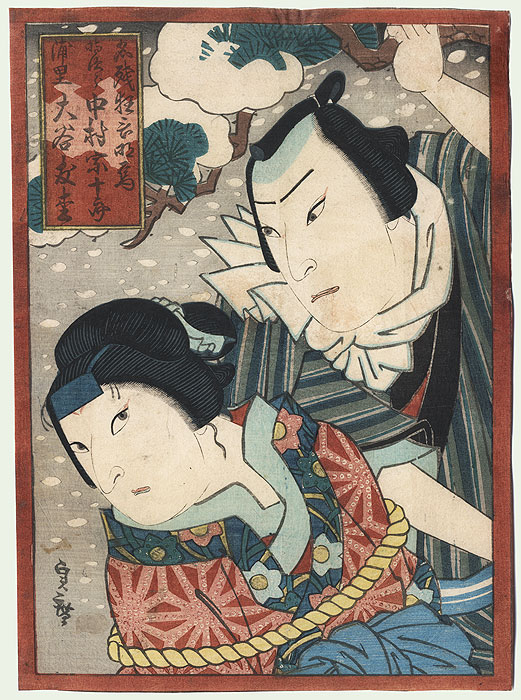
Two kabuki actors are shown in close-up against a snowy setting. The foreground figure, an onnagata portraying a woman, bends forward with a thick yellow rope wrapped horizontally around the upper torso and arms. A male character stands immediately behind her, leaning over her shoulder and apparently controlling or escorting her. The image concentrates on the emotional and physical relationship between the figures rather than on a fully described stage setting.
Visual Description
The composition is tightly cropped within a dark red border. A gray field filled with irregular white snowflakes forms the background, interrupted at the top by dark pine branches and snow-covered foliage. The foreground figure wears a richly patterned red, blue, and green kimono. A thick yellow rope passes across the upper arms and chest, pinning the arms close to the body. The figure's head tilts forward and slightly left, with narrowed eyes and a subdued, worried, or resigned expression. The elaborate black coiffure and costume indicate a female kabuki role performed by an onnagata. Behind her, a male actor in a blue-gray striped robe leans forward, his face close to hers. His right arm extends behind or around the bound figure, though the precise position of his hand is obscured by the crop. His expression is stern and intent. The upper-left red cartouche contains several vertical lines of role and actor information. The signature appears vertically at lower left.
History and Context
Historical Context
The specific characters and performers have not been identified securely. The image is clearly connected to kabuki performance, and the foreground figure is an onnagata representing a female role. A reliable biography of the depicted characters cannot be supplied until the upper-left cartouche is fully transcribed and matched with a theatrical record.
Print History
Utagawa Toyokuni I was one of the most influential designers of kabuki actor prints in the late eighteenth and early nineteenth centuries. His actor portraits emphasized recognizable facial types, expressive gestures, fashionable costumes, and clearly staged relationships between performers. This sheet belongs to that commercial theater-print tradition, in which audiences could purchase images of popular actors and memorable dramatic scenes.
Cultural Context
Kabuki prints transformed performance into collectible images. Rather than reproducing an entire stage, designers frequently isolated two or three performers at a moment of emotional concentration. Costumes, actor crests, role names, gestures, and facial expressions allowed contemporary viewers to recognize the play and performers. Scenes involving capture, pursuit, punishment, disguise, loyalty, or threatened violence were common sources of dramatic tension.
Series Context
No series title has been securely identified. The red cartouche functions primarily as a label for roles and performers. The print may have been issued independently or as part of a group associated with a particular production.
Known Variants
Other impressions may differ in color strength, trimming, registration, paper tone, and preservation. The supplied image appears to preserve the main border and cartouche, though the exact original sheet dimensions are unknown.
Collection History
From the collection of Zetsu Nawa.
Relevance to Kinbaku
The print is directly relevant to the visual history of rope restraint because a thick rope clearly binds the foreground figure's torso and upper arms. The image predates modern erotic kinbaku and presents restraint within kabuki narrative, but it demonstrates how a bound body could operate as an instantly legible symbol of capture, danger, helplessness, and dramatic vulnerability.
Historical Connections
The sheet shows rope restraint circulating in popular theatrical imagery during the Edo period. The rope communicates that the female character has been captured, controlled, transported, threatened, or otherwise deprived of freedom. This contributes to the broader historical archive from which later Japanese visual cultures of restraint developed, although the print alone cannot establish a direct technical or institutional lineage to twentieth-century kinbaku.
Iconographic Connections
The central visual elements have strong relevance to later bondage imagery: a thick rope passing across the torso, the arms pinned against the body, a forward-bending posture, the controlling presence of a man immediately behind the bound figure, elaborate clothing compressed by rope, and an expression of subdued distress. The close crop heightens the viewer's attention to the rope and bodily relationship.
Interpretive Cautions
The print depicts a kabuki role, not necessarily a historical arrest or a technically accurate restraint method. The rope may simplify or exaggerate stage action for visual clarity. Because the play and characters have not been identified, the narrative meaning of the scene remains uncertain. The print should not be classified automatically as erotic. The bound figure's beauty, costume, and vulnerability may carry an erotic charge for modern viewers, but the original commercial function was theatrical actor portraiture.
Research Value
The image is valuable for comparing theatrical restraint with later kinbaku illustration. It demonstrates how rope could function graphically across patterned clothing and how restraint could be made emotionally legible through posture, facial expression, and proximity between captor and captive. Further identification of the actors and play could reveal whether the scene concerns arrest, abduction, rescue, punishment, or a loyalty narrative.
Themes
Subjects and Keywords
Sources
- The Metropolitan Museum of Art: Kabuki Actors: Bandō Mitsugorō and Iwai Hanshirō, by Utagawa Toyokuni I — Provides an institutional comparison for Toyokuni I's paired kabuki actor compositions and confirms his use of closely grouped performers in actor portraiture.
- The Metropolitan Museum of Art: Kabuki Actor Segawa Kikunojō III in a Mad Female Role, by Utagawa Toyokuni I — Provides an institutional comparison for Toyokuni I's depiction of onnagata performers and female-role characterization.
- The British Museum: Utagawa Toyokuni I, artist biography and collection records — Confirms Toyokuni I's identity, dates, importance in actor portraiture, and characteristic lively treatment of kabuki performers.
- Ukiyo-e.org: Kabuki Actor and Onnagata, attributed to Utagawa Toyokuni I — Provides a comparative catalog record for a two-actor kabuki composition by Toyokuni I featuring a male actor and an onnagata.