Inada Kyūzō Shinsuke Murders a Kitchen Maid Suspended from a Rope
Summary
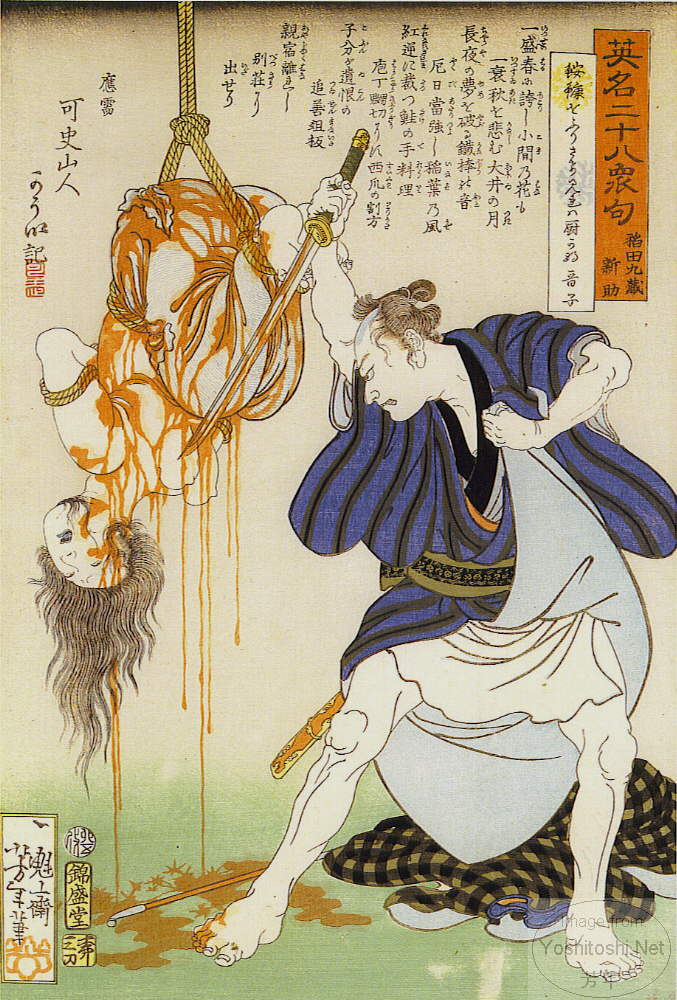
A woman identified in modern catalogs as a kitchen maid hangs upside down from a ceiling rope while Inada Kyūzō Shinsuke cuts or stabs her with a sword. Her ankles are tied together above her, her hands are bound behind her back, and an additional rope encircles her waist. Her orange robe has fallen downward under gravity, exposing much of her inverted torso. Blood streams from her clothing, hair, and wounds onto the floor. Shinsuke crouches beside her in a blue-and-black striped robe, gripping a blade with both hands and concentrating on the suspended victim. The scene is accompanied by a prose account and verse, while the restrained body and descending blood dominate the composition.
Visual Description
The print is organized around a severe diagonal and vertical structure. A thick suspension rope descends from the upper edge and branches into a compact knot around the captive's ankles. Her feet point upward while her head and long loose hair hang near the lower-left quadrant. Her wrists are tied behind her back, and rope passes around her waist and over the fallen folds of her garment. The orange robe bunches around her hips and upper torso, leaving her abdomen, breasts, shoulders, and much of her legs exposed. Orange-red blood runs in long lines down the fabric, limbs, and hair before pooling on the pale green floor. At right, Shinsuke crouches in a wide, grounded posture. He wears a dark indigo robe with broad black stripes, a patterned sash, and light undergarments. His hair is disordered, his brow lowered, and his gaze fixed upon the victim. He holds a long blade diagonally across the composition, its point directed toward or into the woman's suspended body. A second sword or scabbard lies near his feet. Dense prose occupies the upper center, with the orange series-and-subject cartouche at upper right. A separate vertical verse inscription appears at left. The artist signature, publisher mark, and seals cluster at the lower-left corner.
History and Context
Historical Context
Inada Kyūzō Shinsuke is presented as the perpetrator in a sensational murder narrative, but a securely documented independent biography has not been established from the sources consulted. The design is generally cataloged as showing him murdering a kitchen maid. The subject may derive from kabuki, kōdan storytelling, crime literature, or a dramatized historical incident, as was common throughout the series.
Print History
Twenty-Eight Famous Murders with Verse was created collaboratively by Yoshitoshi and his fellow Kuniyoshi pupil Ochiai Yoshiiku in 1866 and 1867. Each artist designed fourteen sheets. The series became a defining example of muzan-e, commonly translated as cruel pictures or bloody pictures. Yoshitoshi's Inada Kyūzō Shinsuke is among its best-known designs because of the extreme inversion, exposure, and downward streams of blood. Some impressions of the series used pigment mixed or overprinted with animal glue to give blood a thickened, glossy surface.
Cultural Context
Violent scenes from kabuki, oral storytelling, vendetta literature, crime tales, and historical legend were popular in the final years of the Tokugawa shogunate. Such images combined moral judgment, theatrical spectacle, technical virtuosity, curiosity about notorious violence, and the pleasurable shock of fictional horror. Although often discussed through modern categories such as gore or splatter, the prints also depended upon established theatrical poses, poetic framing, famous actors or characters, and literary commentary.
Series Context
The series title is a verbal play on the Twenty-Eight Lunar Mansions and on collective suffering. Its uniform design places the series and subject title in an orange-red cartouche, narrative text across the upper field, and a verse or literary contribution nearby. Yoshitoshi and Yoshiiku competed through unusually forceful compositions, expressive anatomy, and elaborate printed effects.
Known Variants
Surviving impressions vary substantially in the intensity and gloss of the blood pigment, color saturation, trimming, paper tone, and preservation. Some examples retain darker, more viscous blood effects. The supplied reproduction appears relatively bright and may represent a later impression, digitally altered reproduction, or an impression whose blood pigment has shifted in color. No alternate compositional state has been confirmed.
Collection History
An impression is held by the Fine Arts Museums of San Francisco. Nagoya City Museum has exhibited an impression from the Ozaki Hisaya Collection, and the design has appeared in exhibitions at the Ota Memorial Museum of Art.
Relevance to Kinbaku
The print is highly significant to the visual history of Japanese rope restraint because the victim is subjected to a coordinated system of ankle suspension, wrist binding, waist restraint, inversion, exposure, and knife violence. It predates modern erotic kinbaku and depicts sadistic murder rather than consensual practice, yet it is one of the clearest nineteenth-century commercial images connecting rope, bodily display, gravity, pain, and spectacle.
Historical Connections
The design confirms that complex inverted restraint was visually intelligible in commercial print culture by 1867. Rope is not an incidental prop: it creates the conditions for the attack, controls every major axis of the victim's body, exposes her through gravity, and converts the murder into a sustained tableau. Such imagery formed part of the larger theatrical and visual archive later available to illustrators and writers concerned with seme and kinbaku. This connection is historical and iconographic, not proof of a continuous technical practice.
Iconographic Connections
The image contains many elements later prominent in kinbaku and SM illustration: ankles lashed together at a high point, arms tied behind the back, a separate waist rope, complete inversion, long hair hanging downward, garments falling away from the body, exposed breasts and abdomen, a blade used in close proximity to the restrained body, and a composed aggressor positioned beside a helpless suspended victim. The blood lines reinforce the vertical pull of gravity and visually extend the suspension rope toward the floor.
Interpretive Cautions
The depicted act is torture and murder, not consensual bondage. The victim's nudity and bodily display may produce an erotic charge for some viewers, but the original image belongs primarily to sensational crime and theatrical horror. The rope arrangement should not be treated as a safe or practical suspension method. The body, knots, and force relationships were designed for graphic impact, and the precise narrative source remains incompletely identified.
Research Value
The print is exceptionally useful for studying how inversion, rope, clothing, hair, blood, and edged weapons were combined in late-Edo visual culture. It permits comparison with Yoshitoshi's later Lonely House on Adachi Moor, kabuki semeba prints, execution imagery, and twentieth-century kinbaku illustration. Its reception history may help trace how a non-erotic murder scene became part of the modern visual imagination surrounding rope torture.
Themes
Subjects and Keywords
Sources
- Fine Arts Museums of San Francisco: Inada Kyûzô Shinsuke murders the kitchenmaid suspended from a rope — Confirms the artist, English descriptive title, victim as a kitchen maid, suspended-rope subject, and 1867 date.
- Ota Memorial Museum of Art: Tsukioka Yoshitoshi: Blood and the Bewitching exhibition — Confirms the design as Yoshitoshi's Inada Kyūzō Shinsuke from Twenty-Eight Famous Murders with Verse and contextualizes the series as representative bloody or cruel imagery.
- Hara Shobo: Inada Kyuzo Shinsuke, from Eimei nijuhasshuku, catalog ID 29993 — Confirms the artist, subject title, series, 1867 date, vertical ōban dimensions of 36 by 24.6 centimeters, and print format.
- Nagoya City Museum: Inada Kyūzō Shinsuke from Twenty-Eight Famous Murders with Verse, Ozaki Hisaya Collection — Documents a museum-held impression, the 1867 date, Yoshitoshi's participation in the collaborative series, and the use of glossy glue-enhanced pigment for blood effects.
- Japanese Woodblock Print Search: Inada Kyūzō Shinsuke: woman suspended from rope — Catalogs the work as number 12 in the series, identifies the subject as a woman suspended from rope, and gives a publication date of May 1867.
- Yamada Shoten: Twenty-Eight Famous Murders with Verse: Inada Kyuzo Shinsuke, item 66274 — Confirms the artist, Japanese series and subject titles, 1867 date, woodblock technique, and classification as muzan-e.