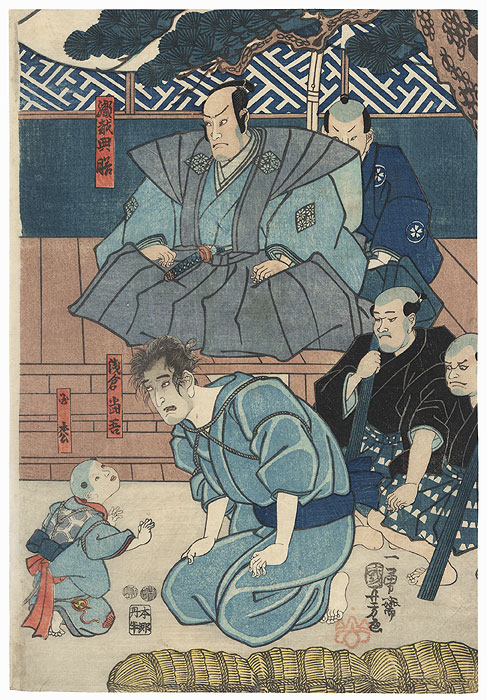
Ichikawa Kodanji IV as Asakura Tōgo before the Lord Orikoshi
Summary
The kabuki actor Ichikawa Kodanji IV appears as Asakura Tōgo, kneeling under guard before a seated feudal authority. Tōgo wears a pale blue robe, his hair is disordered, and a rope passes around his upper torso and arms. Two retainers kneel behind him, one appearing to hold or control the restraint. A small child approaches the prisoner from the left with hands raised, introducing a poignant family element into the formal scene of custody and judgment. Above them, the lord sits rigidly on a raised platform with attendants behind him.
Visual Description
The composition is divided vertically between authority above and captivity below. A stern lord occupies the upper center on a raised wooden dais. He wears a broad gray ceremonial kamishimo decorated with small crests, sits with fists planted near his knees, and carries a sword at his waist. A blue-robed attendant stands behind him. The dark blue wall, pine branches, and geometric architectural pattern create a formal mansion or tribunal setting. In the lower half, Asakura Tōgo kneels facing slightly left. His pale blue striped robe is gathered around his folded legs, while his loose hair, strained expression, and hunched shoulders signal hardship and confinement. A rope runs around his upper torso and appears to secure his arms close to or behind his body. Two guards kneel behind him, one in black and patterned trousers holding a long staff or sword and another partly cropped at the right edge. At lower left, a small child in a patterned robe and red sash approaches Tōgo with both hands raised. A row of tightly bound straw or rice bundles spans the foreground, echoing the rope around the prisoner and reinforcing the material vocabulary of binding. Red role cartouches identify the dramatic figures. Kuniyoshi's signature, publisher mark, and censor seals appear near the lower-right and lower-center margins.
History and Context
Historical Context
Asakura Tōgo is the theatricalized counterpart of Sakura Sōgorō, a legendary seventeenth-century village headman remembered for appealing directly to the shogun against excessive taxation imposed on peasants in the Sakura domain. According to popular accounts, he knowingly violated legal procedure to deliver the petition and was executed, together with members of his family. His story became a major example of the righteous peasant martyr who sacrifices himself for communal justice. Because direct treatment of recent rulers and political grievances could attract censorship, kabuki adaptations altered names and locations.
Print History
Kuniyoshi produced several designs connected with Higashiyama Sakura Zōshi in 1851, including scenes of Tōgo as a living prisoner and as a vengeful ghost. The production was staged at the Nakamura-za with Ichikawa Kodanji IV in the central role. Kodanji's performance helped establish the play and the character as important examples of mid-nineteenth-century socially charged kabuki.
Cultural Context
The Sakura Sōgorō legend joined agrarian protest, benevolent self-sacrifice, family tragedy, unjust authority, execution, and supernatural revenge. The story became popular through kabuki, kōdan storytelling, illustrated books, prints, and pilgrimage culture. The bound petitioner before a lord visualizes the unequal legal relationship between peasant subjects and feudal power.
Series Context
The print is not known to belong to a numbered series. It was likely issued as a theatrical souvenir or publicity image for the 1851 Nakamura-za staging of Higashiyama Sakura Zōshi.
Known Variants
Other Kuniyoshi sheets from the same production show Asakura Tōgo as a ghost confronting Orikoshi Dairyo Masatomo. Surviving impressions of the present design may vary in trimming, color saturation, registration, paper tone, and preservation of the background blues.
Collection History
Related 1851 Kuniyoshi prints of Ichikawa Kodanji IV as Asakura Tōgo are held by the British Museum, Museum of Fine Arts Boston, Waseda University Theatre Museum, Chazen Museum of Art, and other collections. From the collection of Zetsu Nawa.
Relevance to Kinbaku
The print is directly relevant to the history of rope restraint because Asakura Tōgo is visibly held under guard with rope around his upper torso and arms. The image places restraint within formal state authority, agrarian protest, family vulnerability, and public judgment rather than erotic or theatrical torture.
Historical Connections
The image demonstrates how rope binding signified lawful or quasi-lawful custody in popular theatrical imagery. Tōgo's restrained body marks the point where petition becomes criminalized resistance. His confinement before the seated lord turns rope into a visible expression of the state's power to immobilize, judge, and punish a politically troublesome subject.
Iconographic Connections
The rope crosses the prisoner's pale robe and visually compresses his torso. His disordered hair, kneeling posture, lowered social position, guards behind him, child before him, and elevated lord produce a sharp hierarchy between freedom and confinement. The row of tied straw bundles in the foreground provides a secondary visual rhyme with the restrained body.
Interpretive Cautions
The image is a kabuki actor print, not documentary evidence of an actual seventeenth-century hearing or arrest. The binding may reflect stage convention and visual shorthand rather than a technically precise police restraint. The exact rope route behind Tōgo is concealed. The scene contains no erotic content and should not be described as consensual kinbaku.
Research Value
The print is valuable for expanding a kinbaku-related archive beyond female torment and suspension. It provides a strong example of male political restraint, peasant martyrdom, family spectatorship, and the visual language of custody. It can be compared with execution prints, bound warriors, courtroom scenes, and later images of state prisoners.
Themes
Subjects and Keywords
Sources
- Fuji Arts: Utagawa Kuniyoshi, Ichikawa Kodanji IV as Asakura Togo, 1851, inventory 806020 — Provides the supplied comparison image and confirms the artist, actor, role, and 1851 date.
- British Museum: Utagawa Kuniyoshi, Asakura Togo borei, museum number 2008,3037.21325 — Confirms Kuniyoshi, Ichikawa Kodanji IV as Asakura Tōgo, the play Higashiyama Sakura Zōshi, Nakamura-za performance context, vertical ōban format, and 1851 date.
- Museum of Fine Arts Boston: Actor Ichikawa Kodanji IV as the Ghost of Asakura Tōgo, object 226246 — Confirms Kuniyoshi's authorship, Ichikawa Kodanji IV's role as Asakura Tōgo, and the 1851 performance and publication context.
- Waseda University Theatre Museum: Asakura Tōgo borei, Ichikawa Kodanji, record 401-0019 — Provides an institutional comparison for Kuniyoshi's 1851 actor prints of Ichikawa Kodanji IV as Asakura Tōgo.
- Ukiyo-e.org, aggregating the British Museum: Asakura Togo borei — Summarizes the British Museum record, including artist, title, play, actor, format, theater, and 1851 date.
- The Art of Japan via Ukiyo-e.org: Scene from Higashiyama Sakura Zōshi — Identifies Ichikawa Kodanji IV as Asakura Tōgo and Bandō Hikosaburō IV as Orikoshi Dairyo Masatomo in the 1851 play context.