Four Kabuki Scenes
Summary
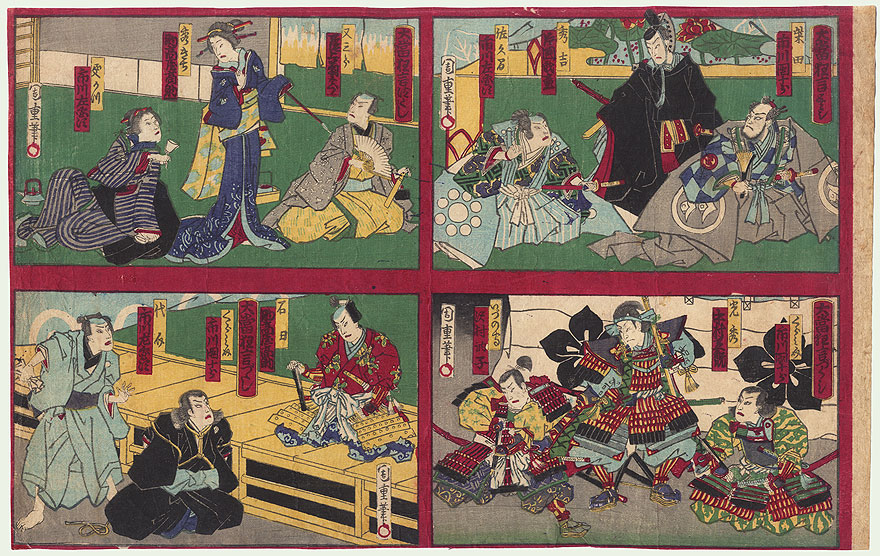
The composition gathers four kabuki scenes into a grid framed by broad crimson borders. The upper-left scene presents a seated or fallen striped-robed figure confronted by a standing woman and a kneeling man. The upper-right scene shows several armed male characters in a formal confrontation, with one black-robed figure standing above the others. The lower-left scene centers on a kneeling black-robed man before a raised platform while two armed figures stand nearby; a loose cord or rope lies on the floor. The lower-right scene depicts three armored warriors in an intense exchange. Role-and-actor cartouches identify the performers throughout, but the plays and characters have not been fully transcribed.
Visual Description
The print is arranged as four rectangular stage pictures, two above and two below, separated by thick red framing. Gold-cloud patterns and green floors unify the upper scenes, while the lower scenes use pale architectural and heraldic backgrounds. In the upper-left panel, a figure in a dark blue striped robe reclines or kneels at the far left, raising one hand toward a standing woman in a long dark-blue kimono. A man in yellow trousers kneels at right with a folding fan and sword. The upper-right scene contains four male characters in elaborate robes. A black-clad figure stands centrally with a sword while crouching or seated warriors face him from either side. In the lower-left panel, a pale-blue-robed man stands at far left, and a black-robed man kneels before a wooden platform occupied by an armed figure in a bright red floral garment and armor elements. A looped cord lies near the standing man's feet. The lower-right scene shows three warriors in brightly colored armor. The central figure stands with one hand extended toward a kneeling warrior, while a third armored man watches from the right. Numerous red and pale actor-role cartouches fill the upper edges of all four panels. Chikashige signatures and red seals appear within or beside the individual scenes.
History and Context
Historical Context
The actors and dramatic characters have not been securely identified. The cartouches appear to provide a substantial cast list, but a reliable account of the figures requires a full transcription and comparison with contemporary kabuki programs or theater records.
Print History
Morikawa Chikashige was a pupil of Toyohara Kunichika and specialized in actor portraits and multi-figure kabuki compositions during the early Meiji period. His designs continued the Utagawa-school tradition of commercial theater prints while using bright imported pigments and densely populated layouts. Multi-scene formats allowed publishers to advertise several climactic moments, casts, or performances on one object.
Cultural Context
Kabuki prints served as souvenirs, cast records, publicity images, and collectible representations of celebrated actors. Role labels and individualized faces allowed contemporary audiences to recognize performers and recall specific stage moments. A composite design such as this could compress several narratives into a single visual field, producing something close to a printed theatrical program.
Series Context
No formal series title has been identified. The four-panel structure may commemorate several plays appearing within one theater program, several scenes from a long production, or a selection of popular roles. The modern title Four Kabuki Scenes is descriptive rather than a securely transcribed original title.
Known Variants
The three constituent sheets may survive separately or in different arrangements. Surviving impressions may vary in red and green color saturation, aniline-pigment bleeding, registration, trimming, and alignment at the sheet joins. No alternate compositional state has been established.
Collection History
From the collection of Zetsu Nawa. From the collection of Zetsu Nawa.
Relevance to Kinbaku
The print has contextual rather than direct relevance to the history of kinbaku. It documents a theatrical world in which capture, submission, armed authority, threatened punishment, and changes in bodily status were communicated through posture, costume, weapons, and stage arrangement. No figure is unambiguously shown tied with rope in the supplied image.
Historical Connections
Kabuki provided an important cultural reservoir for later Japanese images of restraint and torment. Prints like this preserve conventions for representing prisoners, defeated warriors, vulnerable petitioners, armed captors, and formal scenes of judgment. The object therefore helps reconstruct the surrounding theatrical vocabulary in which explicit rope-restraint scenes were understood.
Iconographic Connections
Several panels contrast kneeling or fallen figures with armed standing authorities. The lower-left scene includes a loose cord or rope-like object on the floor, but it is not visibly attached to the kneeling man. The grid format also demonstrates how bodily control and threatened violence could be presented as one episode among a larger repertory of dramatic actions.
Interpretive Cautions
The print should not be cataloged as a definite bondage image. No secure rope binding is visible, and the looped object in the lower-left scene may be a cord, prop, weapon attachment, or discarded restraint. The dramatic narratives remain unidentified, so claims about imprisonment, torture, or punishment must remain provisional. Its usefulness for kinbaku research lies chiefly in kabuki context and visual conventions rather than in technical evidence of tying.
Research Value
The work provides a valuable control example for distinguishing explicit rope restraint from broader theatrical signs of submission and coercion. It can be compared with prints showing Okiku, Urazato, Asakura Tōgo, or other visibly bound characters to determine what visual information makes captivity legible with and without rope.
Themes
Subjects and Keywords
Sources
- Fuji Arts: Morikawa Chikashige, Four Kabuki Scenes, inventory 480648 — Provides the supplied comparison image, modern English title, artist attribution, and identification of the object as a nineteenth-century Japanese actor print.
- Ukiyo-e.org, aggregating Artelino: Morikawa Chikashige, Kabuki Play — Provides a dated comparison for Chikashige's multi-figure kabuki compositions and identifies a related actor triptych as a kabuki performance from 1880.
- Ukiyo-e.org, aggregating Artelino: Morikawa Chikashige, Kabuki Scene — Provides a second comparison for Chikashige's actor-print production and supports an approximate 1880 date for similar theatrical work.
- Tokyo Gakugei University Open Educational Contents Archive: Kabuki Atari Sugoroku, illustrated by Morikawa Chikashige — Confirms Chikashige's production of composite kabuki imagery and his association with printed actor and theatrical repertory material.
- Artelino: Morikawa Chikashige: Meiji Woodblock Printmaker of Kabuki Scenes — Provides biographical context, identifies Chikashige as a pupil of Toyohara Kunichika, dates his activity chiefly to circa 1869–1882, and documents his specialization in kabuki actor prints and multi-panel compositions.