Chūnagon Asatada: Urazato
Summary
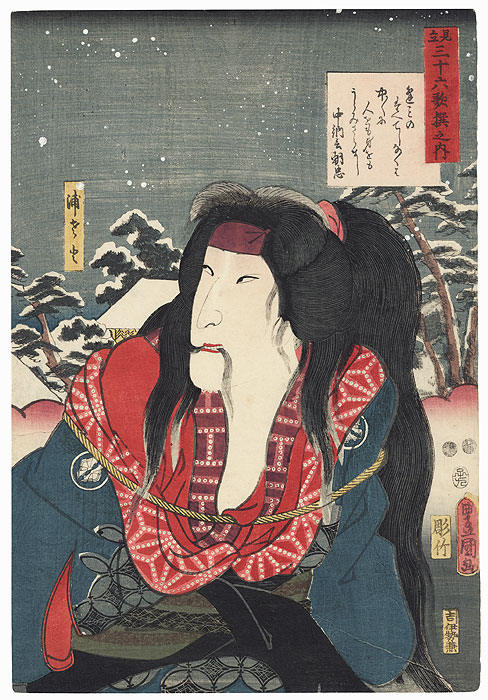
The kabuki actor Bandō Shūka I appears as the courtesan Urazato during the snow-torment episode from the Urazato and Tokijirō narrative. She sits in a snowy landscape with a thick rope passing around her upper arms and torso, pinning her arms behind her body. Her layered garments have opened at the chest, her long black hair hangs loose, and blood marks her lower lip. The portrait combines the physical evidence of punishment with a restrained facial expression of endurance, sorrow, and exhaustion.
Visual Description
Urazato fills nearly the entire vertical sheet in a closely cropped half-length portrait. She wears a dark blue outer robe decorated with circular crests over a brilliant red inner garment patterned with white geometric motifs. The clothing opens deeply at the chest, exposing the upper breast and collarbone. A tan rope crosses horizontally over the red garment and passes around both upper arms, visibly forcing the shoulders backward and holding the arms behind the torso. Her very long black hair falls over both shoulders and continues beyond the lower edge. A dark red band encircles her forehead. Her pale face turns toward the left, with narrowed eyes, slightly parted lips, and a thin line of red at the mouth. Behind her, snow falls against a dark gray sky and rests heavily on pine branches. The bleak landscape reinforces the cold and isolation of the punishment. A red cartouche at upper right contains the series title, a white panel carries Asatada's poem, and a yellow role cartouche at left reads Urazato. The Toyokuni signature, carver's mark, seals, and publisher mark appear along the lower-right margin.
History and Context
Historical Context
Urazato is a courtesan of the Yamanaya house in the theatrical and narrative cycle commonly associated with Akegarasu yume no awayuki. She falls in love with the young merchant Tokijirō. When their relationship violates the restrictions imposed upon her, she is punished by being bound and exposed in the snow. Versions of the story vary across shinnai narrative, kabuki, jōruri, and later adaptations, but the lovers' separation, Urazato's suffering, and the emotional intensity of the snow scene remain central.
Print History
Kunisada designed the Thirty-Six Poets comparison series in 1852. Each sheet combines a classical waka poem with a kabuki role whose circumstances echo the poem's emotional or verbal imagery. Here Chūnagon Asatada's lament that an unhappy meeting has produced resentment is paired with Urazato, whose love for Tokijirō leads to separation and punishment. The work is therefore both an actor portrait and a literary comparison requiring familiarity with classical poetry and contemporary theater.
Cultural Context
Kabuki audiences recognized actors through individualized facial types, role cartouches, costumes, crests, and famous scenes. The snow-torment episode offered a particularly powerful image of unjust suffering: a courtesan punished under the authority of a licensed pleasure establishment for pursuing a forbidden emotional attachment. The scene combines romantic tragedy, institutional control, physical exposure, and the endurance of a woman whose body has become the site of punishment.
Series Context
The series matches thirty-six kabuki roles with poems by the Thirty-Six Immortal Poets. Urazato corresponds to Chūnagon Asatada, while her lover Tokijirō appears on a related sheet paired with Sanjōin no Nyōkurōdo Sakon. Read together, the paired designs connect the classical language of love and separation with the theatrical narrative of the two lovers.
Known Variants
Institutional impressions differ in saturation of the dark sky, brightness of the red garments, registration, trimming, paper tone, and preservation of the snow effects. No distinct alternate compositional state has been confirmed.
Collection History
Cataloged impressions are held by the Hokkaido Hakodate Museum of Art, Waseda University Theatre Museum, Tokyo Metropolitan Library, Ishikawa Prefectural Museum of Art, and other collections. From the collection of Zetsu Nawa.
Relevance to Kinbaku
The print is directly relevant to the history of Japanese rope imagery because restraint is central to Urazato's identity, bodily posture, and punishment. The rope pins her arms behind her and compresses her upper body while she remains displayed in the snow. The work predates modern erotic kinbaku and belongs to kabuki tragedy, but it presents a highly influential combination of beauty, restraint, suffering, exposure, and emotional endurance.
Historical Connections
The design demonstrates that the bound female body was a legible and emotionally charged subject in mainstream commercial theater prints by the mid-nineteenth century. Rope communicates punishment and loss of agency, while the snowy setting extends the ordeal beyond simple immobilization into prolonged exposure. Such theatrical images formed part of the cultural archive later available to illustrators and writers interested in seme and kinbaku, although the print does not establish an uninterrupted technical tradition.
Iconographic Connections
The rope crosses the chest and upper arms, apparently securing the wrists or arms behind the body. The backward shoulder position, opened clothing, visible chest, loosened hair, blood at the mouth, cold landscape, and emotionally restrained expression create a visual language later familiar in Japanese bondage illustration. Unlike scenes dominated by an attacker, this portrait isolates the captive and invites sustained attention to her condition and internal response.
Interpretive Cautions
The scene depicts punitive, non-consensual restraint within a kabuki narrative. It should not be described as a safe tying method or as evidence of consensual erotic practice. The exact rope path behind the figure is hidden, and the arrangement was designed for pictorial and theatrical clarity. Modern erotic responses should be distinguished from the print's original functions as actor portraiture, literary comparison, and romantic tragedy.
Research Value
The sheet is especially important for studying the transition from narrative restraint scenes to iconic single-figure portraits of bound women. Because the aggressors are absent, rope, clothing, facial expression, and landscape carry the entire emotional narrative. Comparison with other Urazato prints, performances of the snow-torment scene, and twentieth-century kinbaku illustration may clarify the long reception of the beautiful suffering heroine.
Themes
Subjects and Keywords
Sources
- Tokyo Metropolitan Library Digital Archive: Mitate sanjūrokkasen no uchi: Urazato, collection code 4300661944 — Confirms the title, artist, publisher Iseya Kanekichi, September 1852 publication date, censor and date seals, vertical ōban format, kabuki classification, Urazato role, and Bandō Shūka I as the performer.
- Hokkaido Hakodate Museum of Art: The Comparison of the 36 Poets: Chūnagon Asatada [Urazato] — Confirms Kunisada as artist, the series and subject title, 1852 date, woodblock technique, and museum collection record.
- Waseda University Theatre Museum via Ukiyo-e.org: Mitate sanjūrokkasen no uchi: Urazato, record 401-0149 — Confirms the artist, title, 1852 date, and complete poem by Chūnagon Asatada printed above the portrait.
- Ishikawa Prefectural Museum of Art: Mitate sanjūrokkasen no uchi: Chūnagon Asatada, Urazato, collection number 104004710 — Confirms the artist, series, poet, role, and inclusion of the design in the museum's collected Thirty-Six Poets album.
- Machida City Museum of Graphic Arts: Prologue: Toyokuni I and Kunisada exhibition catalog — Explains that the series compares classical poems with appropriate kabuki roles and identifies Urazato as a courtesan punished by exposure to snow because of her love for Tokijirō.
- British Museum: Mitate sanjūrokkasen no uchi series record — Provides institutional context for the series as kabuki roles viewed through the Thirty-Six Poets and documents the series' combination of actor portraits, poems, signatures, publisher marks, and carver marks.