Bound Prisoner Surrounded by Officials
Summary
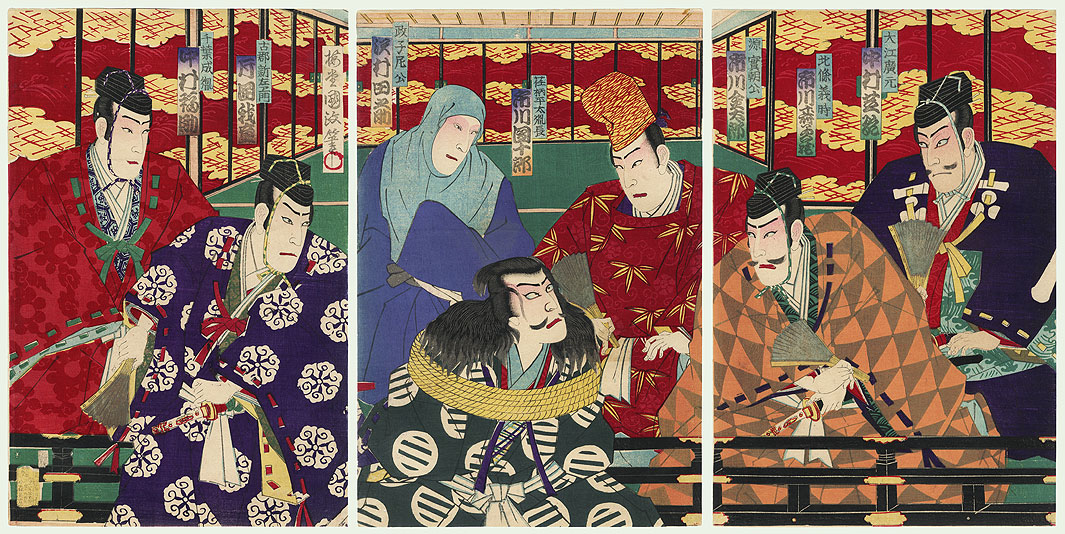
A male prisoner sits or kneels at the center of a formal interior, restrained by numerous turns of thick yellow rope around his chest, upper arms, and back. His disordered hair, striped garments, tense upward gaze, and compressed posture distinguish him from the elaborately dressed officials and retainers surrounding him. Seven other theatrical figures occupy the three sheets, some holding folding fans or swords and others leaning toward the captive as though questioning, judging, guarding, or confronting him.
Visual Description
The triptych creates a continuous architectural interior defined by black railings, green flooring, and red screens patterned with gold clouds. The prisoner occupies the lower center and functions as the visual hinge joining the three sheets. He wears a dark robe decorated with large pale circular emblems over striped undergarments. A broad mass of yellow rope circles his upper torso repeatedly, pinning his arms against or behind his body. His long, disordered hair spreads over his shoulders, and his painted kabuki face turns upward with a defiant, suspicious, or alarmed expression. Behind him, a figure in a muted blue hooded garment watches closely. To the prisoner's right, a man in a red robe patterned with bamboo leaves bends toward him and extends one hand. Two additional men on the right sheet wear orange geometric and dark blue formal robes, carry swords, and hold folding fans while observing the proceedings. On the left sheet, two richly dressed men in red and purple stand near another low railing, one gripping a sword and fan. Vertical actor-role cartouches hang above each figure. The arrangement suggests a judicial, political, or ceremonial confrontation rather than an outdoor arrest.
History and Context
Historical Context
The dramatic characters have not yet been identified. The central figure is clearly represented as a prisoner, accused person, captured warrior, outlaw, or political opponent appearing before several officials. A reliable biography or narrative summary requires transcription of the actor-role cartouches and identification of the kabuki production.
Print History
Kunisada III was a late representative of the Utagawa school and produced actor prints, theatrical triptychs, illustrated books, and historical designs during the Meiji period. His works continued the established yakusha-e format while adopting brilliant modern pigments and the increasingly crowded ensemble compositions favored by late nineteenth-century publishers and theater audiences.
Cultural Context
Kabuki actor prints allowed viewers to recognize current performers, roles, costumes, and climactic scenes. Captured warriors, exposed conspirators, criminals, loyal retainers, and political opponents frequently appeared before courts or groups of adversaries. Rope immediately marked a character's altered social position, transforming an active male hero or villain into a controlled and publicly scrutinized body.
Series Context
No series title has been identified. The work appears to be an independent triptych commemorating a specific production or revival. The large ensemble and individual role cartouches indicate that the cast was an important selling point.
Known Variants
Individual sheets may survive separately, and complete triptychs may vary in color strength, alignment, trimming, registration, and preservation. The supplied image appears to reproduce a complete triptych, although the sheet joins are visible.
Collection History
No institutional collection record or earlier provenance has yet been located. From the collection of Zetsu Nawa.
Relevance to Kinbaku
The print is directly useful for studying the representation of male restraint in late nineteenth-century kabuki imagery. The captive's torso is encircled by numerous visually prominent rope turns, converting him into the physical and emotional center of a crowded political or judicial scene.
Historical Connections
The triptych demonstrates that thick, highly visible rope binding remained an established sign of captivity in Meiji theatrical imagery. The rope distinguishes the prisoner from armed and socially elevated figures around him and communicates control without requiring an active beating or execution. It contributes to the broader visual archive from which later representations of kinbaku and seme could draw, but it does not establish direct technical transmission.
Iconographic Connections
Multiple horizontal rope bands compress the captive's upper torso and fix the arms behind or against the body. His loose hair, lowered position, upward gaze, and isolation amid elaborately costumed authorities intensify his vulnerability. The contrast between the prisoner's restricted body and the surrounding men's swords, fans, upright postures, and freedom of movement creates a strong visual hierarchy.
Interpretive Cautions
The scene is a kabuki performance rather than documentary evidence of an actual Meiji interrogation. The rope pattern may be exaggerated, simplified, or arranged for stage and pictorial visibility. The prisoner's identity, alleged offense, and ultimate fate remain unknown. The work is not explicitly erotic, and its relevance to kinbaku lies in theatrical iconography, bodily control, and the history of rope representation rather than in consensual bondage.
Research Value
The print expands the archive beyond restrained women and graphic torture by presenting an adult male captive within an ensemble scene of authority. It is useful for comparing gendered representations of helplessness, the public display of prisoners, and the function of rope in kabuki narrative. Identification of the play and actors could reveal whether the binding signifies criminality, political resistance, heroic sacrifice, disguise exposed, or temporary capture.
Themes
Subjects and Keywords
Sources
- Fuji Arts: Utagawa Kunisada III, Bound Prisoner, inventory 436750 — Provides the supplied comparison image, modern English catalog title, artist attribution to Kunisada III, and identification of the work as a nineteenth-century Japanese print.
- Ukiyo-e.org: Utagawa Kunisada III artist index — Provides comparative records for Kunisada III's actor prints, triptychs, signatures, and Meiji-period production.
- Philadelphia Museum of Art: Utagawa Kunisada III, Picture Book of the Deeds of Minamoto Yoshitsune — Confirms Kunisada III's identity, dates of 1848–1920, and activity as a Japanese woodblock-print artist during the Meiji period.
- Waseda University Theatre Museum via Wikimedia Commons: Kabuki scene by Kunisada III, Waseda inventory number 100-1866 — Provides an institutional comparison for Kunisada III's kabuki triptychs and documents his use of the signature Ōju Kōchōrō hitsu.