Beauty in Distress
Summary
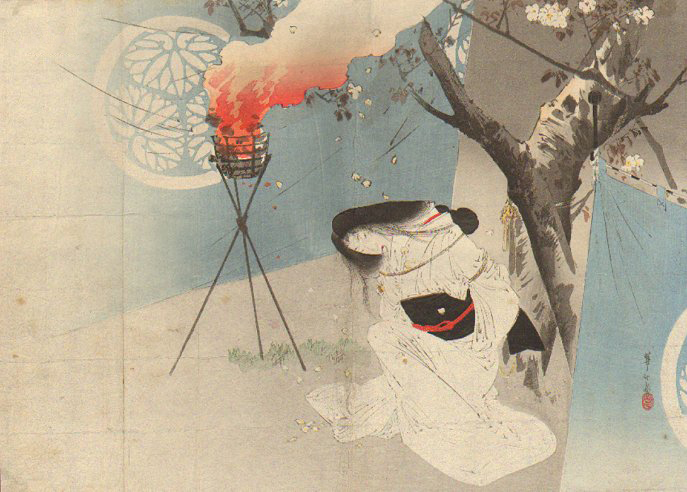
A woman in a pale kimono is bound to the trunk of a flowering cherry tree at night. Her arms appear secured behind the tree, while rope crosses her upper torso and neck or shoulder area. A brazier or torch burns on a tall tripod nearby, casting orange light and smoke against a cool blue-gray background. The woman bends forward with her head lowered, creating a quiet image of captivity, exhaustion, and imminent danger rather than an active struggle.
Visual Description
The horizontal composition is divided between the burning torch at left and the bound woman at right. A flowering cherry tree rises behind the captive, its dark trunk and branches spreading across the upper field. White blossoms punctuate the subdued blue-gray background. The woman wears a nearly white robe patterned with faint linear designs and a dark obi marked by a narrow red accent. Her body leans toward the tree, with the head lowered and partly concealed by her sleeve or shoulder. A rope line passes diagonally across the upper back and neck or shoulder region, while another restraint appears to draw her arms behind the trunk. Her posture suggests fatigue, grief, pain, or resignation. At left, a metal basket or brazier mounted on three slender supports contains a vivid orange-red flame. Smoke drifts upward and toward the tree. Large pale circular crests or decorative motifs appear faintly in the background, and a small Kason signature and red seal are visible near the lower-right edge.
History and Context
Historical Context
The woman and the literary episode represented have not been identified. The image likely illustrates a scene from a novel or serialized story in which a woman is captured, punished, threatened, or awaiting rescue.
Print History
Suzuki Kason was a Japanese-style painter and print designer active during the Meiji and early Taishō periods. His woodblock work is especially associated with kuchi-e, illustrated frontispieces inserted into popular novels and literary magazines. These prints translated emotionally charged moments from fiction into refined color images and often emphasized women, costume, seasonal settings, romance, danger, and psychological suspense.
Cultural Context
Kuchi-e occupied a transitional zone between ukiyo-e publishing and modern literary illustration. They were mass-produced through sophisticated woodblock techniques but served modern fiction, magazine readership, and new forms of commercial publishing. Images of women in danger, romantic suffering, supernatural situations, or threatened violence provided readers with an evocative entrance into the story.
Series Context
No series has been identified. The work was probably issued as the frontispiece to a specific literary publication rather than as an independent numbered print series.
Known Variants
The image may survive with fold lines or binding traces reflecting its original insertion into a book or magazine. Variations may occur in color saturation, trimming, paper tone, and preservation. No alternate compositional state has been confirmed.
Collection History
The matching online record derives from an Artelino auction listing aggregated by Ukiyo-e.org. A second aggregated record titles a similar or matching design Bound Woman. No institutional collection or original publication record has yet been located. From the collection of Zetsu Nawa.
Relevance to Kinbaku
The print is useful for studying the transition from nineteenth-century theatrical and punitive restraint imagery into modern literary illustration. The bound woman is presented as an isolated emotional subject rather than as one figure within a crowded torture scene, creating a visual structure closer to later seme and kinbaku illustration.
Historical Connections
The image demonstrates that rope-bound female figures continued to circulate in Japanese commercial woodblock publishing around the turn of the twentieth century. Its kuchi-e format places it close to the literary and magazine culture from which later erotic-grotesque, seme, and kinbaku illustration developed. This makes it an important chronological bridge, although the original story and its reception remain unidentified.
Iconographic Connections
The woman is isolated against a sparse background, bound to a vertical support, bent forward, and visually framed by rope, flowering branches, darkness, and fire. Her pale clothing contrasts with the dark tree, while the lowered face invites attention to internal suffering rather than overt action. Similar devices later became common in illustrations centered on the beautiful captive.
Interpretive Cautions
The original literary context is unknown, so the reason for the restraint, identities of the participants, and degree of threatened violence cannot be stated. The image may represent punishment, abduction, imprisonment, supernatural peril, or a rescue narrative. It should not be described as consensual kinbaku or as evidence of an actual restraint method. The rope arrangement is partly obscured and may have been designed primarily for pictorial clarity.
Research Value
The work is especially valuable as a bridge between ukiyo-e-derived woodblock production and twentieth-century literary imagery. It shifts the focus from graphic physical torment to atmosphere, emotional vulnerability, and an isolated bound female figure. Identifying the original publication could reveal the narrative function of restraint and clarify connections between kuchi-e, popular fiction, and later seme illustration.
Themes
Subjects and Keywords
Sources
- Ukiyo-e.org, aggregating Artelino: Suzuki Kason, Beauty in Distress — Provides a matching catalog image, confirms Suzuki Kason as artist, gives the title Beauty in Distress, dates the work broadly to circa 1900–1910s, and describes the woman as tied to a flowering cherry tree beside a burning torch.
- Ukiyo-e.org, aggregating Asian Collection Internet Auction: Suzuki Kason, Bound Woman — Confirms the artist, the alternate title Bound Woman, an approximate date of 1900, and classification as a kuchi-e book frontispiece.
- Artelino: Suzuki Kason: Japanese Woodblock Prints and Kuchi-e — Provides biographical context for Suzuki Kason, including his dates of 1860–1919 and his association with relatively rare kuchi-e literary illustrations.
- Scholten Japanese Art: Suzuki Kason, Looking for Cherry Blossoms — Provides a documented comparison for Kason's kuchi-e production, including literary-magazine publication, signature, seal, dimensions, and folded frontispiece format.