Beating a Courtesan with a Cherry Branch
Summary
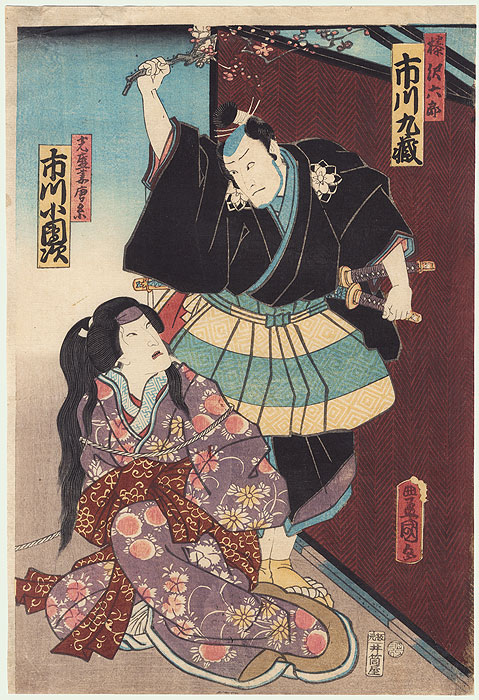
A male kabuki character played by Ichikawa Kuzō stands over a seated female-role character played by Ichikawa Kodanji. The woman is tightly restrained across the chest and upper arms with rope, which appears to continue behind her body and toward the left edge. The man raises a flowering cherry branch as an improvised striking implement while gripping the hilts of two swords at his waist. The image freezes the action immediately before a blow, combining bodily restraint, threatened violence, rich costume, and theatrical facial expression.
Visual Description
The composition is dominated by two closely overlapping figures before a red-and-black patterned sliding screen. The standing man wears a black outer robe marked with a pale floral crest over blue, green, cream, and yellow geometric garments. His feet are planted beside the seated woman, and two swords project from his left hip. His right arm is raised high, gripping a slender branch bearing small pink or white cherry blossoms. His face is angled downward with a stern, concentrated expression. The woman sits on the floor with her legs folded and body leaning backward. She wears an elaborate purple kimono patterned with chrysanthemums, cherry-like blossoms, and other flowers over red-brown textiles filled with gold scrollwork. Thick rope passes horizontally and diagonally across her chest and upper arms, restricting her arms against or behind her body. A rope end continues along the floor toward the left margin. Her long black hair hangs loose, and she looks upward with parted lips and an expression of fear, appeal, or pain. Yellow actor-name cartouches and narrow red role labels identify the performers. Kunisada's Toyokuni signature appears in a red cartouche at lower right, with the publisher mark near the bottom margin.
History and Context
Historical Context
The identities of the dramatic characters remain uncertain because the narrow role cartouches have not been securely transcribed. The actors are identifiable as Ichikawa Kuzō and Ichikawa Kodanji, two prominent performers active in late-Edo kabuki. The scene probably belongs to a play involving a courtesan, wife, attendant, or other female character subjected to coercive punishment by a samurai or household authority figure.
Print History
Kunisada was the leading designer of kabuki actor prints in nineteenth-century Edo. By 1861 he was signing his works as Toyokuni and producing portraits closely tied to current theatrical performances. These prints allowed audiences to collect recognizable actors in dramatic poses, costumes, and climactic scenes. The present design isolates a moment of threatened punishment, using the flowering branch, rope, and actors' gazes to make the narrative immediately legible.
Cultural Context
Kabuki semeba and punishment scenes often combined cruelty with elaborate costume, heightened gesture, and emotional display. A flexible branch could operate as an improvised whip or beating implement, while rope signaled that the victim had lost freedom of movement. The cherry blossoms create a deliberate contrast between seasonal beauty and threatened violence.
Series Context
No series title has been identified. The print appears to have been issued independently in connection with a specific performance. The paired actor and role cartouches follow standard yakusha-e conventions.
Known Variants
Other impressions may differ in color saturation, registration, trimming, paper tone, preservation of the blossoms, and legibility of the seals. No alternate compositional state has been confirmed.
Collection History
The illustrated impression is Earlier provenance and institutional collection history have not been established. From the collection of Zetsu Nawa.
Relevance to Kinbaku
The print is directly relevant to the visual history of Japanese rope restraint because the seated woman's upper body is visibly immobilized by thick rope while an armed man prepares to strike her. It presents rope as part of a theatrical system of coercion, punishment, bodily display, and anticipated pain rather than as modern consensual kinbaku.
Historical Connections
The work documents rope restraint as a recognizable component of mainstream kabuki imagery in 1861. The ropes establish the captive's helplessness before the raised branch makes the threatened punishment explicit. Such actor prints contributed to the cultural repertoire of bound and suffering bodies available to later seme and kinbaku artists, although the print does not prove a continuous technical lineage.
Iconographic Connections
The rope crosses the woman's patterned clothing in conspicuous bands, holds the arms behind or close to the body, and draws the shoulders backward. Her loose hair, upward gaze, folded posture, rich costume, and isolation beneath the aggressor create a visual formula later encountered in Japanese bondage illustration. The flowering branch adds a striking contrast between delicacy and violence.
Interpretive Cautions
The scene represents coercive theatrical violence and should not be described as consensual bondage. The female figure is a male kabuki actor performing a woman's role. The exact rope configuration behind the body is concealed, and the tying may reflect stage convention or pictorial clarity rather than a practical restraint method. The modern Fuji Arts title identifies the figure as a courtesan, but that role description remains provisional until the cartouche or play is verified.
Research Value
The print is particularly valuable for examining the intersection of restraint and beating imagery. Unlike suspension or execution scenes, it presents a seated captive at intimate range from the aggressor. It can be compared with Urazato snow-torment prints, Okiku well scenes, courtesan-rescue triptychs, and later kinbaku images that juxtapose beautiful clothing, rope, and implements of pain.
Themes
Subjects and Keywords
Sources
- Fuji Arts: Utagawa Kunisada, Beating a Courtesan with a Cherry Branch, 1861, inventory 516926 — Provides the matching comparison image, modern English catalog title, attribution to Utagawa Kunisada or Toyokuni III, and 1861 date.
- Kunisada Project: Utagawa Kunisada series and signature documentation for 1860–1865 — Provides comparative documentation for Kunisada's late works, signatures, publishers, actor prints, and production chronology.
- Kabuki on the Web: Ichikawa Kuzō actor-name lineage — Documents the inherited Ichikawa Kuzō stage name and the actor lineage necessary for distinguishing performer generations.
- The Metropolitan Museum of Art: Utagawa Kunisada, Japanese color woodblock print, object JP1092.38 — Provides authoritative comparison for Kunisada's Edo-period color woodblock technique, artist identity, ōban-scale dimensions, and actor-print production.