Bandō Shūka I as Yamanaya Urasato, with the Child Chidori
Summary
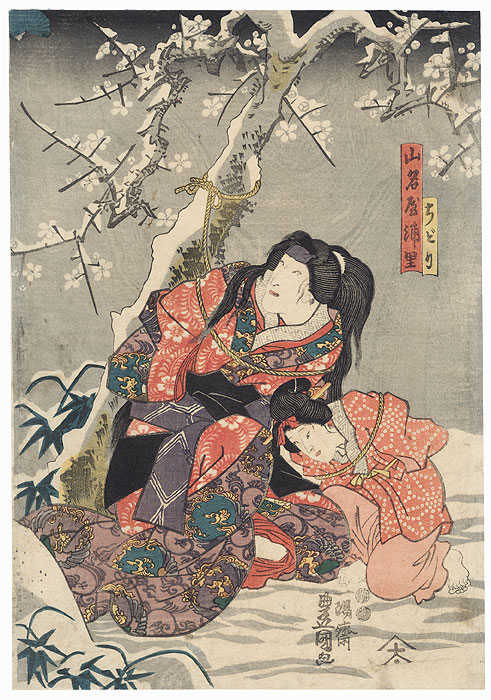
The kabuki actor Bandō Shūka I appears as the courtesan Yamanaya Urasato, bound with rope to the trunk of a flowering plum tree in a snowy garden. A child identified as Chidori kneels close against her body, seeking protection or comfort. The print represents the famous snow-torment episode from the tragic story of Urasato and her lover Tokijirō, in which Urasato is punished for attempting to meet him. The supplied sheet is one half of a diptych whose missing companion panel depicts Tokijirō coming to their rescue.
Visual Description
A large flowering plum tree rises diagonally through the composition, its dark, angular trunk and white blossoms forming the structural center of the image. Yamanaya Urasato sits or kneels in the snow with her back pressed against the trunk. A yellow-brown rope encircles both the tree and her upper body, holding her firmly in place. Her arms appear drawn behind her or compressed between her body and the tree, although the exact position of her wrists is concealed by her layered clothing and the trunk. Her head tilts slightly to the right, and her expression is subdued, weary, and composed rather than dramatically contorted. She wears an elaborately patterned outer robe combining red-orange floral passages, dark blue-green panels, gold-colored motifs, and a richly patterned lower garment in brown, purple, and blue. The robe has slipped from one shoulder, exposing the pale upper chest and neck in a manner consistent with theatrical scenes of suffering and disarray. The child Chidori kneels at lower right in a red-orange robe patterned with small white motifs and a pale pink lower garment. The child leans into Urasato's lap or side, with head lowered and one hand touching or gathering her clothing. Snow covers the ground and clings to the plum trunk and branches. Dark bamboo leaves enter from the left and lower-left margins. A narrow red character cartouche at upper right identifies Yamanaya Urasato, with smaller phonetic characters beside the name. Kunisada's signature and seals appear near the lower edge. The right and upper margins appear closely trimmed but retain the principal cartouche and composition.
History and Context
Historical Context
Yamanaya Urasato is the courtesan heroine of a popular theatrical tragedy centered on her love for Kasugaya Tokijirō. Their relationship is opposed by the brothel establishment, and Urasato is punished after attempting to meet him. In the celebrated snow scene, she is tied to a tree in the rear garden while their child remains beside her. Tokijirō arrives and attempts to rescue them, but the lovers ultimately find no viable escape and the story culminates in a double suicide. The narrative circulated through kabuki and dance-drama forms under titles including Akegarasu Yuki no Urasato, Akegarasu Hana no Nureginu, and later variants of Akegarasu Yume no Awayuki.
Print History
The sheet was produced in connection with an 1851 performance at the Ichimura Theater. It originally belonged to a diptych. This panel shows Urasato tied to the plum tree with the child Chidori, while the companion panel shows Ichikawa Danjūrō VIII as Kasugaya Tokijirō approaching or climbing into the garden to rescue them. The Waseda University Theatre Museum preserves or documents an impression cataloged as Yamanaya Urasato and Chidori. Detached sheets circulate separately, which can obscure the rescue action and the broader theatrical composition.
Cultural Context
Kabuki actor prints were closely tied to contemporary performances, celebrity culture, and the commercial theater districts of Edo. Kunisada specialized in representing recognizable actors in current roles, using costume, makeup, pose, and character cartouches to connect printed images with the stage. The Urasato snow scene combines several popular theatrical motifs: the suffering courtesan, forbidden love, punishment by a brothel household, a loyal lover's attempted rescue, a vulnerable child, seasonal snow, and an ultimately tragic conclusion. The flowering plum tree heightens the emotional contrast between beauty, endurance, exposure, and suffering.
Series Context
The design is not securely identified as part of a named serial publication. It is best treated as a theatrical diptych issued for a particular 1851 performance. A larger performance-related print records the play within a Kaei-era production context involving the Urasato and Tokijirō narrative, but that separate multi-figure design should not be confused with this intimate snow-garden diptych.
Known Variants
Surviving impressions may circulate as an individual sheet or reunited with the companion Tokijirō panel. Variations are likely to include trimming, fading, discoloration of the gray sky and snow, loss of metallic or fugitive pigments, and differences in the preservation of the publisher and censor marks. No distinct recut edition has been established in the records reviewed.
Collection History
From the collection of Zetsu Nawa.
Relevance to Kinbaku
The print is directly relevant to the visual history of restraint because Urasato is visibly tied to a tree as punishment. The binding is theatrical, coercive, and narrative rather than consensual or explicitly erotic, and it should not be treated as technical documentation of modern kinbaku.
Historical Connections
The image demonstrates how rope restraint functioned within nineteenth-century kabuki as an instantly legible sign of punishment, confinement, cruelty, and threatened separation. Urasato's binding prevents escape and dramatizes the power of the brothel household over her body and relationships. The scene belongs to a wider theatrical vocabulary of captured women, tied prisoners, rescue attempts, snow torment, and tragic lovers. This provides historical evidence for the cultural visibility of rope restraint, but not for a continuous technical lineage leading directly to modern erotic kinbaku.
Iconographic Connections
The rope is prominently visible around both the tree and Urasato's upper torso, turning the plum trunk into a fixed anchoring point. Her restrained posture, slipped robe, exposed shoulder, tilted head, richly patterned clothing, and the child's physical closeness create an emotionally charged image of immobilization and vulnerability. The contrast between rigid tree, encircling rope, soft textiles, snow, blossoms, and the child's curved body produces a visual structure that later viewers may find resonant with bondage imagery. The companion panel's rescue action is essential to the original meaning of the restraint.
Interpretive Cautions
The scene is a kabuki performance represented through an actor print, not an eyewitness record of an actual punishment. The visible rope may simplify or stylize stage properties and does not provide enough detail to reconstruct a secure tying method. Although Urasato's exposed shoulder and elaborate costume contribute to theatrical beauty, the print is not shunga and contains no explicit sexual activity. Her restraint is involuntary and punitive. Resemblance to later kinbaku poses should be described as iconographic comparison rather than proof of direct transmission.
Research Value
The print is especially valuable because it connects fixed-point restraint with a well-documented theatrical narrative, named roles, identifiable actors, seasonal staging, and a companion rescue panel. It supports research into how kabuki transformed rope into an emotional and compositional device; how female suffering was made visually beautiful without becoming explicit erotica; and how detached sheets can alter interpretation by removing the rescuer from view. Comparison with stage scripts, production records, later actor prints, and other versions of the Urasato snow scene could clarify changes in binding, costume, actor gesture, and narrative emphasis.
Themes
Subjects and Keywords
Sources
- Waseda University Tsubouchi Memorial Theatre Museum via Ukiyo-e.org: 「山名屋浦里」「ちどり」 by Utagawa Kunisada, dated 1851 — Confirms the artist, Japanese character identifications Yamanaya Urasato and Chidori, and the year 1851.
- Waseda University Tsubouchi Memorial Theatre Museum via Japanese Ukiyo-e.org: 歌川国貞「山名屋浦里」「ちどり」 — Provides the Japanese-language institutional catalog record and comparison image for the exact composition.
- Fuji Arts: Bandō Shūka I as Yamanaya Urasato and Ichimura Uzaemon XIII as Chidori, 1851 — Supports the actor identifications, character roles, Kunisada attribution, 1851 date, and correspondence of the supplied image with a cataloged impression.
- Matt Brown Fine Art: The Story of Tokijiro and Urazato, from the kabuki play Akegarasu Yuki Urasato — Documents the diptych context, identifies Bandō Shūka I as Yamanaya Urasato, Ichimura Uzaemon XIII as the child, and Ichikawa Danjūrō VIII as Kasugaya Tokijirō, and connects the design with an 1851 Ichimura Theater performance and the rescue narrative.
- National Theatre of Japan, Cultural Digital Library: Performance records for Akegarasu Yume no Awayuki and the Yamanaya Urasato room and garden scenes — Documents the continuing kabuki performance tradition of the Urasato and Tokijirō story and its recognized scene structure.