Actors in the Torture Scene from Banshū Sarayashiki
Summary
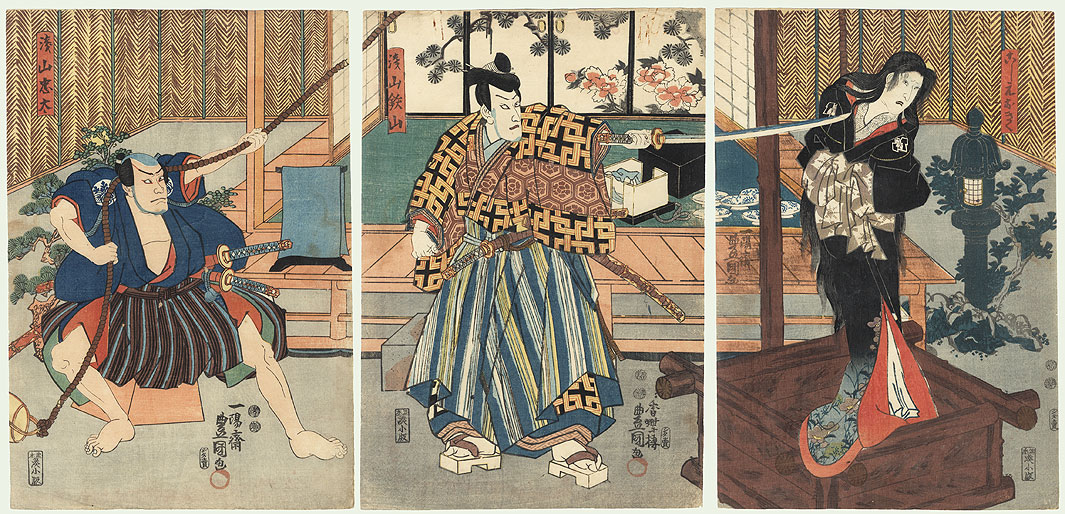
The triptych represents the notorious torture scene from the kabuki adaptation of the Okiku well legend. Okiku is suspended by ropes across the mouth of a well at the right while Asayama Tetsuzan, holding a drawn sword, supervises the punishment from the center. Asayama Chūta stands at the left gripping the hauling rope. The three sheets create a continuous stage-like interior in which the rope runs diagonally from the attendant, across the composition, to the bound woman. The image concentrates on coercion, threatened violence, bodily suspension, and the theatrical spectacle of the semeba, or torment scene.
Visual Description
The left sheet shows Asayama Chūta in a wide, braced stance. He wears a dark blue garment and striped hakama and grips a thick brown rope with both hands. The rope passes over or around his shoulder and rises diagonally toward a wooden support before continuing across the triptych. Two swords are tucked at his waist. His expression is severe and physically engaged, emphasizing the force required to control the suspended victim. The center sheet shows Asayama Tetsuzan in an elaborately patterned brown-and-black upper robe and blue-striped hakama. He holds a drawn sword horizontally in his right hand, directing its point toward Okiku. His second sword remains at his waist. He stands calmly at the center of the action, visually identified as the commanding aggressor. The right sheet depicts Okiku suspended above or immediately beside a well. Her torso is bent forward, her arms appear drawn behind or close to her body, and rope passes around her upper body and toward the suspension line. Her black outer robe opens to reveal pale and red underlayers, while one long patterned hem trails across the wooden well platform. Her face is turned outward with an expression of exhaustion, pain, or apprehension. A garden lantern, flowering plants, sliding screens, painted pine and peony panels, wooden railings, and the well structure establish an elite residence or mansion courtyard. The actors' names and roles appear in red cartouches near each figure. Toyokuni signatures and red seals appear at the lower portions of the sheets.
History and Context
Historical Context
Okiku is the victim at the center of the Sarayashiki, or Dish Mansion, legend. In its many regional, literary, puppet-theater, and kabuki versions, she is a maidservant accused of losing or breaking one of a set of valuable household plates. She is interrogated, tortured, killed, and cast into a well, after which her ghost returns and repeatedly counts the plates. The identities, motives, and precise sequence of events vary considerably among versions. In the Banshū tradition, Asayama Tetsuzan is the villainous household authority responsible for her persecution, while Chūta serves as his accomplice or subordinate.
Print History
The triptych was produced as a commercial actor print for the September 1850 Nakamura-za production. Kunisada, who had adopted the prestigious name Toyokuni, was the dominant designer of kabuki actor prints in this period. The image records a theatrical cast rather than historical individuals: Ichikawa Kodanji IV as Okiku, Ichikawa Danjūrō VIII as Asayama Tetsuzan, and Kataoka Ichizō I as Asayama Chūta. The triptych format allowed the publisher to transform the stage spectacle into a broad continuous composition, with the suspension rope serving as a visual line connecting all three sheets.
Cultural Context
Sarayashiki stories were among the best-known Japanese ghost narratives. Their theatrical appeal rested not only on Okiku's posthumous haunting but also on the semeba, the extended scene of interrogation and physical torment preceding her death. Kabuki productions exploited stage machinery, rope suspension, wells, trapdoors, rapid transformations, and aerial movement to make both her suffering and her supernatural return spectacular. Such scenes combined moral horror, actor virtuosity, technical stagecraft, sensational violence, and sympathy for the persecuted woman.
Series Context
The print does not appear to belong to a numbered thematic series. It is a three-sheet actor composition tied to a particular kabuki production. Institutional sources sometimes catalog the dramatic material under Banshū Sarayashiki, while research on the 1850 performance gives the production title as Minori yoshi kogane no kikuzuki. These titles describe different levels of the same object: the traditional Okiku episode and the specific theatrical adaptation in which it appeared.
Known Variants
Surviving impressions may vary in color, registration, paper tone, trimming, and arrangement of the sheets. Individual sheets may circulate separately. No alternate compositional state has been confirmed from the supplied image.
Collection History
Related institutional records and exhibition documentation identify other impressions or closely corresponding actor-print records associated with the same 1850 Nakamura-za production. From the collection of Zetsu Nawa.
Relevance to Kinbaku
The triptych is highly relevant to the visual and theatrical history of Japanese rope restraint. Rope is the central mechanical and compositional device of the scene: it binds Okiku, suspends or draws her over the well, connects her body to Chūta's exertion, and makes Tetsuzan's authority physically visible. The work predates modern erotic kinbaku and depicts punitive theatrical violence, but it preserves an important nineteenth-century image of suspension, restraint, vulnerability, and controlled spectacle.
Historical Connections
The image documents the public circulation of rope-based torment as part of mainstream kabuki and commercial print culture in 1850. Theatrical semeba scenes made restraint visually intelligible to large audiences through exaggerated posture, strong rope lines, suspension apparatus, and recognizable relationships between victim, torturer, and assistant. Such images form part of the cultural environment preceding twentieth-century kinbaku illustration. They demonstrate continuity in visual themes of binding and suffering, but they do not by themselves establish a direct technical lineage from kabuki stage restraint to modern erotic practice.
Iconographic Connections
Features significant to later kinbaku imagery include suspension or partial suspension, the bound female body displayed above a platform, rope passing across multiple sheets, an assistant hauling the line, a dominant figure supervising with a sword, layered garments displaced by bodily strain, an arched or forward-folded posture, visible helplessness, and the transformation of restraint into a spectacle for the viewer. The diagonal suspension rope organizes the entire composition and turns physical control into the triptych's principal graphic structure.
Interpretive Cautions
This is a kabuki actor print depicting fictionalized torture, not a documentary record of an Edo-period interrogation. The rope configuration may reflect stage rigging, theatrical visibility, and print composition more than practical penal restraint. The scene is violent and non-consensual. It should not be described as erotic kinbaku without qualification, even though modern viewers may perceive eroticized vulnerability in Okiku's posture, costume, and display. The correct historical categories are kabuki semeba, ghost-drama narrative, punitive suspension, and actor portraiture.
Research Value
The triptych offers unusually clear evidence of how rope, architecture, performers, and stage machinery worked together in a theatrical torment scene. It is especially useful for research into suspension imagery, the relation between kabuki semeba and later SM illustration, the visual coding of victim and aggressor, and the role of actor prints in preserving otherwise ephemeral stage practices. Comparison with illustrated playbooks, stage diagrams, later Sarayashiki prints, and twentieth-century kinbaku imagery may clarify which compositional devices persisted across media.
Themes
Subjects and Keywords
Sources
- Itsuō Art Museum: Hyūdorodoro Kaiki Matsuri: Kabuki ni Detekuru Obake da zo, exhibition checklist, entry 16 — Identifies a Toyokuni III vertical ōban triptych for Banshū Sarayashiki, performed at the Nakamura-za in September 1850, with Ichikawa Kodanji IV as Okiku, Ichikawa Danjūrō VIII as Asayama Tetsuzan, and Kataoka Ichizō I as Asayama Chūta.
- Waseda University Theatre Museum: Kabuki production archive record for Minori yoshi kogane no kikuzuki — Documents the 1850 theatrical production, Kunisada or Toyokuni actor-print material, Nakamura-za context, and production-level title associated with the Okiku episode.
- Ritsumeikan University Art Research Center: Akama Ryō, How Have Yōkai Been Depicted in Ukiyo-e?, Art Research, volume 22-1 — Discusses the September 1850 Nakamura-za production, identifies its Okiku torture and ghost scenes as major attractions, and explains the importance of well suspension, torment, and aerial stage effects in Sarayashiki imagery.
- Itsuō Art Museum: Exhibition documentation for kabuki ghost and torture imagery — Provides comparative chronological records for Sarayashiki, Yotsuya Kaidan, and related kabuki ghost scenes represented in actor prints.