A Husband Tortures His Wife with a Heated Iron
Summary
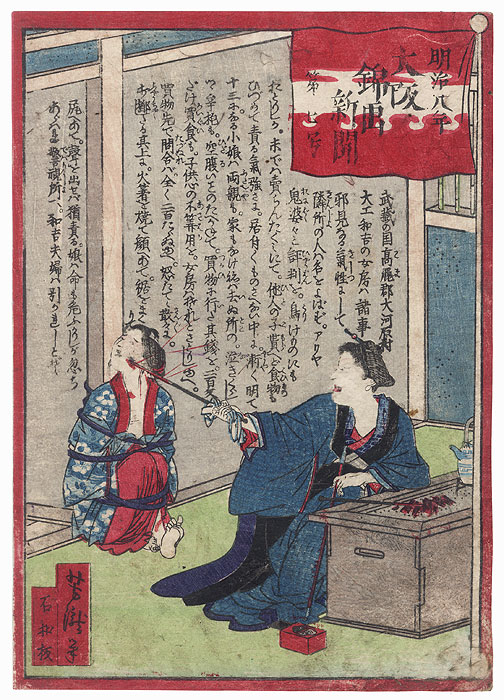
A bound woman kneels inside a domestic room while a seated man applies or threatens her with a heated metal implement taken from a brazier. Rope encircles the victim's torso and arms, immobilizing her in an upright kneeling posture. Blood is visible around her neck and garment. The seated aggressor calmly extends the heated instrument toward her face or throat while a large rectangular hibachi stands beside him. Extensive text above and behind the figures recounts the reported incident, presenting the image as sensational illustrated news.
Visual Description
The sheet is enclosed by a narrow red printed border. A large red cartouche at upper right bears the series title 明治八年大阪錦画新聞 and the issue designation 第七号. The upper half of the image is dominated by columns of handwritten-style Japanese prose printed across a pale interior wall. In the lower-left portion, a woman kneels with her legs folded beneath her. She wears a blue patterned outer garment over a red lower garment. A broad rope passes horizontally around her upper torso and arms, pinning the arms close to the body. Additional turns appear around the waist and lower torso. Her head is pulled slightly backward and turned toward the aggressor. Dark red marks around her throat and upper chest suggest burns, puncture, or blood. Her expression is tense and distressed. At right, a seated male figure in a dark blue robe faces her. He holds a long metal implement, probably tongs or a heated iron, toward the woman's neck or face. His posture is composed and controlled, heightening the contrast with the captive's helplessness. A large gray hibachi or brazier occupies the lower-right corner. Glowing red coals are visible at its top, and a small red box rests on the floor near the aggressor. The setting includes sliding architectural panels, a green tatami-like floor, and a blue wall or opening at upper right. The image appears to be a complete independent sheet rather than one panel of a diptych or triptych. Margins are narrow but the red outer border remains substantially visible.
History and Context
Historical Context
The individuals depicted have not been securely identified by personal name in the catalog records consulted. The report is associated with Ōkawara-machi in Koma District, Musashi Province. Later summaries describe the incident as a husband torturing his wife with a metal implement heated in a hibachi. The extent to which the print records a documented criminal case, reproduces a newspaper report, or embellishes a moralizing anecdote remains unresolved.
Print History
The design was issued around 1875 as No. 7 of Meiji 8 Osaka Nishikiga Shinbun. It was designed by Yoshitaki and published by Sekiwa. A closely related retelling of the same story appeared as No. 36 of Osaka Nishikie Shinwa, also designed and written by Sasaki Yoshitaki but published by Awabun and carved by Fukuzō. The existence of two illustrated versions suggests that sensational stories could be reworked across competing Osaka news-print series. The supplied impression retains the colored border and principal inscriptions but may have minor trimming and surface wear.
Cultural Context
Nishiki-e shinbun emerged during the early Meiji period as a hybrid of commercial woodblock printing and modern journalism. Osaka publishers adapted reports of crimes, scandals, accidents, exemplary behavior, and bizarre events into compact, brightly colored prints. These images often employed moralizing contrasts between virtue and vice while emphasizing violence or emotional extremity. Domestic cruelty was particularly suited to this format because it could be presented simultaneously as shocking news, a warning against immoral conduct, and a spectacle of bodily suffering.
Series Context
Meiji 8 Osaka Nishikiga Shinbun was one of several short-lived Osaka illustrated news series issued in 1875. Individual numbers were produced by artists including Yoshitaki and Sad信 II and published by firms such as Sekiwa and Awabun. The sheets usually contain a large identifying cartouche, a prose report, and a single compact scene. No. 7 is cataloged as the story of a husband who subjected his wife to torture with a heated iron. The same narrative was later or concurrently adapted as Osaka Nishikie Shinwa No. 36.
Known Variants
At least two distinct pictorial treatments of the underlying story are documented: Osaka Nishikiga Shinbun No. 7 and Osaka Nishikie Shinwa No. 36. These are separate designs rather than minor states of the same block. Surviving impressions of No. 7 may vary in trimming, registration, fading of the red border, pigment saturation, abrasion, and legibility of the text. No recut state of this exact composition has been established.
Relevance to Kinbaku
The print is directly relevant to the historical iconography of rope restraint because the woman is visibly bound before being tortured. The scene represents coercive domestic violence and involuntary confinement, not consensual erotic bondage or modern kinbaku.
Historical Connections
The design shows rope functioning as a practical and narrative tool of immobilization within an early Meiji account of domestic cruelty. Binding prevents the victim from resisting while the aggressor applies a heated implement. The image therefore contributes to the broader history of rope as a sign of custody, punishment, criminal violence, and bodily domination. It does not, by itself, establish any technical or institutional relationship with modern erotic kinbaku.
Iconographic Connections
The captive is shown kneeling with rope wrapped horizontally around her torso and arms, a configuration that emphasizes compression and helplessness. Her vertical posture, restrained arms, exposed neck, and proximity to the heated implement concentrate attention on vulnerability. The rectangular hibachi, extended iron, red wounds, and taut rope create a sequence linking restraint to anticipated pain. For kinbaku research, the print is useful as an example of how visible rope could organize a scene of power and bodily control even when the subject was journalistic and moralizing rather than erotic.
Interpretive Cautions
The print is an illustrated news image, not a technical record of actual tying practice. Rope placement may have been simplified to remain legible at chūban size. The prose should be transcribed before making detailed claims about the victim, aggressor, motive, sequence of events, or legal outcome. Although the image includes a restrained woman and intimate proximity between aggressor and victim, it should not be eroticized. The scene depicts abuse, injury, and threatened torture. Similarity to later bondage imagery is iconographic and does not prove a continuous historical lineage.
Research Value
The sheet is valuable for studying representations of restraint within domestic rather than judicial or theatrical settings. It permits comparison between Edo-period punishment imagery and Meiji illustrated journalism, and between two surviving pictorial adaptations of the same crime report. It also offers evidence for the way rope, household implements, architecture, and printed prose were combined to make domestic violence visually intelligible to a mass audience. Comparison with Osaka Nishikie Shinwa No. 36 may reveal how Yoshitaki altered pose, binding, gender presentation, and narrative emphasis for different publishers.
Themes
Subjects and Keywords
Sources
- The University Museum, The University of Tokyo: ニュースの誕生 exhibition catalog: 明治八年大阪錦画新聞 第七号 — Confirms the series title, issue number, publisher 石和, artist 芳瀧, opening geographical wording 武蔵の国高麗郡大河原町, and dimensions of approximately 25 by 17.5 centimeters.
- Yosha Bunko, William Wetherall: Osaka nishikiga shinbun No. 7: Hibachi iron torture — Confirms the series, number 7, circa-1875 date, publisher Sekiwa, artist Yoshitaki, vertical chūban format, and summary that a husband tortures his wife with a heated iron.
- Yosha Bunko, William Wetherall: Osaka nishikie shinwa No. 36: Hibachi iron torture — Documents a second version of the story by Sasaki Yoshitaki, published by Awabun, carved by Fukuzō, and identified as Osaka Nishikie Shinwa No. 36.
- Fuji Arts: Yoshitaki, Hibachi Iron Torture — Provides the supplied comparison image and a specialist-market identification of the scene as Hibachi Iron Torture by Yoshitaki.
- Viewing Japanese Prints: Ichiyōsai Yoshitaki, 1841–1899 — Provides biographical and naming context for the Osaka artist Yoshitaki, who was active in actor prints and illustrated news.