A Bound Woman Threatened with a Bamboo Pole
Summary
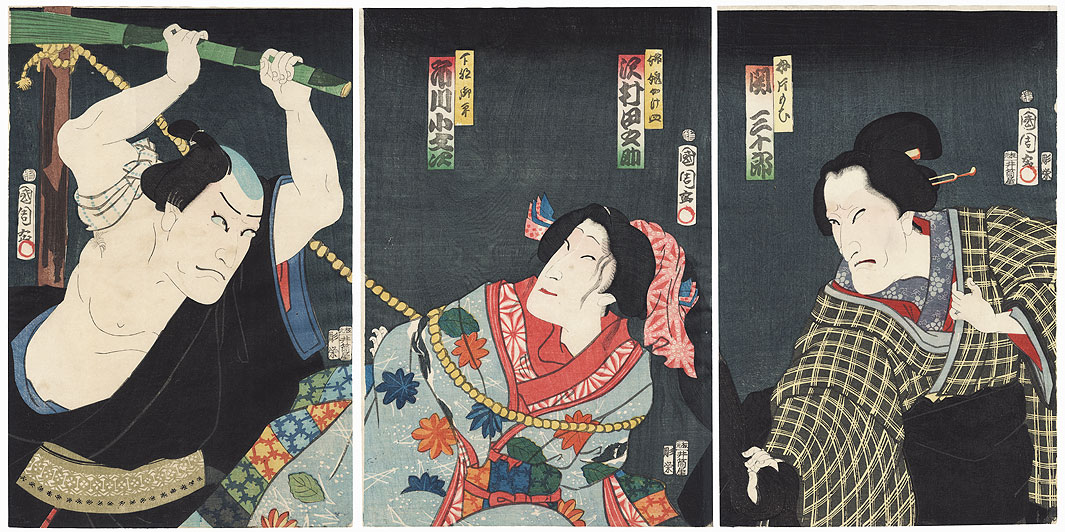
Three kabuki actors appear against a nearly continuous black stage-like background. At left, a muscular male character raises a thick green bamboo pole above his head as though preparing to strike. At center, an onnagata portraying a woman is bound around the upper torso with a conspicuous yellow rope and looks upward toward the threatened blow. At right, another onnagata in a black-and-yellow checked robe watches with an angry or alarmed expression, one hand pressed to the chest and the other lowered near the edge of the composition. The triptych compresses threatened violence, restraint, and emotional reaction into three closely joined half-length portraits.
Visual Description
The three ōban sheets form a continuous theatrical composition with no developed landscape or architectural setting. A deep black or blue-black ground extends across all panels, causing the pale faces, arms, rope, and patterned costumes to stand out dramatically. On the left sheet, a broad-shouldered male actor wears a dark robe opened at the chest. His shaved forehead and swept-back hair are rendered in the conventional yakusha-e manner. Both arms are raised, and his hands grip a thick segmented green bamboo pole held horizontally above his head. A yellow cord or decorative stage rope hangs in the background behind him. His brows are furrowed, and his face is turned sharply toward the bound figure. The central actor, portraying a woman, wears a pale blue robe decorated with large red, orange, blue, and green flowers. A thick yellow rope crosses diagonally and horizontally around the upper body, visibly restraining the arms and torso. The figure leans backward and turns the face toward the aggressor, with narrowed eyes and a faint, ambiguous smile or expression of theatrical endurance. A large red, blue, and white cloth ornament frames the hair. On the right sheet, an actor portraying an older or stern woman wears a black robe covered with a yellow-white lattice pattern and a blue patterned collar. The figure's face is contorted in anger, anxiety, or disapproval. One hand gathers the garment at the chest while the other is lowered with tense fingers. Actor and role cartouches float above each figure, and each sheet bears Kunichika's vertical signature with a red circular seal. Small rectangular production marks appear near the signatures. The sheets retain narrow margins and appear to have been assembled in the correct left-to-right narrative order.
History and Context
Historical Context
The specific characters and dramatic episode have not been securely identified. The actors visible in the cartouches belong to the leading Edo kabuki world of the 1860s. Sawamura Tanosuke III was especially celebrated for onnagata roles and was frequently portrayed by Kunichika. Kawarazaki Gonjūrō I and Seki Sanjūrō III also appeared prominently in contemporary actor prints. Their combined presence suggests that the triptych advertised or commemorated a current production rather than illustrating a generic fictional episode.
Print History
The triptych was issued as a commercial yakusha-e composition, probably during the 1860s, when Kunichika was establishing himself as a major designer of kabuki actor portraits. The three sheets were intended to be viewed together, although individual panels may also survive separately. A dealer catalog uses the modern descriptive title Beating a Beauty. That title is useful as a visual summary but should not be treated as an original Japanese title or as proof of the play, characters, or exact narrative action.
Cultural Context
Kabuki actor prints allowed audiences to collect images of celebrated performers in recognizable roles and dramatic moments. Kunichika specialized in close, psychologically forceful portraits that emphasized faces, gesture, costume, and stage conflict. In this triptych, the broad black background suppresses secondary scenery and brings the threatened blow and visible rope into immediate focus. The central female role would have been performed by a male onnagata actor, so the image records a theatrical construction of endangered femininity rather than a portrait of an actual female captive.
Series Context
No named series has been established. The print appears to be an independent performance-related triptych. Its shared dark ground, coordinated cartouches, aligned figures, and repeated signatures demonstrate that the three sheets belong to a single composition.
Known Variants
Commercial and institutional impressions of Kunichika actor triptychs often survive as complete sets, partial sets, or detached panels. Likely differences among impressions include trimming, fading, misregistration, abrasion of the black ground, and changes in the intensity of red and blue pigments. No distinct recut edition or alternate state of this design has been confirmed.
Relevance to Kinbaku
The triptych is directly relevant to the visual history of restraint because the central female character is conspicuously bound around the torso while another character raises a bamboo pole in a threatening posture. The scene is theatrical and coercive, not consensual erotic kinbaku.
Historical Connections
The print demonstrates that visible rope restraint was an intelligible and commercially compelling element of late Edo kabuki imagery. Binding marks the central character as physically controlled and unable to avoid the raised weapon. Such scenes belong to a larger theatrical vocabulary of captured women, prisoners, interrogation, punishment, and rescue. This establishes a historical visual context for rope restraint but does not demonstrate a direct technical lineage to modern kinbaku.
Iconographic Connections
The thick yellow rope is designed for immediate visibility against the floral blue robe and black background. Its broad curve links the left and center sheets and directs attention from the raised bamboo pole to the captive's torso. The restrained character's backward lean, turned face, compressed arms, patterned costume, and exposed neck produce a highly aestheticized image of danger and vulnerability. The triptych format also creates a relational structure: aggressor, captive, and witness or rival occupy separate sheets but share one visual field.
Interpretive Cautions
The image depicts actors performing a dramatic scene. It is not documentary evidence of an actual beating, criminal punishment, or historical tying procedure. The rope is probably a stage property and may be arranged for visibility and safe performance rather than secure restraint. The modern title Beating a Beauty is descriptive and potentially sensationalizing. The intended blow, character relationships, and precise moral alignment of the three figures cannot be determined without identifying the play and reading the role cartouches securely. The image is not shunga and contains no explicit sexual activity.
Research Value
The triptych is valuable for studying how actor prints use rope, pose, and sheet division to construct theatrical violence. It offers a strong example of torso binding presented at close range, with almost all narrative emphasis concentrated on facial expression and gesture. Identification of the exact production would permit comparison with scripts, theater programs, other actor prints, and stage conventions governing the representation of a bound onnagata. It would also clarify whether the right-hand figure is a rescuer, rival, accomplice, or witness.
Themes
Subjects and Keywords
Sources
- Fuji Arts: Toyohara Kunichika, Beating a Beauty, catalog record 1209814 — Provides the supplied comparison image, the attribution to Kunichika, and the modern descriptive title Beating a Beauty.
- Museum of Fine Arts Boston via Ukiyo-e.org: Actors Seki Sanjūrō, Kawarazaki Gonjūrō, Bandō Hikosaburō, and Sawamura Tanosuke, object 472771 — Documents a Kunichika actor composition involving the principal performers whose names appear in the supplied triptych and provides a potentially related institutional comparison record.
- Museum of Fine Arts Boston: Actors Seki Sanjūrō, Kawarazaki Gonjūrō, Bandō Hikosaburō, and Sawamura Tanosuke — Institutional source for the actor lineup and Kunichika attribution, although the abbreviated online metadata does not securely identify the play or precise date.
- Ōta Memorial Museum of Art: Toyohara Kunichika artist introduction — Provides institutional biographical and historical context for Kunichika as a major designer of kabuki actor prints during the late Edo and Meiji periods.
- The Metropolitan Museum of Art: Album of Thirty-Two Triptychs of Kabuki Actors by Toyohara Kunichika and associated artists, object 53711 — Provides comparison material for Kunichika's triptych format, kabuki actor identifications, theatrical subjects, and production context.