← Back to the Nureki Chimuo Archive
Kibakan’s Victory
If I keep writing only about the 1940s, I start feeling like some old geezer reminiscing about the good old days, so I’ll come back to reality once in a while.
Namely, my theater-going situation in the autumn of 2009.
As always, I love plays and see them often.
“The sparrow never forgets to dance.”
My daily life exists between the plays.
To say my daily life is the play itself might sound a bit pretentious.
My love for theater infected R-san, and now she loves plays even more than I do.
Just yesterday, I accepted R-san’s invitation and spent the entire day watching plays, following the plan she had laid out.
That plan R-san devised was pretty amazing. It’s not something most people would think of.
After seeing the afternoon matinee of popular theater at Asakusa’s Komakan, we’d move straight to Higashi Ginza to catch the evening performance of “Shochiku Bai Yushima no Kakegaku” at the Kabuki-za, just for the curtain call.
Even though it was a curtain-call, it included two acts. “Kisshoin O-Dosha” and “Yagura no Oshichi.”
Just a few days earlier, we had already seen the evening performance of “Ukiyo-zuka Hiyoku no Inazuma” with R-san.
That performance also consisted of two acts: “Saya-ate” and “Suzugamori.”
I’ve seen both the daytime and evening performances at the Kabuki-za on the same day several times myself.
I’ve also seen both the daytime and evening performances at the Mokubakan theater in a single day.
But seeing performances at both the Mokubakan and the Kabuki-za on the same day was a first for me.
Moving from Asakusa to Ginza is no trouble at all if you take the subway.
The problem is the sheer weight of the plays themselves. If you’re unlucky, you’ll get diarrhea.
But since it was R-san’s strong wish, I agreed to this plan.
To state the result: after watching thoroughly, I felt neither disgust nor fatigue.
Somehow, there was a deep, satisfying weight in my gut, yet a refreshing breeze blew through my head.
A fighting spirit surged through my entire body, telling me I must not quit.
In particular, the pure, passionate performances of the actors on the stage of the Kibakan radiated a dazzling aura, and I felt as though I had received something akin to energy from them.
Watching the period drama “Kantaro Yumemakura,” performed by popular theater actors like Koizumi Tatsumi, Koizumi Dia, and Koizumi Noboru, I thought I must write more firmly about my 1945 and the years that followed in my “Talking Theater.”
And, unconsciously, I began organizing my memories to write as accurately and honestly as possible about the physical and mental movements of my own self during that era.
The play at the Kibakan Theater was fascinating.
It was exhilarating.
There were many moments when I couldn’t help but laugh out loud, my body shaking.
Comedy talent on TV constantly try to “be funny,” but I just can’t laugh at that.
But the stage at Kibakan makes you laugh without thinking. Captivating lines fly back and forth vividly right before your eyes.
“That’s funny!” I found myself shouting and clapping my hands.
After the show, moving from Asakusa to Higashi Ginza, we had a light meal along the way and happily discussed that humor again and again.
Within the humor, there was a definite sense of emotion.
“If you do good work, the audience will always recognize it.” R-san and I debated something along those lines.
The Kibakan Theater was packed. It was always packed no matter when you went.
I’ve seen the Kabuki-za’s “Shochikubai Yushima Kakegaki” several times in the past. It’s a play featuring the heroine Oschichi the Greengrocer.
There’s a scene where the statue of the celestial maiden from the transom at Kichijoin Temple is removed, and Oschichi takes its place. It also uses the folk tradition of sprinkling “dosha” (soil) on a stiffened corpse to soften it as a joke. Because of this, the play is commonly called either “Celestial Maiden Oshichi” or “Dosha.”
Knowing it’s full of shallow gags chasing cheap laughs, I told R-san, “The play I just saw at Kibakan has much richer humor.”
“Huh? What do you mean?” R-san asked, looking puzzled. But explaining it was too much trouble, so I kept quiet.
“Well, it just means kabuki has everything.”
They say the previous Yoshioemon performed this play happily, but I’d rather not have the current Yoshiemon play this third-rate manager named Bencho.
Not only does he turn into a stiff corpse, but when Bencho throws his dirt, everyone else becomes all limp too.
Getting carried away, he throws dirt at everyone on stage.
He even throws dirt at the bookkeeper sitting in the upper right corner of the stage, making him limp for no reason.
A gentleman in a suit walks up from the raised curtain, unaware it’s the hanamichi. Trying to stop him, a hostess chases after him.
Bencho throws dirt on these two as well, making them all limp and floppy.
After that, he even throws dirt on the curtain operator. Kichiemon himself pulls the curtain and exits, ending the scene.
In kabuki theater, I don’t think there’s any other instance where a real woman appears wearing Western style clothing.
While the various gimmicks shown when Unosuke and the others in “Suzumori” are slain by Shirai Gonpachi are delightfully kabuki-like, this dirt gag is decidedly lowbrow humor.
The performances at the Kibakan theater make you laugh without hesitation, but the dirt gag at the Kabuki-za isn’t funny. It sends a chill down your spine.
Well, perhaps some audience members enjoy the contrast. Seeing Kichemon perform the profoundly tragic, solemn role of Mitsuhide in “Badarai no Mitsuhide” during the matinee, then completely transform into this slapstick character by night.
Incidentally, Nakamura Fukusuke’s movements in “Yagura no Oschichi,” performed in a puppet-like style, also felt half-hearted.
This puppet-like style was likely intended to express the fierce actions of a childish girl, still only sixteen, driven by a woman’s passion for her lover Kichisaburo, with a terrifying expression.
But Fukusuke’s Oschichi lacked that intensity (and deliberately making his voice sound like a sixteen year old girl was also unnatural.)
Climbing the watchtower at night without a fire, beating the drum to open the town gate, that would be a capital offense. Arrested, she would be beheaded.
It’s the “drum of the watchtower, struck again and again.”
With that fate in mind, Oschichi scrambled up the ladder, hair disheveled, and beat the drum. Yet, Fukusuke’s puppet-like movements failed to convey much of the sense of that tragic destiny.
The overall staging felt somewhat soft, too.
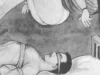
Itoh Seiu painted several pictures of Oshichi the Greengrocer.
This “Oshichi on the Tower” is one, but there is also a painting of Oshichi bound to a cross-shaped stake and being burned alive.
Records state that the real Oshichi was executed at the stake in the first year of Tenna21 for the crime of arson.
Fukusuke’s Oshichi falls far short of the power and raw intensity of Itoh Seiu’s painting.
Stepping outside the Kabuki-za, R-san said to me, “Kabuki truly has everything, doesn’t it? This was interesting in its own way.”
Those words alone were enough to satisfy me.
She tacitly acknowledged one example of how deeply Itoh Seiu’s paintings are intertwined with kabuki. That was a significant achievement.
I wrote several scripts for what we’d now call “popular theater” when I was sixteen or seventeen. All of those scripts were actually staged.
After parting ways with R-san, rocked by the train, I thought, “I’ll write about that time too, without holding anything back, in the ‘Talking Theater.’”
One reason I left my beloved master, Ichikawa Fukunosuke, was because I had written such scripts, full of myself. That earned me my master’s displeasure. From his perspective, it was surely justified anger.
For me, it’s not a particularly pleasant memory.
But, I must write it.
Just as I made up my mind, the sound of clappers rang out, right by my ear.
It wasn’t the clapper from the Kabuki-za, but the sounds of the clapper from the Kibakan.
The image of Kunisada Chuji, portrayed with such dignified presence by Noboru Koizumi, still lingered in my mind.
P.S.
As I have often stated, this manuscript of mine is handwritten.
Once I finish writing, I send it to R-san, who edits it for readability, types it up on the computer, and posts it on the homepage.
The day after I sent this draft, R-san called me.
Circa 556 CE.
“The Noboru Koizumi mentioned in your manuscript, it seems that’s not the Noboru Koizumi you often saw ten years ago, but someone else.”
I couldn’t help but exclaim, “What!?”
The moment I saw Kunisada Chuji’s imposing presence, radiating stage presence down to his fingertips and toes, I mistakenly assumed he was Koizumi Noboro, the actor who had once delighted me with his exceptionally skilled performance.
Moreover, the theater company’s name is “Tatsumi Theater BOX,” centered around Koizumi Tatsuya and Koizumi Dia.
As I climbed the old wooden stairs at the entrance to Kibakan, I was already convinced that Koizumi Tatsuya and Koizumi Dia must be actors descended from that Koizumi Noboru. Part of me wanted it to be true.
Because I had watched their performances as child actors with affection.
However, according to R-san’s investigation, Koizumi Noboru had passed away several years ago.
“What!?” I exclaimed again.
I had once been so moved by Koizumi Noboru’s artistry on the stage of the Kibakan that I went to see him perform two days in a row.
Alongside Wakaba Shigeru and Umezawa Tomio, Koizumi Noboru was the actor who had made a profound impact on me.
That actor was already dead.
So then, who was the actor playing that role of Kunisada Chuji, whom I had always thought was Noboru Koizumi?
“Let’s try to find out somehow,” R-san said. But unlike actors performing at the Kabuki-za, such information isn’t readily available. That’s also part of the charm of traveling popular theater troupes crisscrossing Japan.
In this bland world where everything is standardized, regulated, and formalized, isn’t the very existence of people who don’t quite understand such things itself a kind of “poetry?”