← Back to the Nureki Chimuo Archive
Manju, a Dog, and a Pipe
As I’ve written several times before, my notes contain only the names of kyogen plays performed at the Tsurukame Theater and the Shirahige Theater, along with the cast members.
It states, “Tsurukame Theater: December 20, 1945 (Showa 20) opening night, December 27 closing night.”
And the plays and cast members are noted as follows.
1. The Lover’s Wife’s Parting Ties / Shige’s Parting at the Well. One Act
Nursemaid (Menoto) / Shigeno’s Child … Bando Takejaku Honda Yasozaemon (Red Old Man) … Sawamura Tetsuzaburo Horse Handler (Umakata) Mitsuyoshi … Bando Shoko Daughter, Princess Shirabe … Bando Kotake Attendant One … Bando Sakiko Attendant Two … Ichikawa Fukujiro
2. The Keian Chronicles of Peace and Tranquility / Maruhashi Chuya / The Edge of the Moat / The Scene of the Arrest
Maruhashi Chuya … Bando Takejaku Matsudaira Izumori … Ichikawa Fukunosuke Yumishi Fujishiro … Kataoka Tobei Sake Warmer Kansuke … Sawamura Testuzaburo Intermediary 1 … Hideo Umezawa Intermediary 2 … Kotaro Arisawa Intermediary 3 … Ichikawa Fukujiro Arresting Officers … Many
3. Two Crossing Guards. Two Scenes.
Sankichi … Kataoka Tobei Kinzo … Sawamura Tetsuzaburo Geisha Someko … Onoe Otojo Horiguchi Shinsaku … Bando Takejaku Sankichi’s Wife … Fushimi Yoko
And on the next page of my notes, it reads, “1946 - Tsurukame Theater New Year’s Performance - Opening Day. December 31st.”
In other words, the second run at Tsurukame Theater would be the New Year’s performance.
The plays and cast names were as follows:
1. Silence. One Act.
Tokuni Taro … Bando Takejaku Uesugi Terutora … Onoe Takenosuke Aramusha Taro … Sawamura Tetsuzaburo And various others.
2. New Edition of the Song Offering Text
Farmer Hisasaku … Onoe Takenosuke Daughter O-Mitsu … Bando Takejaku Apprentice Hisamatsu … Onoe Otojo Oil Merchant’s Widow O-Tsune … Bando Reiko Daughter O-Some … Ichikawa Fukunosuke Maid Yoshi … Ichikawa Fukujiro
3. Comedy. Daughter at Eighteen. Two Acts
O-Hana … Bando Yoko Fujigoro … Onoe Takenosuke Seizaburo … Onoe Otojo Someko … Bando Sakiko O-Hana’s Mother … Bando Reiko Homatsu … Ichikawa Fukujiro
From late December of Showa 20 (that is, the year of defeat) until mid-January of the following year, Showa 21, I was unquestionably performing at the Tsurukame Theater. The dates are recorded, so I know this for certain.
My memories of the stage during that time are quite vivid.
It had been about three months since I became Fukunosuke’s apprentice. Perhaps because I had grown accustomed to life in the troupe and had gained some leeway, both mentally and physically.
At the opening scene of “Maruhashi Chuya,” set at the outer moat of Edo Castle, Umezawa Hideo, Kotaro Arisawa, and I were dressed as chugen (intermediate actors), exchanging lines with the old man from Tetsuzaburo’s sake shop.
Though called a sake-warmer stall, it was more like a simple bamboo-mat-covered stand.
“Ah, what a splendid feeling. I only drank two small cups at the riverside tavern, but I’m thoroughly drunk. Well, I suppose I should be. First thing this morning, I had two cups of sake with breakfast at home. Then at the loach shop on the corner, I had five cups while it was still hot. After leaving there, I had three cups of clam sake, two cups each. Then, since they had good raw yellowfin tuna in the goose pot, I had another cup of sashimi sake. What a hellish plum branch! Three cups here, five cups there. All told, about thirty cups. This is turning into a Genta-like situation. I’ll have to pawn my armor. Even naked, I can’t stop drinking sake…”
Takejaku’s crisp delivery echoed in my ears, and I found myself writing on and on.
Maruhashi Chuya’s costume at that time was a high-collared, dark-brown cotton kimono, a red haori over it, a single sword in a vermillion scabbard, and a manju19-style hat.
And the way he delivered his lines with a slightly exaggerated flair, singing them as if they were a famous melody, was the very essence of the joy of “small theater.”
Chuya approached the stage in high spirits. Spotting me and Umezawa playing the intermediaries, he called out, “Well, well, simmered oden20, eh?”
He then exchanged lines with the sake shop owner.
The two intermediaries, having been treated to sake by Chuya, bowed their heads in thanks and withdrew to stage left.
From here, my big moment in this play begins.
Backstage, I hurriedly shed the intermediary’s costume.
Stripping down to my skin, I slipped into a stuffed dog costume (they’d probably call it a full-body suit nowadays), got down on all fours, and immediately returned to the stage.
A rounded bamboo straw hat.
Oden is a fish cake stew.
Basically, this time, I was a dog.
And I played opposite Chuya in his scene.
The dog barked, “woof woof!” at Chuya.
Chuya: “What’s this, ‘woof woof’? You’re quite the modern fellow. Barking ‘woof’ is only natural. They say red dogs taste like beef, so bark ‘moo.’”
Dog: “Woof woof!”
Chuya stares down the dog, then eventually picks up a stone and throws it.
The stone splashes into the moat. Chuya draws his pipe, takes aim, and measures the depth of Edo Castle’s moat.
Chuya, in truth, is not drunk.
He’s part of the rebel group led by Yui Masayuki, who plots to overthrow the Tokugawa Shogunate.
“Manju hat, dog, pipe”, that meant Maruhashi Chuya was at the moat’s edge.
Drunk on the hanamichi, he’d say, “...three cups here, five cups there, gather ‘em up, about three sho…”
Alongside this famous line by Kawatake Mokuami, this image became widely known among the people during the Meiji era, and early Showa eras.
Now, it’s not just unknown. It vanished without a trace. Alas!
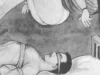
Behind Chuya, who is measuring the depth of the moat with water sounds and his pipe, Matsudaira Izumigami approaches unnoticed. Without a word, he holds an umbrella over Chuya’s head.
A light rain is falling.
Playing the shogunate dignitary Matsudaira Izumigami is my teacher, Ichikawa Fukunosuke.
Though perhaps a bit too slender, he embodies the role of a samurai with dignified poise and grace.
Enemy and ally find themselves face to face beneath a single umbrella, creating a uniquely beautiful kabuki composition.
The sight of Izumigami, a high ranking shogunate councilor, holding an umbrella over Maruhashi Chuya, a common rogue and, moreover, a rebel, was utterly cool.
“You two!” a voice calls out from the audience.
The stray dog pelted with stones by Chuya, that is, me, yips and retreats backstage.
Then, without a moment to catch my breath, I shed the dog costume and change into the next scene’s guard outfit.
(I had intended to write about my own performance in this act. That is, Ichikawa Fukujiro’s, but I became so intoxicated by the play’s overall mood that my own role ceased to matter.)
I became one of the officers arresting Chuya.
Since it was an unmanned troupe, I performed fight scenes where I was slashed by Chuya three or four times, retreating only to reappear again and again. There was no time to transform from dog to arresting officer.
On my opening night, I somehow managed to make it work. I had my arm and leg guards on, but I forgot my headband, and it became clear it just wasn’t going to work.
So I decided to take the plunge and appeal to Takejaku.
“Master, I’m sorry, but I cannot do it. There’s simply not enough time to switch from being a dog to an arresting officer in the middle of the prologue.”
Then, with the gentlest of smiles, Takejaku looked me straight in the face and said, “I see, I see. Well, it might be a bit much, I suppose. But this troupe is short on actors, as you can see. Do your best to manage it. Your dog is very good.” With that, he gave me two bars of soap.
How precious soap was in Showa 21 (1946). No one would believe it if I wrote it here now. They wouldn’t understand.
So I won’t write it.
The soap was black, made from solidified fish oil, and smelled of sardines.
Even so, it was a precious commodity.
I stood before Takejaku, received the two bars of soap with both hands, and tears welled up in my eyes from sheer gratitude.
Takejaku’s kindness made me happy.