← Back to the Nureki Chimuo Archive
In the Red Light District
The drooling boy played by Kataoka Tobei, perched on my back. “Take me to where all the pretty girls in fancy dresses line up under the red lights!” he shouted loudly, throwing a tantrum. Summoning my courage, I set out alone for that red-light district.
Past the Joban Electric Railway crossing and emerging on the other side of Kameari Station, I was already tense.
The place was easy to find.
A corner of the dark night sky was faintly tinged red. I walked toward it.
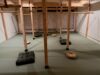
With the gutter river at my back, they stood in a row, their cheap, makeshift appearance unmistakably that of shacks.
Three or so plain, two-story rectangular wooden houses, devoid of any decoration, huddled together as if clinging to each other.
The sight of these shacks, built with walls of roughly hewn, pale wooden planks, standing quietly along the black, flowing ditch, seemed like the naked form of a sinister woman.
On the side facing the alley, windows about fifty centimeters square were lined up neatly in a row. Beyond that, the building was featureless.
Inside the windows, women sat, extending only their hands and faces out to call the men passing by.
These windows were spaced about a meter apart, all at the same height.
In other words, women set every meter, beckoning customers. All together, there were probably around thirty windows.
I wrote there was no decoration, but small red lights hung above each window. While they could look cheap and pitiful depending on your perspective, they served as effective decoration.
It was truly a red-light district, and they were indeed women in decorated windows.
What struck me as most peculiar at that moment was that the alley outside the windows, where the women’s faces were lined up, was enclosed by a crude, roughly hewn wooden fence.
To see the women’s faces clearly up close, one had to step into the narrow alley inside that wooden fence.
Basically, that flimsy wooden fence, which looked as if it would collapse if pushed by hand, was an enclosure designed to hide the women’s faces from the outside world.
It was a “device” to prevent passersby from openly seeing the precious “merchandise.”
Outside the wooden fence lay a dark, desolate back alley, but inside, it became a strange, otherworldly realm illuminated by red lamps. I caught a glimpse of that other world.
As a boy, I was first struck by such a simple yet clever trick used to sell a woman’s body.
Looking back now, it was nothing more than a makeshift brothel, set up as quickly and cheaply as possible.
Yet, even as a makeshift setup after the American air raids had burned everything down, it was undeniably an effective stage set, a way to line up many women in a small space and present them to men’s eyes in an alluring, sensual way.
But more than being surprised by that, seeing the women leaning out the windows calling to men right before my eyes, I felt intensely that it was a “pitiful sight,” and the shock nearly crushed my heart.
For the women beckoning men from the windows, I could feel nothing but pity.
They appeared not as human beings, but as “commodities” stripped of both body and soul.
Despite that pitiful environment, I felt awe for the women who sold their charms with resilient smiles. Pitiable, yes, but they were also terrifying beings.
Not a shred of the romanticism found in the love stories of the classical courtesans I admired could be felt here.
I’m not trying to act like a “good boy” or a “moralist.”
(Even if I, Nureki Chimuo, played the moralist here and now, it wouldn’t change a thing.)
Though still a child, at sixteen I already possessed a man’s sexual desire.
Yet, in the sight of those women beckoning men from the windows, I felt not a shred of desire.
I suppose it’s “normal” for a man to be aroused by the coquettish charms of such women.
Is a man like me, who feels only misery when looking at the women sitting at the windows, no eroticism, no sexual arousal, truly “abnormal?”
Thinking about it, I was someone who received “militaristic education” during most of my impressionable years.
After losing the war, society suddenly started clamoring about “democracy” and “gender equality,” but I had disliked militarism even during the war.
“...I absolutely adore soldiers, When I grow up, I’ll carry a rifle and raise a flag, Ride a horse, and go on adventures…”
I was taught a nursery rhyme-like song like this as a child (oh, what does it mean that I still remember such a dreadful song like this!), but I never once thought I wanted to become a soldier.
I dislike rough things.
The reason I hated gym class and sports days so much
I dislike moving my body, and I instinctively detest war and soldiers.
During the final days of the war, when the government was screaming, “One hundred million hearts as one, a fireball!” I was on stage in a period drama, blissfully happy, playing the daughter of Horibe Yahei.
I gained a reputation for being more girlish than the girls themselves. I was unpopular with the militaristic schoolgirls, but I was secretly pleased (I’ve written about this before).
I was born with, you might say, a “gender equality” mindset and way of thinking; I believe that was simply my nature.
I never looked down on women simply because they were women.
Rather, I harbored something akin to reverence for them since childhood.
I think I inherited this trait from my father.
My father was also timid around women.
He was always gentle with my mother.
I never once saw him raise a hand to her.
No, perhaps “gentle” is too vague a word. Yes, I just remembered.
He never called my mother “you”. He always addressed her as “you, ma’am.”
Compared to my father, I can be quite cold toward women. But at least on the surface, I’m gentle.
Oh, I’ve gone off on quite a tangent again. I wasn’t supposed to write this far.
How did I get here from “drooling?”
I never intended to recount the story of the “red-light district” right after the war in such detail.
I’ve strayed quite far from the play at the Tsurukame Theater.
But I suppose I wrote it because I felt the urge to. It can’t be helped.
In any case, I was confronted with the reality of women selling their bodies to men in such a manner, and I found it tragic and was deeply shocked.
That shock was heavy and profound.
That I can remember scenes from over sixty years ago and my own feelings in such detail, and write about them now, is surely proof that I received an extraordinary shock to my heart that night.
I stood frozen in this “red-light district” that night for ten or fifteen minutes, at most.
Call it a boy’s sentimentality if you will, but unable to bear the injustice and sadness of one human being buying another with money, I fled the scene.
It may be hard to believe, but on my way back to Kameari Station, I was actually shedding tears.
Even now, I detest the act of a man buying a woman’s body with money.
Is it strange for a man like Nureki Chimuo to say such a thing?
Some will surely think it strange, or even a lie. That wouldn’t be surprising.
Yet, I absolutely love the romanticized, idealized tales of courtesans that appear in plays and novels.
(I myself have written many such stories.)
While I could never lay a hand on a real courtesan, in the world of fantasy and delusion, I can embrace courtesans as boldly, joyfully, and lewdly as I please.
That night’s experience made me wonder if perhaps my desire for women was a little different from other men’s.
I felt contempt welling up inside me for the kind of man who shamelessly lays bare his desires in such places, buying and hunting down women’s bodies.
When Kataoka Tobei, playing the “drooling child,” whined, “Hey, old man, take me to that place across the station where there are lots of pretty ladies,” I decided to picture in my mind the scene from the Kabuki play “Sukeroku,” the one at the Miuraya brothel in Yoshiwara, starting with the next day’s performance.