← Back to the Nureki Chimuo Archive
About Shirahige Theater
「島千鳥月白浪」is correctly written as “Shima Chidori Tsuki Shiranami.”
It is a Meiji period play by Kawatake Mokuami, a “zangiri” play.
“Torii-mae” refers to the area in front of the torii gate of Kudan’s Shokonsha, the present-day Yasukuni Shrine.
It is unusual to perform only this scene from the long tale of retribution, making it very much like a “small play.”
Several years ago, the National Theater staged a full performance of this “Tori-chidori.” When the late Ichimura Uzaemon (17th generation) appeared, dressed in a suit, wearing leather shoes, and holding a folding umbrella in one hand, the audience murmured in surprise for a moment.
The story of the comedy “Migwari Yakko” is as follows.
A lord of rather poor character bought a new sword. To test its sharpness, he sent one of his servants (a yakko, middleman or retainer) on an errand to a friend’s house, carrying a letter.
The letter instructed the friend to kill the servant and test the sword’s sharpness.
It is a cruel tale in which the servant, carrying the very sword that will kill him, sets off for the samurai’s residence.
The samurai devises a plan to save the servant’s life, and the story ends as a comedy. The compassionate samurai was played by the troupe leader, Bando Takejaku.
I played a middleman among the protagonist Sukomahei’s (played by Onoe Takenosuke) companions, a role with no lines. This was my first stage appearance at the Tsurukame Theater.
“The Battle of Kawanakajima: Terutora’s Meal Service” is a truly magnificent classical Gidayu tale.
Its original title is “The Battle of Kawanaka Jima in Shinano Province,” but nowadays only this “Terutora’s Meal Service” scene is performed. And even then, it’s only done in so-called “short plays.” In other words, it’s a rare, precious one-act piece.
(I seem to recall it being performed once at the Tokyo Kabuki-za a few years ago, but unfortunately, I couldn’t go see it at the time.)
Above, I’ve written very roughly about the three plays I performed in when I first stood on the stage (or rather, at the edge of the stage) with the Takejaku troupe.
Even just these three plays hold so many memories, and I have mountains of things I want to write about.
But if I wrote all that, there’d be no end to it.
For example, memories about “Torii-mae.”
The protagonist, Akashi no Shimazo, has a line when he tries to persuade his fellow rogue, Matsushima Chita, to become a good man.
I absolutely adore this section of dialogue, so quintessentially Mokuami in its famous cadence. Years later, I even visited the grave of Sokuzenshinji (aka the Phantom Thief Nezumi Kozo) at Ryogoku Ekoin Temple. The lines are:
“...They say Nezumi Kozo could see through the darkness at night, but you, doing the same thievery, can’t see a damn thing. Go pay your respects at Sokuzenshinji’s grave and drink some shikimi water. What’s this? Drawing your dagger to threaten me? You think you’ll cut me? You might chip the corner of this stone monument, but you won’t chip my skill. Go on, cut me if you dare.”
There’s a legend that the thief Nezumi Kozo was skilled at gambling. Since ancient times, gambling enthusiasts have chipped off the corner of the stone monument and kept the fragment as a talisman.
Now, the grave is completely covered with wire mesh, preventing anyone from touching it.
Instead, right next to that stone monument, a stone grave specifically prepared for gambling-loving pilgrims to chip away at is somehow odd.
I don’t do horse racing or pachinko, but next to Ekoin Temple is a hall called Theater X. When I go there to see a play, I stop by Nezumi Kozo’s grave. I enjoy seeing how the substitute stone has been chipped away.
It’s amusing that such a silly superstition, passed down from the Edo period, still lives on today.
…Well, if I start writing down all the related memories like this, there’s no end to it.
(Come to think of it, this “end” is also a kabuki term, referring to the end of a play or the climax of a scene.)
If I’m not careful, the story veers off course endlessly and just keeps expanding.
While writing this manuscript, I catch myself unconsciously murmuring in a kabuki tone, “They say Nezumi Kozo could see through the darkness of night…” using the voice of Bando Takejaku from over sixty years ago, I find myself lost in a pleasant reverie.
R-san says, “Even if you get carried away or the story expands, just write it. Write it down no matter what. In this era, the only person who knows these things is you now, so write diligently without hesitation.” She stares straight at me, her expression resolute.
I, too, want to immerse myself in recollection, writing down whatever comes to mind, rambling on.
But that won’t be possible, will it?
I inevitably end up considering the overall balance.
So, I push forward, eliminating or omitting sentimental feelings as much as possible.
From October to November 1945, the Takejaku Troupe relocated from the Tsurukame Theater in Kameari, Katsushika Ward, to the Shirahige Theater in Mukojima, Sumida Ward, where they performed.
Ichikawa Fukunosuke, the troupe’s leading onnagata, and his apprentice Fukujiro, that is, myself, naturally performed at the Shirahige Theater as well.
The repertoire at that time.
1. Chidori Island, Moonlit Waves Before the Torii Gate, Act One
The lead role of Akashi no Shimazo is naturally played by Takejaku, but the supporting role of Matsushima Chita has changed from Kisaburo to the newly joined Sawamura Tetsuzo.
Kisaburo's presence vanished from this performance onward. In other words, he had left the Takejaku troupe. The reason for this departure was beyond the understanding of a lowly rookie like myself.
All I knew was that Sawamura Tetsuzo had joined the troupe in Kisaburo’s place.
I had liked the actor Kisaburo since the days of the Honjo Kotobuki Theater.
He had a commanding presence, a handsome face, and the dignified bearing of a true kabuki actor, specializing in villainous roles with a fine delivery.
No matter how hateful the villain he played, there was always a certain charm about him, and I believe he was beloved by the audience.
Whenever Kisaburo appeared, the women in the audience would immediately call out in vibrant voices, “Ki-kuniyaya!” “Kino-kuniyaya!”
(Looking back now, the shouts from the audience at the Kotobuki Theater came almost exclusively from young women.)
The actor Sawamura Tetsuzaburo would remain with the Takejaku troupe for some time afterward and perform actively, but I didn’t particularly like him. He was small and frail in build and face, and his delivery was poor, with a raspy voice that didn’t resonate well. Yet Tetsuzaburo would go on to play one important villain role after another for the troupe.
2. Comedy: The Substitute Servant, Act Three
The newcomer Sawamura Tetsuzaburo played Lord Kuroda Sakyo, the protagonist and crucial supporting role. All other cast members were the same as in the Tsurukame Theater production.
I was one of the servants (yakko) of the Kuroda household. My line came after my senior, played by Umezawa Hideo, delivered, “The lord bought a new sword. Better not get too close to it.”
My response was: “Why on earth is that?”
That was my entire line. Just that one line.
3. Ishii Tsuneemon. Scene 6.
The “Sixth Scene” consists of: Outside the Wall, Tsuneemon’s Residence, Takao’s Room, Outside Yoshiwara, the Brothel, and Outside the Wall. The cast was:
Ishii Tsuneemon………Bando Takejaku Takao Tayu………Ichikawa Fukunosuke Geisha………Onoe Otojo Waitress………Bando Reiko Chugami Ichisuke………Onoe Takenosuke Ito Satota………Kataoka Tobei Disciple 1………Umezawa Hideo Disciple 2………Arisawa Kotaro Disciple 3………Ichikawa Fukujiro
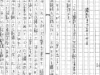
This cast list is also a copy I made of a handwritten poster posted behind a short diagonal hanamichi stage left.
The area around the Shirahige Theater was also a district of low-roofed, blackened, soot-stained wooden houses in Tokyo’s lower town, which had narrowly escaped destruction in the American air raids.
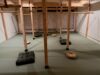
It was a rather improvised production, using a slightly modified, fire-scarred, run-down movie theater converted into a makeshift stage.
The theater’s front and back, the dressing rooms, everything looked visibly poor. There were absolutely no programs, synopses, printed flyers, or posters. It was, after all, the immediate postwar period, a time when all supplies were scarce.
I had never heard of the play “Ishii Joemon.” It wasn’t mentioned in old theater books or kabuki magazines. It seemed like the kind of play only staged in small-time theaters.
Set in the glamorous Yoshiwara pleasure quarter, it was a play that mixed and mashed together stories like Konya Takao, Sukeroku, and Sano Jirozaemon.
Yet it was a bright, easy-to-follow story, thick with comedic flavor.
The decision to replace the heavy, serious Joruri piece like “Terutora’s Banquet” in the third act with the simple and straightforward “Ishii Tsuneemon” was undoubtedly the promoter’s request.
The maid at the courtesan house, Sakamoto Reiko, was an actress. This Reiko also performed at the Honjo Kotobuki Theater. Her name appears in the playbill.
In other words, “small plays” meant that when there weren’t enough actors, actresses would also appear within the kabuki performances. After this, several actresses would perform with the Takejaku troupe.
On the stage of “grand kabuki,” actresses could not appear, except for child roles. Any female role, no matter how minor, was played by an onnagata.
Breaking this rule would mean kabuki ceases to be kabuki.