← Back to the Nureki Chimuo Archive
Handwritten Flyer
The conversation stalled when we reached the Tsurukame Theater, and after that, it just wouldn’t move forward.
While repeatedly writing about this era, some parts have overlapped, making things a bit confusing.
I’ve lost track of how far I’ve written myself.
I’ll take the plunge and move the story forward significantly.
“Okawa Kogyosha owned not only the Tsurukame Theater but also a small theater called the Shirahige Theater on the east side of the Sumida River.
This theater, too, was originally a movie theater that had been remodeled.
The indiscriminate bombing by the American air force was particularly severe from Honjo to Fukugawa, causing many deaths, but this corner of Mukojima miraculously survived the fire.
They widened the movie theater’s stage, extended a small hanamichi, added a curtain, and made it suitable for plays.
Okawa Kogyosha divided the ‘Hanagata Kabuki Troupe’ from the former Kotobuki Theater in Honjo Midoricho between these two small theaters, the Tsurukame Theater and the Shirahige Theater, and had them perform alternately.
They separated the two stars, Bando Tsuruzo and Bando Takejaku, assigned actors to each, and formed two theater companies.
In essence, the ‘new’ Hanagata Kabuki became two separate troupes, one led by Tsuruzo and the other by Takejaku.
They then staged performances at the Tsurukame Theater and the Shirahage Theater, alternating weekly.
Ichikawa Fukunosuke was an onnagata in the Bando Takejaku troupe.
Therefore, as Fukunosuke’s disciple, I naturally became a member of the Takejaku troupe.”
In the sixty-eighth installment of this “Talking Theater,” I wrote about the above.
I intended to continue from there, but my memory has scattered, and I don’t know where to begin.
After several days of hesitation, I had an idea: I’d simply transcribe my diary entries from that time.
That way, I’m sure I’ll be able to move forward easily.
I crawled on my stomach, burying my head deep inside the closet crammed full of old books and documents.
Covering myself in dust, I laboriously dragged out a cardboard box shoved into the darkest, farthest corner.
Opening the lid, I found over thirty diaries from more than sixty years ago (Oh, it really has been over sixty years!) packed tightly inside, lying silent.
(Yes, to me, those diaries felt as if they were breathing.)
But then I started wondering again, what’s the point of writing about things from sixty years ago now?
That feeling and the feeling that I must write are constantly intertwined within me.
But anyway, I searched for the one volume that should have notes on the plays performed by the Bando Takejaku troupe.
It was hard to find. My hands became covered in dust. I sat down in front of the closet and, taking my time, finally found that one volume.
It was a diary, its corners worn down and tattered.
When I opened the pages, there were the pen strokes I had written over sixty years ago.
There, unmistakably, was the me from sixty-odd years ago, a disciple of Ichikawa Fukunosuke and a member of the Bando Takejaku troupe.
Not only the plays I performed, but my daily life back then and the feelings of my heart were etched within. The blue ink letters truly seemed to breathe.
I found myself engrossed in reading the pages I had opened.
Within those words was a me that was not the me of today.
The me in my memory should have been living happier, brighter days during this time.
The me in the diary spent each day in anxiety and doubt, lost, tormented, and starving.
While it’s common for adolescence to be troubled, the image of the boy here was pitifully, almost cruelly, painful.
Calling myself pitiful is perhaps self-indulgent, but after more than sixty years, one can see oneself as objectively as if one were someone else. So please forgive me.
When I say I was starving, it wasn’t just spiritually. I was actually, physically starving.
The war had ended, and the bombing by the American air force had ceased, but a food shortage was upon us.
I suffered from hunger pangs, constantly living with the awareness of starvation right behind me.
That fear of death was more immediate, more vivid, and present around the clock than the American bombing raids over Tokyo.
I was as thin as a skeleton.
(And what of me now? Horribly ugly and slovenly fat. It’s because I gorge myself daily without restraint. Flab bands loosely around my belly, my back has stooped, my legs have shortened. I’m so hideous I can’t bear to look at myself in the mirror. Out of sight, out of mind.)
Over sixty years ago, I was a thin boy with a fragile, vulnerable heart.
But now, when I look back on that time, only the images of a boy living joyful days, filled with bright hope, right after the war ended, comes to mind. All I have now are sweet memories. That’s why this “Talking Theater” is filled only with pleasurable recollections.
I’m getting too carried away. I’m trying to write only about pleasant things.
Over the long years, I’ve forgotten all anxiety and suffering, leaving only the sensation of pleasure lingering in my mind and body.
But the diary from over sixty years ago brought back the days of anxiety and suffering with raw, vivid realism. Perhaps it was the power of the boy’s handwritten words, carved out one character at a time.
But I shall refrain from detailing here those anxieties, doubts, skepticism, and suffering.
For now, I must force myself to brighten my mood and write about the plays performed by the Takejaku troupe.
Otherwise, this “Talking Theater” won’t move forward. Right, first, I’ll just list the plays performed by the Takejaku troupe. Then, somehow, I’ll push this writing forward.
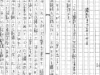
Tsurumake Theater 1. Chidori Tsukishiro Nagare: Before the Torii Gate. Act One
Matsushima Chita………Sawamura Kisaburo Benten Teru………Ichikawa Fukunosuke Tokuzo………Umezawa Hideo Akashi Shimazo………Bando Takejaku
2. Comedy: The Substitute Servant. Three Scenes (Okawabata, Before Kuroda Residence, Inside Kuroda Residence)
Kuroda Sakyo………Sawamura Kisaburo Servant Kompei………Onoe Takenosuke Chikuan………Ichikawa Fukunosuke Kuroda’s Servant………Umezawa Hideo Kuroda’s Servant………Ichikawa Fukujiro (Nureki) Takaoka Ryunosuke………Bando Takejaku
3. Battle of Kawanakajima: Terutora’s Banquet Scene
Mother: Karakami………Onoe Takenosuke Daughter: Masaru………Ichikawa Fukunosuke Terutora………Bando Takejaku
This was a note-like description.
Nothing else is written. This was scribbled in the margins of my diary in October 1945, when I was fifteen years old.
I now wish I had recorded the exact date and time of the performance, the duration, the admission fee, and the number of audience members in greater detail.
But thinking about it, a fifteen year old child could hardly have had the mental space to accurately document such factual information.
Back then, I simply wrote things down as I felt, following my emotions.
“Simply as I felt, following my mood and emotions” is because these characters are written in a copycat style of Kanto-ryu calligraphy. A faint Kanto-ryu written with a pen and blue ink.
This title and cast list were copied from a poster displayed on the wall behind the left-side hanamichi on the stage of the Tsurukame Theater.
That poster, too, was a very crude, single-color ink affair, likely written by someone at the theater.
It was the period immediately after the war, when Tokyo was littered with burnt ruins and every kind of material was in short supply.
There was absolutely no synopsis or anything resembling a program.
There were no printed promotional posters either.
The only advertising consisted of small, handwritten, single-ink-color posters plastered on utility poles around town.
Even so, the customers came. It was an era when entertainment was the only thing available.