← Back to the Nureki Chimuo Archive
The Smell of Mud Paint
Adjacent to the Tsurukame Theater stood Katsushika-so, a dilapidated two-story wooden apartment building.
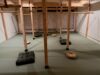
Ten rooms lined each floor, with each unit partitioned into a single six-mat room like a matchbox. Toilets, kitchens, and baths were shared.
Upon removing shoes at the first-floor entrance, a hallway ran straight through the center to the back, flanked by five rooms on each side.
The staircase to the second floor was immediately to the right beside the entrance.
At the top of those stairs stood a large wooden shoe rack used by all the residents.
The second floor similarly had five identical six-mat rooms on each side, separated by a central hallway.
It felt less like an apartment and more like a dormitory for single people. There was nothing superfluous or decorative about it.
At the end of the hallway were the shared kitchen and toilet. The bathhouse was only on the first floor.
Actors and stagehands performing at the Tsurukame Theater were permitted to use the entire first floor of this Katsushika-so, adjacent to the theater, as dressing rooms.
This was because the apartment building itself was also owned by the Okawa Entertainment Company.
The people renting the rooms on the second floor were ordinary individuals with no particular connection to the theater.
Only those whose homes had been burned down by American air raids lived in the ten rooms on the second floor.
Ichikawa Fukunosuke, a male actor playing female roles, was given the room with the best sunlight, closest to the theater’s back entrance.
“Compared to the Kotobuki-za, the theater itself is a bit shabby, but the dressing rooms are surprisingly splendid, aren’t they?” All of Fukunosuke's regular patrons who visited the dressing rooms for the first time remarked with admiration.
At the entrance to the room hung a splendid purple noren curtain, embroidered with the characters, “For the Honored Fukunosuke Ichikawa, His Beloved Yori.”
Simply lowering this single noren transformed the bleak dormitory-like atmosphere into a vibrant, lively space.
All the regular patrons referred to the Kotobuki Theater as “Kotobuki-za.”
This was likely because it had been called Kotobuki-za for so long. Even my father called it “Kotobuki-za.”
Even now, over sixty years later, whenever I hear or say the word “Kotobuki-za,” something warm and nostalgic, like tears, resonates deep within my chest, trembling and overflowing. Kotobuki-za might have been the place where I existed, in some insect-like form, before I was born into this world.
Thinking of “Kotobuki-za” plunges me into a mood filled with affection, lukewarm and sweet, impossibly soft and gentle, like being drawn in, body and soul.
Why does that little theater in Honjo Midoricho hold such charm and affection for me?
I’ve asked myself this question many times before, but I still don’t know.
Fukunosuke had an attendant who was called “the head clerk.”
She was a middle-aged woman named Nakajima, who had served as Fukunosuke’s attendant for over ten years.
She dressed Fukunosuke in his stage costumes, undressed him, and handled all the other minute details of his personal care.
It was from Nakajima-san that I learned the customs of the actor’s world, dressing room slang, and the essentials of being a disciple of an onnagata.
But even after a month, I was still not allowed on stage.
I didn’t care if I didn’t have any lines, I just wanted to put on makeup, wear a wig, don period costumes, and step onto the stage.
When I told Nakajima-san this, “Well now, it would be impossible to suddenly give you a speaking role as an onnagata. But since this is a small troupe without many members, I think you’ll eventually get a minor role.”
Her cheekbones were sharp, and a large gold tooth gleamed in her mouth, giving her a somewhat intimidating appearance at first glance. But Nakajima-san was a kind auntie.
“Oh my, you’ve been watching our master’s plays since the Kotobuki-za days? How reliable of you. But when you say Kotobuki-za days, you were still in elementary school, weren’t you? Huh, your father took you to see him. Your father liked our master too, didn’t he?”
By “master,” she meant Fukunosuke.
We were taught to call him “master” (oyakata), not “teacher” (sensei) or “master” (shisho)12.
When a patron who had been loyal to Fukunosuke since the Kotobuki-za days came, Nakajima-san would step back slightly and always introduce me.
“This is Fukujiro, who has recently become my master’s apprentice. With a theater like this, I believe he’ll be able to take the stage soon. I humbly ask for your continued patronage.”
She would then place both hands on the tatami mat and bow respectfully. I would do the same, pressing my forehead to the tatami and bowing.
Then, those patrons would say “study hard” and give both me and Nakajima-san a gift of money.
Such patrons were mostly middle-aged women, dressed in kimonos that looked of good quality.
I thought to myself, “They must be people whose homes weren’t burned down in the war.”
In Japan, there are different ways to refer to a superior. Oyakata is master in the sense of a production or artisan. Shisho can mean master, teacher, or stable master of a sumo stable. Sensei is a well known word, but can mean teacher, master, doctor, etc.
Around this time, I was keeping a fairly detailed diary, intending to go to school, but I didn’t write down how much money was in the gift envelope.
I think I had this feeling that writing down how much I received would be vulgar.
Yet I clearly remember how overjoyed I was when I received it.
It was the first gift money I’d ever received after entering the theater world.
Looking back now, I should have written down the amount.
In that immediate postwar situation (when many people in Tokyo were still living in hand-dug air-raid shelters underground), the amount in that gift envelope I received is undoubtedly precious information now, yet I have absolutely no memory of it.
Was it one yen? Five yen? Ten yen?
No, ten yen was a lot of money back then. It was probably closer to one yen, wasn’t it?
The general prices of food and other items during that era called inflation can be roughly understood by looking at the charts in the reference books.
But when it comes to congratulatory money, there are no set rules, so it’s impossible to guess.
It truly reflects the giver’s genuine feelings toward the recipient.
In a small, quiet theater tucked away in a corner of Tokyo, still scarred by war, where a fifteen-year-old boy took his first steps toward becoming an onnagata, how much hope did those women place in him.
It was an era when all culture and performing arts were at the mercy of the American occupation forces.
Plays themed around revenge, like “Chushingura,” were all banned.
It was the year of defeat, with no bright light visible for the future of kabuki theater.
By the way, I must write down the circumstances of why I became a disciple of Ichikawa Fukunosuke.
I had known of Fukunosuke’s existence since elementary school, but only from watching his onnagata stage presence from the audience seats.
I wasn’t particularly captivated by Fukunosuke alone.
I loved the overall atmosphere of the kabuki plays performed at Kotobuki-za.
Fukunosuke, of course, didn’t know anything about me. He didn’t know my father either. Both my father and I were just two members of the audience.
It was a kabuki actor named Kataoka Tobei who first brought me to the Tsurukame Theater.
I met this Tobei, believe it or not, inside the Hitachi Works Kameari Factory.
As the war drew to a close, I, my classmates, and our seniors were all taken out of the classrooms under a government directive called “student mobilization.” We were made to assist with the work of manufacturing weapons inside the dozens of enormous buildings, alongside thousands of laborers.
Middle school back then was a five-year program. By the time we were upperclassmen, our physiques were already nearly adult.
Inside the factory with its absurdly high ceilings, heavy iron machinery roared incessantly from to night, from night to morning, twenty-four hours a day.
I absolutely hated that bleak view and the unappealing smell of machine oil.
We weren’t told what weapons or military equipment we were making. It was supposedly a military secret (though there were rumors it was heavy-duty tanks), but I disliked such heavy labor and had absolutely no motivation to do it.
In the language of the time, I was a terrible “non-patriot.”
I appealed directly to the teacher leading our group, “If this continues, I’ll die. Dying won’t serve the country. Please let me do work suited to me.”
The teacher was an art instructor who had always been kind to me. Since elementary school, I’d excelled at drawing and composition.
Thanks to the art teacher’s recommendation, I was transferred to the Public Relations Section of the Welfare Department, a place free from the oppressive sounds and smells of heavy black machinery.
The Public Relation Section was located on the second floor of a shabby barracks building, far removed from the massive factory complex where deafening noise echoed twenty-four hours a day.
I breathed a sigh of relief. That flimsy, wooden-plank shack looked like heaven to me.
There, every day, posters were created to encourage and admonish the workers, to destroy the US and Britain, to ensure the divine nation’s immortality, to boost production, and to raise morale.
“Immortality of the divine nation” meant that Japan, being a divine nation, would never perish and could never lose the war. It was a shameless, foolish phrase.
It’s hard to believe now, but every single poster was hand-drawn.
The completed posters were then sent out to Hitachi’s various factories scattered throughout the Kanto region.
There were seven or eight members in the Public Relations Department.
Except for the department head, every single one of them had been conscripted.
The term “conscription” is almost a dead word now.
When I was a boy, I heard it daily and was forced to read it. It was commonplace language.
I looked it up in the dictionary just to check.
“Conscription. The act of the state summoning citizens and forcibly assigning them to specific work.” It says. Student mobilization was also a form of conscription.
No one defied the government’s orders.
It was an era where criticism or resistance meant being hauled off by the police immediately.
In the Public Relations Section, there was a Western-style painter affiliated with the Pacific Art Association.
I had this person review my sketches every day. He evaluated my crude drawings sincerely, earnestly, and sometimes harshly.
It wasn’t a workplace senior-junior relationship. With the mindset of master and apprentice, he taught me the heart and technique of painting.
I will never forget the name of this sincere and earnest painter for the rest of my life. His name was Ichiro Madokoro. He is my mentor.
Besides this painter, there were also two junior high school art teachers in the Public Relation Section.
There was also an artist who made living drawing pictures for kamishibai.
There was a sign painter from town.
There was a teacher of composition.
Age-wise, they were all men who could no longer be soldiers.
That is, they were all over forty, unfit for physical labor. In other words, a gathering of intellectual types.
When I learned this, I cried out in my heart and rejoiced, “This is paradise! Heaven!”
Naturally, I was the youngest.
Why were those people so kind?
Why were they so kind when American forces bombed from the sky almost every day, destroying parts of Japanese cities, and though the numbers weren’t made public, countless defenseless civilians died in each air raid?
How could those adults maintain such kindness while working in a corner of a massive weapons factory, knowing they might be killed tomorrow?
I learned the tasks assigned to me with a spring in my step.
Within less than a month, I had become accustomed to the work in the Public Relations Section and was drawing posters like a pro.
Because it was something I enjoyed, I picked it up quickly.
Happy days followed.
The seniors around me, well, more than seniors, everyone was like a teacher to me, answered any question I had without complaint and taught me everything.
They patiently showed me everything, from how to mix mud-based paints (since poster colors were now a luxury item, production had stopped) to how to boil animal glue.
The intense smell of mud paint mixed with animal glue made me feel the scent of art, and I almost cried.
No matter how poor the quality of the materials, paint carried no smell of war.
No matter the theme, the work of drawing pictures and writing characters with paint and brushes was enjoyable.
I drew a poster of Roosevelt with a Japanese Air Force bomb stuck in his head, dead and lying in a coffin.
Next to the coffin, I wrote, “The final victory is ours!”
Roosevelt was the President of the United States at the time.
The section chief praised this original poster I created, and I drew a hundred copies by myself, which were posted all over the vast factory.
Orders came in from other factories, and I drew another hundred.
Even as a child, I thought that drawing and posting hundreds of these posters would be unrealistic and, far from boosting morale, would only be a waste of paper. But I suppose they wanted to add a little color to the bleak factory interior.
I drew the blood flowing from Roosevelt’s head in a somewhat poisonous color.
By the way, R-san.
Do you find my writing like this interesting to read?
I’m starting to feel anxious.
I don’t think this era is something I’d get so absorbed in writing about, but now that I’ve started writing like this, it is still somewhat interesting to me.
Or rather, if I thought it was boring, I wouldn’t feel like writing at all.
I started writing about this Public Relations Department because I wanted to tell the story of how Kataoka Tobei-san took me to the Tsurukame Theater.
But somehow, the stage shifted to the Public Relations Section of the weapons factory.
Since school was gone, I wrote earlier that I kept a meticulous diary every day during this period instead. I’m writing this now while rereading that diary.
It’s filled with the emotions of a boy, so I find myself tempted to ramble on with unnecessary details, and I’m trying to restrain myself.
It was within this Public Relations Section that I met Tobei-san, the actor.
So, in terms of sequence, I explained the workplace for those unfit for factor labor, those unable to lift heavy objects, amongst all the conscripted workers. But I ended up going on too long.
Yet, I find myself wanting to write a little more about my time in this place.
Alongside training in drawing and design lettering, I also studied acting in this workplace.
I had always thought I would have to write about those things someday.
Taking advantage of the opportunity given by R-san, I’d like to write a bit more about the time between fifteen and sixteen. What do you think?