← Back to the Nureki Chimuo Archive
A Poem from Sixty Years Ago
I am a third-rate writer (san-mon).
For those who don’t know what “san-mon” means, I’ll look it up in the dictionary I have on hand.
“San-mon”: The price of three mon coins. An extremely low price. When attached to other words, it conveys meanings such as “cheap,” “of low value,” or “poor quality.” Examples include “ban,” “novel.” and “writer.”
A “san-mon writer” refers to an inferior writer, or is a derogatory term for a writer.
To belittle myself by calling myself a “third-rate writer” or the like feels rather self-deprecating and embarrassing. But deep down, that is truly how I feel.
Even though I feel that way, I’ve been writing for a long time to make a living, so I do take a little pride in it, and when I’m praised occasionally it makes me happy. It makes me feel as if I’ve reached the heavens.
In May 2008, Nakahara Rutsu-san of the Sex Industry Museum wrote an essay titled “Another Side of Nureki Chimuo: A Life of Frenzied Writing” for the “Commentary” section of my sixth paperback book, which was published in quick succession by Kawade Shobo Shinsha around that time and I was truly delighted by it.
It wasn’t just perfunctory, formulaic praise. She had painstakingly read through my past writings (which, if nothing else, are incredibly numerous) and I was deeply grateful for that.
I was so moved by Nakahara Rutsu-san’s “Commentary” that I felt I would gladly take the reins of this person’s horse and, as a mere servant, die in battle right in front of the horse if war were to break out.
I reread it over and over again and it filled my heart with warmth. While I felt a bit embarrassed that the praise might be excessive, I was deeply grateful from the bottom of my heart.
In particular, the brilliance of the few lines Nakahara Rutsu-san wrote at the very end of this “Commentary” still captivates me to this day.
“... The reason why ‘Nureki’s Kinbaku Diary,’ included in this book, ‘Bondage: As Long as I Live,’ resonates so realistically with enthusiasts is not merely due to the meticulously rendered details or the skillful writing alone, just as with the numerous novels I’ve briefly introduced so far. A work that deeply explores its author’s world of pleasure resonates with readers who share the same vibrations of pleasure, conveying the softness of pale skin, the sweet fragrance rising richly in the air, the moist texture to the touch, the suppleness of the wrists, and the ecstasy and rapture that feel as if the blood is surging backward throughout the body.”
I was both surprised and filled with admiration for Nakahara-san's flexible sensibility as a writer, which led her to describe my clumsy writing as “the suppleness of the wrists.” This commentary on my novel has become something I will never forget for the rest of my life.
Now, four years later, a new reader has emerged who is reading and evaluating my past novels from a slightly different perspective and standpoint.
It is Mr. Akiyoshi Otaguro, who frequently appears in this “Talking Theater.”
(This is a pseudonym I gave him, and partway through, I began writing his surname as “Akiyoshi (秋良)” instead of “Akiyoshi (明良).” It’s closer to his real name. However, in a manuscript he recently sent me, his signature reads “Akiyoshi (秋良).” I suppose he prefers “Akiyoshi (秋良)” to “Akiyoshi (明良).” Therefore, I will refer to him as “Akiyoshi (秋良)” from now on.)
I realized that Mr. Otaguro has been meticulously and sincerely examining my intellectual history, from the past to the present, as well as all of my works.
As I approach the advanced age of eighty-three and have become quite senile, he gave my forehead a sharp tap with his folding fan, awakening my half-dead brain.
I wrote “intellectual history of the past” somewhat grandly, but this is not merely the past.
He has dragged my writings out from beyond the memories of a time long, long ago, memories that I myself had completely forgotten and cast aside.
I was stunned.
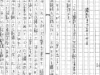
In 1952 (sixty years ago), my poem had been published in a monthly magazine called “Jinsei Techo” (Life Notebook), published by Bunri Shoin, a publishing house located in Kikui-cho, Shinjuku, and Mr. Otaguro had managed to track it down.
I will transcribe that poem here.
The Death of a Young Woman
Haru-chan Even after you drew your last breath, Even after you were taken to the morgue The chamber pot and toilet you used Are still left there, abandoned in the corner of the bathroom How much pain must you have been in? Haru-chan Your voice, struggling to endure the pain Could be heard all the way to my hospital room across the hall Your broken, choked cries calling for the nurse Squeezed my heart every night “We’re short staffed, So please don’t call us to often” An elderly nurse Hurled those words at you with a sharp tone And I trembled with seething rage Every time I heard them Using a dirty toilet And having to ask a nurse to help with that Haru-chan Since you’re a woman, and a young woman at that How agonizing it must have been Your death face, frozen in agony Spoke volumes about it And tonight, I can hear it again That deafening roar That made you cover your ears in sheer madness That piercing Sound of a fighter jet in a steep dive. Amid the foreign roar of explosions, gritting my teeth I think
We tuberculosis patients think About your death, about the reason for your death And about those who killed you About them, those who, in this hospital where we cannot move Are choking the very throat of this place Kicking us straight from our beds into a cold grave Those hateful enemies of ours. Haru-chan The urinal and chamber pot you left behind Are once again tonight Emitting a dull glow in the corner of the bathroom
Of course, I wrote this poem under my real name. The year, 1952, was Showa 27, and I was twenty-two years old.
The following year, that is, in the November 1953 issue of “Kitan Club,” I published a short story titled “The Traveling Actor of Pleasure and Torment” under the pen name Aoyama Mieyoshi. This was the first novel for which I received a writing fee.
During that time, I was also writing other pieces, such as anti-war poetry. At the same time, however, I was the kind of person who had begun writing SM novels.
Mr. Akiyoshi Otaguro, naturally knowing my real name, was the one who tracked down this poem.
“I thought it might be someone else with the same name, but I decided to bring a copy anyway so I could show it to you,” Mr. Otaguro said.
“That’s my poem, no doubt about it. It brings back memories. You did a great job finding it,” I replied.
I was sitting across from Mr. Otaguro at a coffee shop near my workplace.
He had found a poem I wrote sixty years ago, perhaps in another magazine, and made a copy to bring to me.
I plan to write about it next time.