← Back to the Nureki Chimuo Archive
“The Sunset Room” A Photobook of Boundless Abundance
In the March 2012 issue of “Mania Club,” Director Nakahara explains in simple, easy to understand language the rationale behind publishing this photo book, “The Sunset Room.” Among her remarks is the line “I want to create something with all my heart.”
In fact, even if we were to state this purpose now, this sentiment has long been present in the hearts of enthusiasts who have a passionate interest in bondage photography.
If I were to add a few extra words to Director Nakahara’s explanation, the gist of it would be, “This is a photo book created by a group of people who truly love bondage photography and came together with the sincere intention of creating the staged bondage photos that we ourselves want to see.”
I’d like to elaborate on that sentiment a little more specifically.
As an experiment, let me pick up a magazine that’s currently at hand.
It’s a color photo of a beautiful model in a sailor uniform, tied up outdoors with her hands bound behind her back.
It’s a bright, beautiful, and adorable shot.
This is, without a doubt, a staged shot. It is nothing other than a staged shot.
A young girl with cute makeup, bound with rope, is crouching quietly with a chubby face in the chilly outdoors.
There is absolutely no trace of a frightened expression or any sign that she is trying to escape.
There’s no emotion whatsoever, nor any sense of drama.
It is clearly a staged scene where both the photographer and the subject are in complete agreement. There is no friction whatsoever.
However, while it’s undoubtedly staged, for us at Tomoshibi, a group of bondage photography enthusiasts, this staged shot is completely unappealing, irrelevant, contrived, and boring.
The staged scene we’re talking about has a slightly (no, significantly) different meaning.
With this photo of a girl in a sailor uniform, the photographer who took it, and the director who commissioned it, are essentially saying to the reader, “How about that? Look at this cute girl, forced to wear a sailor uniform with a red scarf, tied up and dragged outside. Isn’t she pitiful? Isn’t it amazing? Doesn’t it get you going? This is what SM photography is all about.”
That attitude is painfully obvious.
(I, and many bondage enthusiasts, absolutely hate that blatant attitude. We enthusiasts have our pride. It even feels as though that pride, the sense of being “the chosen ones,” has been wounded. Contrary to the photographer’s and editor’s intentions, it just kills the mood.)
Why is it so obvious?
It’s because this beautiful young woman’s heart, even if it’s just an act, is completely absent from this heart-wrenching situation.
Both the director and the photographer are only trying to capture the form.
The model’s expression, her poses, and even the way the ropes are tied are all so masterfully hollow, nothing but form.
Do they really think that just showing the form will make enthusiasts happy?
(Huh? What’s that? You’re saying the photographer’s eyes only see the form? No way!)
Bondage photography isn’t just about capturing the form of a bound beautiful girl.
(Oh, man, I’m being so persistent. But the more persistent I am, the angrier I am.)
To put it bluntly, we enthusiasts are moved more by the heart than by the form.
(Come to think of it, “Yataro of Shimokita,” which I have written about twice in a row in this “Talking Theater” column and still haven’t finished covering, is a play I saw ten days ago that didn’t feature any ropes or bondage at all. Yet it was precisely because it had heart that
both Director Nakahara and I were moved, and that emotion still hasn’t faded. Which is why it’s still smouldering within me.)
I think the reason photographers and directors who produce this kind of bondage photography end up looking down on us enthusiasts is that they’re ultimately viewing us from a superior perspective. At the very least, they must be convinced that, “If I take photos like this, the enthusiasts are sure to be delighted.”
On set, they probably give the model endless instructions. Do this, do that, make that face, and shoot based on their own subjective preferences, whatever suits the photographer best.
Every time a professional photographer orders the model to “look this way,” “look that way,” or “make a pained expression,” the most alluring, sensual, and intriguing essence of SM, the very essence of a bound woman, fades away from both her expression and her posture.
Who would say, “Ah this is delicious,” after being forced to drink stale bancha tea?
This photograph of a beautiful young girl in a sailor uniform, bound and crouching outdoors, is undoubtedly staged in its own right, but it’s not the kind of staged imagery we at Tomoshibi refer to.
We must say that what we consider a staged image is something that “resembles the real thing but is not the real thing.”
Huh? Yes, yes.
Okay, I didn’t realize we’d gone off on a tangent.
I had actually started writing about the first photo book we published at Tomosbibi.
But thanks to all that extra chatter, I think you now have a concrete understanding that the bondage photos in “The Sunset Room” aren’t just staged shots.
I’ve already covered the content several times throughout this “Talking Theater.”
It’s structured around a simple story.
Photographer Yamanouchi didn’t say a single word to Hiromi Saotome, who was tied up by me, regarding her expressions or poses.
Even before the shoot began, Saotome had fully immersed herself in the role of the heroine.
Photographer Yamanouchi knew very well how instructions or requests given right before the shutter was pressed could ruin the atmosphere of submission.
The one at fault was me.
My habits from previous shoots came out, and I ended up saying unnecessary things and making clumsy, staged-looking, wasteful movements out of self-consciousness toward the camera.
Each time that happened, Director Nakahara would shout out a sharp, unsparing reprimand.
Director Nakahara, whose role had initially been that of a production coordinator on set, had, before I knew it, become a cutting-edge director.
Since her reprimands and instructions were always spot-on and reasonable, we had no choice but to follow them.
Both the photographer and Saotome began to follow her instructions to the letter.
Or rather, we had met and discussed the purpose and objectives of this photo book many times before the shoot even began.
Even without reaffirming it now, the four of us had been in complete agreement on our goals from the very beginning.
As for the content, let’s stop rambling on about it any further.
Compared to commercially available photo books of this kind (though perhaps we shouldn’t even compare them, this is a completely different kind of book), it may seem thin and meager at first glance, but the content is, without a doubt, nothing but a collection of exquisite bondage photographs, each one substantial and full of character.
Just to be clear, the model remains fully clothed throughout.
There isn’t a single photo showing a model stripped naked, with her legs spread in an M-shape and a foreign object inserted. There isn’t even a hint of that. There is zero skin exposure.
Furthermore, there are absolutely no decorative or patterned binding styles that might suggest rope play. The woman is bound with an extremely rough, realistic, and harsh intensity.
This is a photo book designed in such a way that it will hold absolutely no interest for those who prefer conventional, mainstream eroticism.
Only those with a broad and fertile imagination will be able to savor the unfathomable depths of pleasure offered by “The Sunset Room.”
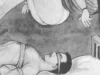
Amid a palette of mostly dark tones, a single woman lies bound, gasping for breath.
This woman belongs only to you. A man appears and disappears beside her. For the sake of the story, it’s me who appears there, but in reality, it is you.
The woman, tied to a pillar, moans and writhes under a tight gag made of a hand towel.
Her heart-wrenching, ragged breathing seems to burst forth from the photographs.
The woman’s agony in that moment was more than just staged. It conveyed a realism that transcended the stage, resulting in a chilling photograph.
Just before she is gagged with two or three layers of cloth, her mouth is stuffed full of white rags.
Director Nakahara, who ordered me to do that, is incredible.
Saotome, who endured it while making pained throat sounds, is also incredible.
Photographer Yamanouchi, who captured it all with such composure and calm, is amazing.
Before editing, I showed just one copy of this gagged photograph to El Bondage-san. He took it in his hands, stared at it intently for a while, and then said, “It’s obscene! It’s obscene! I’ve never seen such an obscene photograph!”
The expression on this painter’s face as he let out that growl was also truly remarkable.