← Back to the Nureki Chimuo Archive
“Sun in the Last Days of the Shogunate” and Conger Eel Bowl
I went to see the Nikkatsu film “Sun in the Last Days of the Shogunate.” As usual, Director Nakahara accompanied me.
It hasn’t even been a week since I saw “Seven Samurai.”
I’m trying my best to convey the knowledge I currently possess, however limited it may be, to Director Nakahara.
I consider this my mission, even if it seems futile.
She receives and understands what I’m trying to convey with such sharp and rich sensitivity that she expands it two or threefold, which makes it all the more rewarding.
Watching “Seven Samurai” and “Sun in the Last Days of the Shogunate” repeatedly is, of course, a learning experience for me. Ultimately, it is a study for my own sake.
Good works have a vitality that allows for new discoveries no matter how many times you watch them, and they have the power to stir up the spirit that tends to grow with age.
“Sun in the Last Days of the Shogunate” is, as expected, fascinating and meticulously crafted. I couldn’t take my eyes off the screen for even a second.
Just like “Seven Samurai,” I’ve watched it repeatedly since its 1957 release. Until now, I’d only been impressed by Frankie Sakai’s witty and elegant performance, which perfectly embodied his role, but this time I was once again struck by the script's elaborate and flawless structure.
This story is based on “Izorini Saheji,” one of the well-known kuruwa tales, and weaves together “Sanmai Kisho” and “Shinagawa Shinju,” while also incorporating elements from 7
Ironically, this film is also called “The Last Samurai,” but this particular film was released in 1957.
“Gonin Mawashi,” “Osetu Tokusaburo,” and “Omitate,” and includes a few episodes reminiscent of the Kamigata rakugo story “Oyako Chaya.”
Furthermore, it even incorporates “Bunshichi Mottoi” in the mix, all done with remarkable skill and seamless integration.
The screenplay lists three names, one of whom was the future master, Shohei Imamura.
As for the character of Kanzo, the rental bookshop owner in “Shinagawa Shinju,” I found Shinsho’s portrayal of Kanzo at the Suehirotei in Shinjuku ten or twenty times more entertaining than Shoichi Ozawa’s, but since the film doesn’t focus on this story, there’s nothing to be done about it.
Director Nakahara watched it purely as a moviegoer and, as expected, was moved by it even more frankly than I was.
I trust her discerning eye more than anyone else’s.
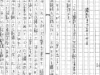
After the screening, she bought a program that included a detailed blueprint of “Dozo Sagami,” the Shinagawa brothel featured in the film. I was impressed by this thoughtful and sincere editorial touch. It makes for excellent reference material.
It is a blueprint of the elaborate, two-story brothel set, which was meticulously constructed.
Both the blueprint and the actual set were meticulously crafted. They were solidly built with a pleasing sense of realism, and it was a joy just to look at them. However, I actually have experience working inside a real, old, large wooden building of that kind, preserved in Higashi-Kanagawa near Tokyo Bay.
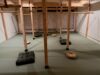
A few years ago, I was allowed to use one for several days during a shoot by the video production company CineMagic.
We filmed a drama there, in the wide staircases and hallways made of old, glossy black wood that seemed to have absorbed the scent of hair pomade and powder, and in the large hall lined with dozens of tatami mats.
I was one of the crew members.
The old, large wooden house itself had such an overwhelming presence that I felt the drama we were creating paled in comparison.
It was a wide, long, polished wooden corridor where I could almost hear the thudding sound of the thick-soled straw sandals worn by the women who once worked here.
So entranced by that atmosphere that my head felt light, I forgot my role as a bondage specialist and presumptuously began offering the director all sorts of unsolicited advice on the customs and language of the red light district.
I’m sure he must have thought I was a real pain in the ass.
But if we’re going to portray this specific world from that era, I felt it was only common sense that he should know at least this much…
Oh, if I keep writing like this, I’ll stray from the main point and start sounding like “Old Man Kikukichi8.”
So, back to the story.
The “meshimori joro” (prostitutes) of Shinagawa-juku depicted by Yuzo Kawashima in “Bakumatsu Taiyo-den,” as well as the men who flock to them, and the poor peasants and samurai portrayed by Akira Kurosawa in “Seven Samurai,” all of these could be described, from the perspective of the average person, as individuals who have strayed from the norm and fallen outside the mainstream.
Furthermore, the people that Tsuzuki-san so passionately depicts through his writing and photography are, just as the title suggests, the very inhabitants of the underground.
(This “underground” refers not to differences in wealth or social status, but to their spirit and way of life.)
To be honest, I actually sense a rich and profound element of sadomasochism in both “Seven Samurai” and “Sun in the Last Days of the Shogunate.”
If I didn’t sense the pleasure of SM, I certainly wouldn’t have been going to the theater every time they were shown, from their release over fifty years ago to the present day, and watched “Seven Samurai” and “Sun in the Last Days of the Shogunate” over a dozen times, excitedly and with great enjoyment.
The essence of these films, to put it simply, lies in the way they portray, with deep insight, analytical skill, and profound sympathy and affection, the desperate struggles of people driven to the ultimate crisis of body and soul. Their thrashing, rampaging, wailing in terror as they flee, and their acts of resistance.
8
Old Man Kikukichi is a term used to describe older people who criticize actors and the stage based on a belief that the Meiji-era 9th generation Ichikawa Danjuro and 5th generation Onoe Kikugoro, or the pre-war 6th generation Onoe Kikugoro and 1st generation Nakamura Kichiemon, were the greatest actors of all time. Basically, a term for people who critique modern theater.
The more exceptional an artist’s ability to concretely convey these joys, sorrows, and emotions, the greater the sense of tension and appeal, and the more engaging it is for the audience.
For me, as one member of the audience, it provides a form of sadomasochistic pleasure that excites me.
Both “Seven Samurai” and “Sun in the Last Days of the Shogunate” were made long before Director Nakahara was even born.
Yet (or perhaps I should say, precisely because of that), the fact that she experiences an even stronger and more intense emotional response than I do after watching these works leads me to believe she shares the same sensibilities as I do.
Since the nature and content of our emotional responses are identical, I naturally feel a sense of joy, as if to say, “You’ve hit the nail on the head,” and I want to clench my fist in delight.
That is the reason I ask her to accompany me to these kinds of films and plays.
Besides these two works, there are still many other old films that have given me a strong sense of SM stimulation (such as Mikio Naruse’s “Ukigumo”). If a theater were to screen them, I think I would invite her again to go see them.
As I mentioned briefly in my previous two posts, after finishing “Seven Samurai,” I went straight to Tsuzuki-san’s photo exhibition and attended a talk show featuring him, where I experienced the same kind of emotional resonance as I did with the film.
Then, four or five days later, when I watched “Sun in the Last Days of the Shogunate,” I once again sensed that same kind of SM quality emanating from the film.
I believe Director Nakahara felt the same way.
(No, actually, I think she felt it even more strongly and deeply than I did. I’ve seen it many times in the past and have built up a sort of immunity, but this was her first time.)
Immediately after the movie ended, even with my immunity, I was still buzzing with excitement, so I lured Director Nakahara into “Omoide Yokocho” at the west exit of Shinjuku Station, and we sat in a corner at the counter of a shop where a hunched over old woman was working as a waitress.
We shared the conger eel tempura from the tempura rice bowl as our appetizer, and while I sipped a lemon highball and she sipped an oolong highball, we talked about the drama we’d just watched, in which the late-night Saheiji was in fine form.
But at that moment, as I picked up a piece of conger eel tempura with my chopsticks, I recalled a scene from the kabuki play “Kawachiyama to Naosamurai.” Specifically, the scene behind the soba shop in Iriya, where the fugitive Naojiro Kataoka and Ushimatsu, hidden in the darkness, converse out of sight of the other.
“Unlike the town, in Iriya, the only food stalls are soba shops.”
“Drinking without tempura or an egg on the side is just a cheap trick.”
I had those lines lingering in the back of my mind.
The final scene of “Bakumatsu Taiyo-den,” where Ibaraki Saheiji slips out of Shinagawa-juku and races toward the seaside to see Dr. Hepburn in Yokohama to cure his increasingly severe tuberculosis, the eerily overcast sky stretching out before him, strangely overlapped with the closing scene of “Iriya,” where Naojiro, pursued by officials and burdened by a dark fate, flees barefoot through the snow.
(Come to think of it, that heartbreaking and tragic farewell with Mitsuzo at the Iriya Lodge is a drama brimming with SM undertones.)
I am currently writing an essay titled “Nureki Chimuo’s Testament of Obscene Pleasure” for a site called Web Sniper.
It’s a piece that can only be read online. But I do get paid a proper fee for it.
It’s a monthly serial, and this is already the twenty-eighth installment.
Recently, I began confessing about my childhood days, how, in the immediate aftermath of the war, I would spend my days in a desolate corner of a scorched out movie theater, gazing at the screen while indulging in masturbation.
Even though it was a long time ago, this is incredibly embarrassing, and I couldn’t have written it without a great deal of courage.
It was actually Tsuzuki-san who gave me that courage.
(Although he himself may not be aware of it. I’m sure he isn’t.)
Tsuzuki-san came to the apartment where I live and took photos of the room where I write my manuscripts, as well as my bed, kitchen, and bathroom (please refer to the paperback book “Chin Nippon Chouroden” by Kyoichi Tsuzuki, published by Chikuma Shobo. It’s full of photos of me and my room). He looked at the materials from my past that I pointed out to him, saying earnestly, with a wonderful, charming smile full of kindness and understanding, “I’d like to know more about your original starting point.”
It was not the smile of an adversary, but clearly that of an ally, a sincere smile, and I was moved by its earnest intensity.
I have encountered far too many enemies who mask their lewd curiosity with fake smiles, pretend to be allies, and then get uncomfortably close. There was no trace of that in Tsuzuki-san.
“I’d like to know what first sparked your interest back when you were much younger.”
Although the phrasing was different, when I was asked something along those lines again, I decided to write about my most embarrassing experience on Web Sniper, so that Tsuzuki-san could read it.
Now that I’ve started writing that section, I’m glad I did. It has given me new courage.
I get intoxicated by the sense of SM in films like “Seven Samurai” and “Sun in the Last Days of the Shogunate,” but at the same time, even when watching B or C-grade popular entertainment films, the kinds that critics completely dismiss, if a bondage scene appears for even a second or two, I’m in high spirits and get thoroughly excited.
That tendency was especially strong when I was young and full of energy.
The me who feels a sense of SM-like ecstasy and is electrified by “Sun in the Last Days of the Shogunate” and “Seven Samurai,” and the me who gets blatantly aroused and gets an erection from a single scene in a thoroughly popular swashbuckling film, I am, without a doubt, the same person.
Somehow, my thoughts have jumped all over the place, and this has turned into a rambling piece of writing.
I would be grateful if you could grasp the gist of what I am trying to say.