← Back to the Nureki Chimuo Archive
“Kuzunoha”: A Tale of Delusion
As I briefly mentioned at the beginning of my last post, Director Nakahara, photographer Yamanouchi and I sat side by side to watch the dance performance “Harakiri Kuzunoha,” performed solo by Hiromi Saotome.
It was an interesting adaptation of the classic kabuki play “Ashiya Doman Ouchi Kagami,” reimagined with a modern twist.
Saotome also gave a passionate and spirited performance.
The next day, I received a fax from the editor-in-chief of the magazine where I have a serialized essay column.
Along with the proofs for the next issue, there was a review of the previous night’s performance, written as follows:
“Saotome-san’s performance last night was wonderful, as expected of Saotome-san. The packed house held its breath, mesmerized by her artistry, watching in silence as if in a trance. I was deeply moved.” He praised her highly.
First of all, the staging was excellent, and the music was superb.
The lighting was also enchanting and fantastical. It was wonderful.
I’ve seen Saotome-san’s self-choreographed and self-performed dances several times before, but watching the performance sandwiched between two beautiful women, photographer Yamanouchi to my right and Director Nakahara to my left, was truly a delightful experience, and I felt compelled to record it.
In other words, although we were separated by the stage and the audience seats, the four of us from Tomoshibi were indeed gathered in a single space at that moment.
The first time I saw the play “Kuzunoha” was at the Kotobuki Theater in Honjo Midori-cho. I was an elementary school student at the time.
This kabuki theater in downtown Tokyo was tragically destroyed on March 10, 1945, due to indiscriminate bombing by the U.S. Air Force of the Honjo, Fukagawa, and Asakusa areas.
A young, beautiful, and popular onnagata named Nakamura Tsurutaro, whom I also admired, perished in the fire that night.
Until the theater was destroyed by fire, my father would take me, then in the lower grades of elementary school, to this theater almost every month, whenever the play changed.
Even as the war intensified, this theater continued to put on performances.
I watched the kabuki while wearing a cotton-padded air-raid hood.
My father was also wearing an air-raid hood.
Although they are now in tatters, I still have about ten copies of the Kotobuki Theater’s programs from that time, thin and made of poor-quality paper.
In the scene from “Kuzunoha: The Weaver” that I saw at this theater, Kuzunoha the Fox was played by Tsuruzo Bando, Abe Yasuna by Shinnosuke Ichikawa, and, naturally, Princess Kuzunoha was portrayed by Tsuruzo in a dual role with a quick change.
Tsuruzo had a plump, round build, and while I didn’t find him particularly handsome, his gestures and movements after revealing his true form as a fox were eerie, and his flamboyant, theatrical performance captivated my young elementary school heart.
Since then, even as an adult, I have continued to watch various actors perform “Kuzunoha” at major theaters.
The bizarre plot, in which a fox transforms into a human woman, marries a human man, and gives birth to a human child, was right up my alley.
Although the legend of “Kuzunoha” originally stems from the old Joruri tale “Shinoda-zuma,” I find myself inexplicably drawn to this kind of inter-species marriage. That is, tales of human-animal unions. I simply love them.
I have seen Sakata Tojuro’s “Kuzunoha” several times, dating back to his days as Senshaku.
I also saw the Bunraku production of “Ashiya Doman Ouchi no Kagami” just a few months ago at the National Small Theater.
In that performance, the fox’s movements were frighteningly realistic and agile, and the moments when it leaped through the air were thrilling.
And then, the climax of Kuzunoha the Fox’s sorrow after her true nature is revealed, the farewell scene where she leaves her own child behind with her husband… “…Ah, how shameful, how disgraceful. All those years spent hiding my true nature have been for naught. Now that my true self has been revealed, I have become a man who must part ways with my wife and children, severing all ties with them. I wish to tell my father of this, but if we were to meet face to face, I would be too ashamed to speak of my situation. Please listen carefully to what I have to say and convey it to my father. …I am not truly human. Six years ago in Shinda, I was hunted down by Akueemon, but my life was spared by Lord Yoshinaga. I am a fox, a fox that has blossomed anew like orchids and chrysanthemums, living for nearly a thousand years…. …To repay that debt of life, I transformed into the form of Princess Kuzunoha, ….(omitted) As I cared for and attended to her, the affection that grew between us, deeper than that of sisters, and the bond we formed as husband and wife made me realize that the importance and preciousness of a husband in this foolish, beastly world of the Three Realms is a hundred times greater than that of a human. …Especially since she gave birth to a child, with her husband and child on her right and left, the sweet words exchanged as they slept together, as if last night’s bed were their final resting place, even the supernatural powers of the wild fox seem to have vanished in the face of such tenderness and love… (omitted)”
There was an overwhelming sense of pathos in this scene of “parting from a child.”
The sorrow expressed in the final lines of the Joruri excerpt presented here is particularly heart-wrenching.
“…Especially after giving birth to you, I had many happy nights sleeping with my husband and child on either side of me.
I never imagined that last night would be the end of that happiness.
Even the formidable supernatural powers, the extraordinary, mystical abilities granted by the gods and Buddhas, of a fox spirit like me, who has lived for a thousand years, seemed to have vanished because of my love for my child and my husband…”
And here’s another thing I like about it.
It’s the few lines starting with “...since the time when husband and wife were still young.”
In other words, it’s a scene where she laments that ever since she was embraced by her husband, her love and devotion for him, even though she is a fox, often called a beast, are a hundred times deeper and stronger than those of any human…
(Well, I suppose some might argue that being loved a hundred times more deeply and intensely than a human woman would be a problem, it would be exhausting.)
However, the very person who was born from the womb of Kuzunoha, a fox possessed of this excessive, obsessive love, and who later became Abe no Seimei, wielding the formidable skills of a Onmyoji, is none other than the young boy from that time.
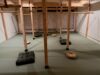
The staging of Hiromi Saotome’s dance drama “Kuzunoha” was particularly interesting, featuring three shoji screens set up on stage and making creative use of the shadows cast upon them.
Abe Yasuna, Kuzunoha’s husband, and the child born to the couple appear as shadows cast upon the shoji screens.
When the curtain rises, Saotome herself provides a concise narration summarizing the story so far.
From there on, the drama unfolds through music and Saotome’s dance alone. It is, quite literally, a one-woman show by Hiromi Saotome.
The highlight of the play is, of course, the message Kuzunoha leaves for her husband and child by writing on the shoji screens, “If you miss me, come and seek me out in the forest of Shida, where the spring flows, among the bitter leaves of the kudzu”
This must be that scene. You’ll understand what it means once you read it.
It is a note that says, “If you ever miss me, come visit me at Shinda Forest in Izumi Province, where I used to live. I’ll be waiting for you there.”
Since a fox’s hands are different from human hands, they cannot hold a brush.
In past performances, the actor playing Kuzunoha would hold the brush in his mouth and write these characters on the shoji screen.
This is called “kyoku-aki” (writing the lyrics).
Furthermore, because he is a fox, he writes only the characters for “Shinda no Mori” in reverse. In other words, the characters cannot be read correctly as “Shinda no Mori” unless viewed from the other side of the sliding door.
This climax is truly characteristic of Hiromi Saotome.
Set to the music, she performed her seppuku with deep emotion, grabbed her entrails with one hand, and with blood dripping from between her fingers, wrote this song on the sliding door with vivid passion.
Her white costume, reminiscent of a fox’s white fur, was stained with fresh blood.
(At that moment, I was suddenly reminded of Terushi’s performance. In the play, Terushi immediately cuts his own belly. The moment he does so, he spits out the red liquid he had been holding in his mouth with a “pfft” and assumes an expression of ecstasy. Terushi, enveloped in a demonic, decadent beauty, performs in a state of intoxication. In my mind, the images of Saotome and Terushi overlapped.)
The audience held its breath at the sheer intensity of the performance, completely captivated by Saotome’s alluring and powerful acting.
Even if she had left a note saying, “If you miss me, come visit me in the forest of Shida,” if Kuzunoha were to commit seppuku and die right here, wouldn’t they never be able to meet again?
Isn’t that a contradiction?
But then again, she is an ancient fox who has lived for a thousand years.
The lights dim, the sliding doors covered in blood-red writing are removed, and the stage is left with only a black cloth. In other words, this is Shida Forest.
Kuzunoha appears there, her form shrouded in her original, pristine white robe.
Truly, she is an ancient fox who has lived for a thousand years and even given birth to a human child.
Even the scars from her seppuku have vanished using her supernatural powers.
Saotome expresses this through music and dance.
Yet what remains etched in her mind are her beloved husband, Yasuna, and her child.
The figure of Kuzunoha, Saotome Hiromi, dancing madly and mysteriously, her thoughts fixed on the two of them.
The performance ended amidst her passionate performance. Applause erupted from the audience, and at that moment, I snapped out of my reverie. Terushi was gone.
The stage was shrouded in darkness, the beautiful dreamlike dance had ended.