← Back to the Nureki Chimuo Archive
The Mind of a Married Woman Held Captive
In the letter from Hiromi Saotome that I introduced last time;
“...Yes, my preference was for shoots that emphasized the premise of ‘why am I being tied up?’ Even on the set of photo shoots for SM magazines, I was always thinking up fictional scenarios in my head. Without a premise, neither my mind nor my body would respond. It is precisely because there is a sense of inevitability that my body reacts to the restraints and I can cry…”
There are a few lines like that.
Saotome writes this candidly and matter-of-factly, but in reality, these are important words carrying profound meaning.
(While they are important words, to tell the truth, they are actually quite obvious.)
One of the reasons we formed Tomoshibi was precisely this. To prioritize the setting and narrative leading up to the bondage itself.
It was Nakahara Rutsu who once again loudly advocated for this, and her advocacy was quite firm and compelling.
Both photographer Yamanouchi and I, of course, agreed.
Even if we don’t raise our hands to agree now, that is the only way to approach bondage photography.
To put it more bluntly, bondage acts that lack a setting, that is, a narrative, and a sense of necessity are nothing more than rope sport.
Hiromi Saotome says that in shoots where the sole purpose is bondage, with no theme or story, she creates a story in her own head.
What a poignant, endearing heart.
For the photo book series starting with “The Sunset Room,” currently in production by Tomoshibi, I first write the script, and Nakahara-san reads it and fills in the gaps.
Nakahara-san also carefully adds details to any parts where the direction was insufficient.
Then, the finished script is specially bound in a stylish format for use on set, and handed out to each person individually (though there are only four of us).
And it is handed out well in advance, more than ten days before the shoot.
Because this mental preparation is so thorough, it’s only natural that Saotome took the time to thoroughly study the script and delivered a great performance, fully embodying the mindset of the married woman, Hiromi.
By the way, following “The Sunset Room” and “The Horsetail Garden,” next up is “The Feel of Water,” which we’ll be filming soon.
As for this title alone, even the strict Director Nakahara Rutsu (who, as everyone knows, is the Director of the Sex Industry Museum) praised it the moment she saw it, “That’s great! Let’s go with this!”
But the real problem is the script.
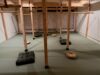
As I wrote last time, captivated by the mysterious atmosphere of the Yamanouchi residence’s bathroom, I’m determined to lock up the married woman Hiromi in that very spot and create some incredible bondage photos that will make my fellow enthusiasts go “Wow!”
The desire is like a karmic burden for me.
For now, rather than focusing on narrative, I’m obsessed with the allure of composing photos of a woman’s body in bondage, set against the backdrop of water in the bathroom.
However, since this is a shoot for Tomoshibi, where we place great importance on storytelling, aiming solely for interesting compositions would result in something shallow.
There is a well-defined backstory for the married woman Hiromi.
I must develop the story based on that backstory.
“The Feel of Water” must be connected to the story from “The Sunset Room.”
“So the main scene will be a confinement sequence set in the bathroom? That’s great. The image of confinement is excellent to begin with. I can really feel it. Confinement… a woman locked away in a single room… wonderful. There’s an emotional quality to it that suggests a narrative.” Director Nakahara, her large eyes gleaming darkly, is enthusiastic.
My vision for the bathroom shoot has been water torture from the start, but Director Nakahara’s vision is confinement or imprisonment.
I see. This difference in vision is interesting.
Each individual scene on set is already fully formed in my mind in concrete detail, but when it comes to writing the story leading up to those scenes into the script, that’s difficult.
It’s difficult, but I have to write it.
If I don’t write this and just shoot the torture scenes, the heroine, Saotome, will have to create the situation in her own mind and act as if it were real.
If that happens, there will be a disconnect between the actor’s mind and the director’s mind.
Likewise, if photographer Yamanouchi doesn’t genuinely empathize with the heroine, she won’t be able to take powerful, compelling photos that move the audience.
She must subtly adjust both the timing of the shot and the camera angle in accordance with the emotional shifts of the married woman, Hiromi.
Bondage photography must express the inner world of the woman being bound.
It’s not a world where simply photographing a naked crotch is enough.
When the loan shark, Tamaru, ties up the married woman, Hiromi, shoves her into the bathroom, and subjects her to water torture, his primary goal is to extract information about the hiding place of the man who borrowed money and then vanished.
At first glance, the married woman seems docile, but she actually has a stubborn personality and is tenaciously resisting the loan shark’s harassment and threats. This woman is infuriatingly stubborn.
The image I already have in my mind of a married woman being tormented is, after all, stereotypical and therefore somewhat conventional.
Although it is conventional, I believe it will make for a stimulating, good photograph for bondage enthusiasts. I am confident of this.
Even though it’s a water torture scene in the bathroom, I won’t strip the heroine naked.
If I strip her, the eroticism will be lost.
I tie up the married woman while she is fully clothed and subject her to the water torture. I pour water all over her body.
Or perhaps I’ll tie her up while she’s in just her underwear. I won’t expose her breasts. I won’t take off her panties either.
I’ll tie her up while she’s wearing a slip.
So, I have a request for Saotome.
On the day of the shoot, please bring a dress-like outfit made of thin fabric, something that clings to the body when wet.
By the way, I’ll note this here. In both “The Sunset Room” and “The Horsetail Garden,” the outfits worn by the married woman are Hiromi Saotome’s own clothes. In other words, they are the clothes she wears in her daily life.
I am confident in my ability to stage the sight of a bound woman writhing in agony while soaking wet.
On set, both Director Nakahara and photographer Yamanouchi will likely be taken aback by my direction.
I’ll have photographer Yamanouchi take photos that perfectly capture the essence of bondage eroticism.
In “The Feel of Water,” I will prove that bondage eroticism is not about spreading a woman’s legs, but about closing them.
I’ll create a photo so stunning that when Hiromi Saotome sees it, she’ll exclaim “Huh? Is that me? I’m so sexy!”
But the real challenge lies in the dialogue and the heart of the scene between the married woman and the loan shark.
I must write that into the script.
Writing the characters’ actions is easy.
But writing their inner thoughts is, as expected, difficult.
That’s because the psychology of people involved in SM is inherently complex.