← Back to the Nureki Chimuo Archive
The Terror of Being Dragged Around
The photo book we at Tomoshibi are currently producing is not a compilation of bondage photos originally published in magazines, a format that publishers frequently used in the past, but rather a collection of entirely new, original photographs that form a single narrative from beginning to end.
(Since we’ve included the script for this “Talking Theater” here, readers should already be familiar with it.)
Every single photograph featured here forms part of a coherent narrative.
The heroine being bound is the same person throughout.
When you think about it, this is an extremely rare kind of photo book. No publisher in the past has ever done anything like this.
one.
I myself have no memory of ever creating something like this, nor of ever appearing in
Moreover, as things turned out, the story of the second work, “The Horsetail Garden,” also serves as a continuation of “The Sunset Room.”
And since I’ve gone this far, I’ll just go ahead and mention it now. Preparations for the third work are already underway.
The story in this one is also neatly connected. It is the tale of a pitiful married woman tormented by a ruthless moneylender, and the title is “The Feel of Water.”
The location for the shoot is the home of Photographer Sachi Yamanouchi.
The main reason this bondage drama, which was originally intended to be completed in a single shoot, suddenly turned into a trilogy in the blink of an eye lies, in fact, in the charm of the Yamanouchi residence.
It simply has such a rich, distinctive flavor.
That flavor, of course, is exactly the kind we love.
I’ve already written about the charm of the Yamanouchi residence in “Talking Theater,” so I’ll skip the details here, but when we’re actually filming, an even deeper, subtle charm, or perhaps a sense of humanity, adds a dramatic mood and overwhelms us with an inexhaustible well of emotion.
After all, photographer Yamanouchi herself, peering through the camera’s viewfinder, exclaims in such wonder and rapture, “Wow, this feels so fresh. It doesn’t look like my room at all. Is this really the house I’ve lived in for years? Hmm, it looks completely different.”
That said, even though it’s a room she’s used to, the way Hiromi Saotome is positioned in such a perfect composition makes it seem fresh.
Although it’s not specifically for bondage shoots, they sometimes rent the Yamanouchi residence for photo sessions with other themes.
However, they say the impression of those works is completely different.
Photographer Yamanouchi says that simply adding Hiromi Saotome transforms a familiar room into a scene tinged with a sinister, immoral aura, an instantly stimulating spectacle.
“Well, part of it is that the presence of the unfortunate married woman portrayed by Saotome fits this room perfectly, but my SM sensibility comes into play when judging and deciding exactly which parts of this house to use and how to use them effectively,” I assert, seizing the moment to make my point.
If I don’t brag about things like this, I’ll never be able to hold a candle to the exceptional gravitas of the women of Tomoshibi.
Hiromi, a married woman, has a husband who is hopelessly addicted to gambling. He borrowed 1.5 million yen from a loan shark named Tamaru but never paid it back. He ran away from home and his whereabouts are unknown.
The core of this photo story is that Tamaru is persistently hounding Hiromi, believing that if he can keep her under his thumb, he will eventually find out where her husband is.
About halfway through “The Horsetail Garden,” Tamaru opens a drawer in the room without permission and discovers an envelope containing cash.
It is 100,000 yen that Hiromi’s husband had sent her via mail.
Tamaru gets angry when he sees this.
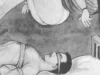
“You know where that man is hiding, don’t you? Tell me?” Saying this, he grabs the end of Hiromi’s rope and drags her all over the room.
For some reason, Nakahara Rutsu was particularly fixated on this dragging scene, saying with a passionate voice, glaring at me with wide eyes, “Now, let’s really nail this part. If we don’t shoot this properly, this bondage drama won’t hold together, Nureki Sensei. You understand, right?”
While she is the production coordinator, at this moment she is unmistakably radiating the intensity of a director with her whole body. Scary!
Since this wasn’t moving video footage, I thought, and even said out loud, even for a dragging scene I could just take breaks in between and slowly strike poses that looked the part. But Director Nakahara’s passion wouldn’t allow for such a compromise.
“A scene where a woman bound with her hands behind her back is being dragged around pitifully, that doesn’t exist in any footage or photograph to date. Even if the binding method is the same, there’s nothing that captures that kind of scene. That’s exactly why we have to act it out and film it properly,” Director Nakahara said, still glaring at me with those wide eyes.
“But it’s going to hurt Saotome-san a lot, with her whole body scraping against the tatami mats,” I said. After all, I am a feminist.
“Saotome-san, please do your best. This is a scene filled with a deeply masochistic emotion, symbolizing the fate of an unfortunate and pitiful married woman. So even if it hurts a little, please endure it, don’t fake it, and let’s shoot this thoroughly.” Director Nakahara was unusually fired up.
Saotome is a seasoned veteran actress, so she simply nods in silence. Though, since her mouth is tightly gagged with a hand towel, she has no choice but to nod.
I lower my center of gravity slightly, brace my feet, take a deep breath, and begin dragging her around. I grip the rope tightly.
Saotome’s body is petite, but because she is bound and deprived of her freedom, she feels heavy. Moreover, she tries to strike a defiant pose whenever she sees an opening.
I have to put some real effort into it if I’m going to move this woman’s body lying on the tatami mats. But even if I drag her with all my might, it won’t result in a sensual pose full of SM appeal.
Naturally, grabbing the rope and dragging her is an act, and turning her body on the tatami mats is an art.
(I wrote about this in quite some detail last time.)
I must move her rope-bound body while consciously aiming for an alluring, sensual pose worthy of SM appreciation, and furthermore, I must repeat the dragging motion as if timing my breath, all while taking into account the position of the photographer Yamanouchi and the angles she is aiming for.
I must not rush, and of course I must not rely on brute force. Yet, I must remain Tamaru through and through.
Saotome also fully embodies the married woman Hiromi, writhing her entire body and expressing the eroticism of a masochistic woman through movements of agony. Agony and hatred toward the loan shark.
Since this was a dragging torture while the gag was firmly in place, she gasped as if her throat were being choked, creating an even more ruthless and harsh spectacle and bringing out the pitiful atmosphere of a woman enduring the pain.
A heart-wrenching gaze, a realistic sense of pain that makes her chest and throat tremble. She has really studied the script well.
What deserves special mention in Saotome’s passionate performance in this intense scene is that not only the pitiable nature of the unfortunate woman, but also the resentment and hatred toward the ruthless loan shark are expressed in a tantalizing way through the eyes of the married woman, Hiromi, as a form of sensual allure.
Her frustration, resentment, hatred toward the man, anger, and resignation, as she attempts to flee only to be caught again, bound with her hands behind her back, and even gagged, are rendered with a mysterious intensity and added sensuality, thanks to Saotome’s natural talent. It is this mix of resentment and hatred that brings the married woman to life.
Feeling compelled to mercilessly torment this vulnerable married woman, the man’s movements continue to assault her body, yet at this moment, half of my consciousness is constantly observing the breathing and expressions of photographer Yamanouchi.
The moment the photographer shows “I want to shoot this!” in her breathing and makes her decision, I must stop my own movements and adjust the subject’s pose to match the photographer’s intent.
Thanks to the flawless cooperation of everyone involved (or rather, a clash of passions), this scene also turned out exceptionally well.
“Amazing, amazing, that’s it, that’s it, I’m so glad we pushed through, ah, that’s it!” Both Nakahara-san and photographer Yamanouchi let out heartfelt cheers.
Saotome, the heroine, is smiling while resting a short distance away.
Exhausted, I slumped down into a chair in the corner and panted heavily.
(I wonder how long I’ll be able to keep up with this tough team of women.)
I just want to lie down for a bit.
But I can’t say that out loud.
Even if I did, they wouldn’t let me.
Even at this stage, we’ve barely made it past the halfway point of “The Horsetail Garden.”
Now I had to re-tie Hiromi, drag her from the room to the entrance, and take her to the garden where the horsetail grew thickly.