← Back to the Nureki Chimuo Archive
Some Materials on “Women’s Sumo”
The cardboard boxes containing books and documents from when I moved here in 2004 (Heisei 16) are still piled up all over my workroom. I haven’t had time to unpack them. When necessary, I occasionally open one box at a time, take out only what I need, and leave the rest untouched, piled up as it is. That mountain of books collapses suddenly for some reason. Then, an unexpected document pops up. Today, it surfaced again. It’s part of the materials about women’s sumo. For those in the minority, it should be invaluable. I too have written several novels about women’s sumo wrestling for SM Select magazine under a different pen name in the past. Though it was only a small amount of material, I felt I had to entrust it to my manager, R. I’ve got no time left. I might make it through this year, but I could die next year. I’m old, after all. What are you saying? Don’t speak such ominous words! R-san would surely raise her thin eyebrows in anger, but I’m nearly 80 now, so it can’t be helped. R-san’s age doesn’t even reach half of mine. I’ve been gradually entrusting her with my “SM materials” up until now, but I thought I should hand over this “women’s sumo” while I still can. Having worked in this field for so long, I’ve built a wide network within what you might call the “SM community.” But my manager, R-san, is the only one I trust enough to entrust with these materials. R-san possesses a greater capacity than I do to read and comprehend these documents. She also has the discretion to make effective use of them.
Having someone who I can trust to cherish my most treasured possessions to is a source of happiness to me. I know quite a few stories of people whose families threw away the materials they had painstakingly collected over many years the moment they died. For the bereaved family members, these mementos must sometimes feel like cursed objects. They are often discarded as if they were trash. The “obsessive collector” is, in the end, forever alone. It is a blessing to have a comrade I can trust with my documents. I must express my gratitude to my manager, R-san, more often. To my knowledge, I have never encountered a case where the deceased’s hidden “hobby” was passed down to their children. Though I call them materials, the items related to the suddenly emerged “women’s sumo” are only a small part of what I have collected. The materials concerning women’s sumo should still be quietly hidden somewhere in my room. For example, somewhere hidden away must be the bag containing the old poster (a copy, mind you) of the banzuke20 from a past women’s sumo event, given to me by Kyoko Nakamura, the “women’s sumo actress.” That extremely rare ranking chart was given to me by Kyoko Nakamura when she lent me her home for an SM video shoot. “Here, I’ll give this to you, Nureki-san,” she said as she handed it to me. It has become one of my most treasured and carefully preserved materials. Looking at the names of the female wrestlers all lined up in that ranking list, the story for a novel about a women’s sumo begins to bubble up inside me.
When I was about third grade in elementary school, my mother took me to stay overnight at the home of distant relatives. It was summer vacation. The place was a large farmhouse on the outskirts of Tsuchiura City in the Ibaraki Prefecture, and a festival was underway at a nearby shrine. Inside the temporary booth erected on the temple grounds, I am watching a genuine “woman’s sumo” performance. I am also witnessing the atmospheric scene of the town procession, with its drum-beating performers. A banzuke is a ranked list of sumo wrestlers
Next to the women’s sumo ring was a freak show displaying monstrous creatures, and I watched that too. After becoming an adult, I became obsessed with such peculiar things and started touring freak shows, but I believe this inclination had already begun to take root during this time. I felt like writing about my childhood days following the drum-beating procession around town for the women’s sumo wrestling show, but since it would take too long, I’ll save that for later. Now I must write about the “materials.” Kyoko Nakamura generously gave me such valuable “materials”; she is a woman of great spirit and a big sister type. Her shop in Shinjuku Golden Gai is always bustling and thriving. About ten years ago, we also shot several videos at Kinbiken, starring Kyoko Nakamura. She gave passionate performances. I’ve gone off on a tangent again. This won’t do. I had intended to write about the materials on women’s sumo this time. Among the documents that came out, there was a program for “Women’s Sumo,” Longing for the Hawaii Tournament, performed at Minatoza in 1994 (Heisei 6). This play toured 22 theaters and halls nationwide. I saw it at the Tokyo Metropolitan Theater in Ikebukuro. Within this program, there is a passage that concisely summarizes and introduces a Yomiuri Shimbun article about women’s sumo wrestling held in November 1890 at Ryogoku, Tokyo, titled “Women’s Sumo Wrestling at Ekoin Temple.” This is incredibly fascinating to me. It has become one of those invaluable materials that conjures up all sorts of images. It allows us to vividly bring back to life the figures of real female sumo wrestlers, figures we can absolutely never see again. This program is sold exclusively at the theater, so it’s likely a text few have had the chance to read. Therefore, with respect and gratitude to the person who created this program (listed as editor Ichiro Murooka), I am publishing the full text here. Women’s Sumo. According to the elders who lived in the Meiji Era, these were beautiful and formidable female wrestlers. Relying on a Yomiuri Shimbun article covering a November 1890 event at Ryogoku Ekoin Temple, we too wish to glimpse a little into the world of women’s sumo. First, the event preview article (dated the 8th)... The twenty-odd female wrestlers who have now appeared from Yamagata, not only engage in sumo wrestling, but also perform other disciplines such as sword
fighting, jujutsu, and strength feats… Particularly the female wrestler known as Ozeki Toenada possesses remarkable strength, She can bite down on a 27-kan21 sumo ring with her front teeth while simultaneously pulling a 4-to22 bale of rice in each hand, slowly traversing the ring. She will perform at Ryogoku Ekoin Temple starting on the 9th. The banzuke are as follows… East West Ozeki Fujiyama Yoshi Ozeki Toenada Take Sekiwake Hokkaido Kiwa Sekiwake Tokaido Moto Komusubi Imoesayama Gin Komusubi Hidakagawa Kuno Maegashira Karashishi Kin Maegashira Shachihoko Nae Maegashira Kinryuzan Kan Maegashira Nikkosan Yasuki Maegashira Awajishima Nami Maegashira Sango-shu Saki Maegashira Shokisen Haya Maegashira Hachijojima En Maegashira Dento Waka Maegashira Senkokubune Tsumu Maegashira Otorizansan Tome Maegashira Denjin Ima Maegashira Kongosan Kiku Maegashira Irifune Tori Steamships, electric lights, and telegraphs, these Meiji-era terms are quite interesting, but this announcement has undergone an unexpected change (dated the 10th). …Due to a scheduling conflict involving the sumo wrestlers and others, a telegram arrived yesterday morning stating they boarded the train from Naoetsu and will arrive in Tokyo that same night. For this reason, the opening day has been postponed to the 13th… Touring performances are always prone to unexpected mishaps. In any case, let’s look at how the first day of this run, which began on the 13th, went. These are two consecutive articles headlined “Flower Tower Maiden Sumo” (dated the 14th and 15th). A to is a measurement of volume, approximately 18 liters. A kan weighs approximately 3.75 kilograms.
Women’s sumo wrestling will finally commence on the thirteenth day of the month. The outline is as follows: a raised earthen ring will be set up, and the wrestlers will perform the ritual hand-washing, and other preparatory rituals to regular sumo. However, the wrestlers uniformly style their hair in a ginkgo leaf twist, apply rouge to their cheeks, and each wear a half-length hakama over a padded undershirt covering their lower body. They cinch a gold-threaded decorative belt bearing their name high on their chest. They begin with a ceremonial ring entrance, followed by two bouts of sumo, totalling six matches. Next up was Imoseyama, where she received three sumo bales weighing 20 kan, 22-kan, 500-kan, and 23-kan on her stomach. To which Kongosan Kiku received great applause as she mounted them, and then the second match began. Next in the flying three-person elimination match, Imoseyama won the victory prize. Both bouts were spectacular and spirited, greatly thrilling the audience, resulting in a rare, large turnout on the opening day. Now, briefly summarizing the main matches: First, Hokkaido had a slight advantage in the initial standoff with one or two decorative stances. However, as both wrestlers fiercely thrust forward or separated to challenge each other, Tokaido won with a single-shoulder carry, followed by a counter-throw. The second bout saw Tokaido win with a splendid back throw. The third bout saw both wrestlers wildly scrambling about, briefly locking in a left-handed four-point grip and pushing against each other. Both bodies suddenly arched, collapsing the bridge position, resulting in no clear winner. They restarted the bout, and Hokkaido won with a neck throw. Nikkoyama’s Shachihoko won the first bout with a left-handed four-point grip and a single-shoulder carry. The second bout was a back throw, the third a failed attempt and Nikkoyama won. Hidakagawa and Imoseyama: first they drew even. Next, they twisted, and Imoseyama prevailed. Kinryuzan won the first bout against Shokisen, first with a cross-step and then with an inner thigh throw. Fujiyama and Hachijojima first clashed heads, then kicked each other back, and both times Fujiyama prevailed. Imoseyama and Toenada, the former’s beauty surpasses the latter’s. Next, we present a list of the wrestlers’ powerful belly-lifting techniques, followed by the showdown between Fujiyama and Tokaido. As they
clash and separate, testing each other briefly with wrist locks, Fuji initiates a single-shoulder carry, only for Tokaido to counter with a decisive back throw. Second, as both wrestlers fiercely clashed, Tokaido concentrated all her strength, pressing with shanimu (rushing ahead with all her strength). Fuji, already in peril, arched her back at the edge of the ring to narrowly block the attack. As she pushed back, Tokaido, now being pushed, lightly seized her opponent's left foot and threw her back with a splendid throw. Thinking victory was assured, unexpectedly, Fuji spun around and thrust forward from behind. Tokaido, enraged, lunged at Fuji in a spectacular display, but the referee intervened to call a draw and order a rematch. Ultimately, Fuji emerged victorious in what proved to be a truly thrilling contest. Toenada first claimed victory over Hokkaido. Next, she thrust through Hokkaido’s clasped hands, and Toenada’s victory was splendid indeed. Then came a flying strike that took down three people, and the match entered the middle phase… …After the intermission, the five-woman act of Fujiyama was performed. First, one was carried on her back, two were held on either side, one clung to the front, and another mounted above. Thus, five sumo wrestlers were borne by one alone, who, accompanied by musical instruments, traversed the ring with remarkable ease. Next came the renowned skill of Toenada: the tooth lifting technique. First, the weight of the dohyo ring was inspected. The master herself advanced to the center of the ring, bent down, and clamped a 25-kan bale of rice between her front teeth. She seemed to summon diamond-like strength throughout her entire body, suddenly lifting the heavy dohyo ring onto her knees. From there, arching her back, she gradually raised it to chest level, slowly circling it around three times. Throughout, she used no hands whatsoever earning the thunderous applause “Bravo, Ozeki!” Then came the Sumo Jinku Teodori23 ... As a final act came the strongwoman Imoseiyama, a resident of Sendai. First, the master of ceremonies faced upward. Upon her belly they piled six bales of straw and a mortar weighing 32-kan. From the sides, rice cakes were pounded with pestles. These cakes were offered to the audience as a treat. On the second day, flowers were thrown at? the spectators, creating a splendid atmosphere… A ritual sumo song and dance
Fierce training and brute strength, song and dance. The spirited female wrestlers and the audience’s fervor come alive. Days spent giving their all, seemingly without a moment’s rest. Let’s catch glimpses of the wrestlers’ expressions outside the ring. Since the wrestlers were raised in the countryside until now, they wore freshly cut robes and haori coats, donned geta sandals with wooden soles, applied rogue to their faces, and tied their hair into topknots; all things they had never done before, as if it was the very first time since birth. The day before yesterday, the priest at the gate of Ekoin Temple and the owner of the chicken shop in Maruya invited the female sumo wrestlers and treated them to a lavish feast of their merchandise, leaving everyone thoroughly satisfied (dated the 18th).... On that occasion, the owner, mindful it was a female sumo wrestler event, took special care with the food and drink. Beyond the usual offerings, he presented seven pieces of chicken, piled high on a koban24 -shaped half-tray, urging them to eat heartily. However, as it was their first banquet since leaving Kyoto, they seemed somewhat reserved. Among them, two or three appeared quite skilled at drinking. Someone turned to Fujiyama Yoshiko and asked, “You seem to drink quite well, but how much can you handle?” Fujiyama smiled faintly and replied, “I’m not much of a drinker myself, so perhaps about one sho25 . But Hachijo-san here is quite the drinker, a sho or five shouldn’t interfere with her training.” (19th) When I was in the countryside, I asked the wrestler if she could easily handle a four-to-bale load. She replied that skill and strength are entirely different things, and that her own strength is actually weaker than her appearance might suggest (dated the 20th). On the 27th, the Ekoin performance, literally putting their bodies on the line, abruptly drew to a close. It was an injunction order from the Metropolitan Police Department. The yagura drums and the hanging banners bearing the wrestlers’ were removed. Sumo was banned; only strength feats and hand dances could continue. For women’s sumo, often viewed merely as a spectacle, how must the wrestlers have felt , unable to engage in the very sumo that was their essence? Thus ended the 1890 Ekoin event. (Punctuation and old characters in the quoted text have been appropriately added or corrected.) The above is an excerpt from the program for the play “Women’s Sumo,” written by Akira Hayasaka and performed by Minatoza at Tokyo Metropolitan Theater in Ikebukuro in 1994. A sho is a unit of volume, around 1.8 liters. Oval shaped
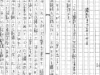
A text spanning eight sheets of 400 character manuscript paper is crammed onto a single page with the characters shrunk to fit. Finally it notes in parentheses, “Punctation within the quotation has been corrected,” but I have further rearranged the lines for this reprint. This is to make it easier to read. However, I suspect even this would have been difficult for modern readers. Yet it is fine writing. As I copied it out, my eyes welled up time and time again at the sight of those female wrestlers living their lives with such utter dedication. How powerful, earnest, endearing, and beautiful they must have been as they wrestled and performed their feats of strength. Their beauty, transcending commonplace eroticism, is fully conveyed through this writing. If this newspaper article from the Meiji area were rewritten in modern prose today, it alone would become a female sumo novel that would delight enthusiasts. I think I’d like to try such a task someday. And I plan to publish it in my upcoming doujinshi, “The Aesthetics of the Minority.” If it were like before, when “SM magazines” existed for SM enthusiasts, my “women’s sumo wrestling novel” would surely be published immediately. Nowadays, “SM magazines” featuring things like “women’s sumo” are practically nonexistent. If someone wrote a novel about female sumo wrestlers competing with vibrators inserted between their legs, maybe they’d publish it. Of course, doing such a thing would destroy the true beauty and eroticism of women’s sumo. It would be like forcing a vibrator into a beautifully and erotically bound female body. I forgot to mention it. Frankly, the stage production of the crucial “Women’s Sumo” fell short, in my view, of the text about the “Women’s Sumo Ekoin Performance” contained within a single page of the program. Above all, the actresses lacked the dignity, spirit, and emotion of female sumo wrestlers. It was disappointing. Yet one page from the program remains a valuable resource for me. I purchased three copies of this booklet near the theater and sent one to Hirahiko Yumatsu-san, a Kyoto-based researcher of women’s sumo. My friendship with Yumatsu-san, author of the substantial and excellent book “Research on the History of Women’s Sumo,” is a subject I shall write about in a separate section.