← Back to the Nureki Chimuo Archive
The Tomoshibi-za Begins to Move
I don’t know what twist of fate it was, but I’ve been so busy these past few months that I haven’t had a moment to write “Talking Theater.”
Whether you call it work or favors I’ve been asked to do, tasks just kept piling up one after another, and I didn’t even have time to get a good night’s sleep.
I love to sleep lazily and aimlessly, whether it’s day or night. It’s not because of my age. I’ve loved sleeping ever since I was young. You could say sleeping is my only pleasure.
(What a cheap pleasure!)
As for pastimes, or rather, various forms of pleasure, other than sleeping, they are often “work” for me.
If you’ll forgive me for sounding a bit pretentious, I am a person who has lived my life treating pleasure as work.
I’ve written up to 319 pages of “The Story of Minomura Ko” (working title), a project I’m working on for Kawade Shobo Shinsha.
That’s 318 pages, written character by character with a ballpoint pen in the squares of 400-character manuscript paper. I still have 700 pages left to write.
Since I’m writing about Minomura Ko, this is of course a fun job, much like a pastime, but other new pleasures keep barging in, so I’ve been attending to those as well, and I’m taking a little break right now.
There are frequent times when I can’t finish a particular story within this “Talking Theater,” and even though I say, “I’ll continue this next time,” I end up unable to write any further.
Even things I absolutely must write down right away end up left unfinished because I simply can’t find the time. Then, immediately, new tasks pile up before me.
That new task is also important, and the situation arises where I must tackle it first. The previous task gets dragged out and put off indefinitely.
Yesterday, R-san came to me with a sharp, raised eyebrow.
“Sensei, please write about Tomoshibi-za in ‘Talking Theater.’ You can’t forget about it. How long do you plan to keep ‘Talking Theater’ on hiatus?”
It was a pretty stern tone.
I found myself at a loss for words, “Oh, right, I have to write that too.” Even without R-san telling me, I must write about Tomoshiba-za.
I’d been thinking that every day for the past few days while working on other tasks. I can’t make her angry. For someone as clueless about IT as I am, she’s practically a godsend.
(After all, R-san is in charge of every single aspect of this “Talking Theater.” Without her, “Talking Theater” wouldn’t have gotten off the ground in the first place, nor would it have survived. Just as I write each character by hand with a ballpoint pen, she types each character of that manuscript into a word processor and puts it together online. To date, the total word count has reportedly reached a staggering 700,000 characters. R-san, thank you!)
Now, about this group we’ve named “Tomoshibi-za.”
There’s quite a story behind it, but I’ll skip the details here and keep it brief.
The core members are Sachi Yamanouchi, Nakahara Rutsu, myself, and though we’re still in negotiations, Hiromi Saotome.
They are the key members who produced the video work “Hostage” recently, and they possess various skills that will be useful in real world situations.
They are the colleagues I trust the most right now, people I get along with perfectly. Getting along well is a basic requirement, but what gives me real confidence is that each of them possesses outstanding abilities in their respective professional fields. No matter how good someone’s personality is, if they aren’t useful on a creative set, I simply can’t include them in the team.
For some time now, every time Sachi Yamanouchi and Nakahara Rutsu met, they would discuss wanting to create a project to follow “Hostage.” This reached my ears, and we have now taken the first step toward realizing our next project.
“Tomoshibi-za” is, simply put, the name of the group formed to ensure the successful realization of our next project.
However, we’ve decided that this time, instead of moving images, that is, a video, we will create a photo book.
The reason we settled on a photo book actually stems from the previous installment of this “Talking Theater” series, “I Bought Two Pairs of Slippers.”
Photographer Kyochi Tsuzuki took photos of my, that is, Nureki Chimuo’s, workroom, as well as of me, who has made that room my home, and kindly compiled them into a compact photo book in the style of a private edition.
It was a truly wonderful photo book, full of love and handmade feel.
When Nakahara Rutsu and Sachi Yamanouchi got their hands on it, they were instantly and powerfully inspired. We decided to use this photo book as a reference and create one of our own.
So, while photographer Tsuzuki’s photo book “Tabata Hojoki” served as the catalyst, the underlying reality was that there was a sense of stifling frustration regarding the respective circumstances swirling around them.
I, too, have that sort of stifling frustration and dissatisfaction. Well, it’s not as if I don’t. (No, I have plenty of it.) But since I’m a man with one foot already in the grave, I’ve given up on most things.
For my part, I feel a desire to help document, in a clear and concrete form, the talents of Sachi Yamanouchi, a person who, though unknown to the public as a photographer, possesses an exceptional sensibility, by lending my own modest support.
Fortunately, a fine model named Fuyuki Sawato is within earshot of my voice. She is a model who embodies a delicate, razor-sharp intensity throughout her entire being, perfectly suited to the meticulous sensibility of photographer Sachi Yamanouchi. She is a person of intense individuality.
Yamanouchi, who serves not only as a photographer but also as a producer, contacted the model, Fuyuki, and reported, “I received a reply from Fuyuki. She said she’d be delighted to model for us. She also wrote in her email that just the thought of being able to touch your ropes again makes her happy and fills her with energy.”
Then, “I’m absolutely thrilled that she’s so eager to do this. Let’s set a date and get things moving. Please pass on your requests to Nakahara-san, and Nakahara-san and I will handle the details together.”
That was the reply from Yamanouchi.
We considered various shooting locations, but after hearing Nakahara Rutsu-san’s opinion, we decided to shoot at Sachi Yamanouchi’s home.
(Or perhaps this, too, was influenced by the “Tabata Hojoki.”)
So, a few days ago, I went to the Yamanouchi residence with Nakahara Rutsu to scout the location. Yamanouchi welcomed us by making zenzai16 over the stove.
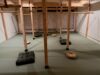
It was an amazing room. Model Fuyuki is unique, but the setting for this shoot is also incredibly unique. There was a beautiful pillar, which made me happy.
I won’t describe here exactly how unique and amazing it is. Let’s just say that you’ll understand once you see the photos taken by Sachi Yamanouchi.
Whether the workroom of Nureki Chimuo, photographed by Tsuzuki, is more impressive, or the Yamanouchi residence, photographed by Yamanouchi, is more impressive, that’s something to look forward to.
I have a feeling that Yamanouchi’s photos might be a bit better, simply because they feature the model, Fuyuki.
Before I knew it, I’d dropped the honorifics and was referring to them as Sachi Yamanouchi and Nakahara Rutsu. I wonder if they’ll take offense. Well, I doubt it.
When they appear as staff members of “Tomoshibia-za,” I’ll continue to omit the honorifics. That feels more natural.
The title of the photo collection has already been decided.
It’s called “Daydream.” Sachi Yamanouchi agrees with it, too.
Will “Daydream” win out, or will “Tabata Hojoki” win out? Whichever one wins, the protagonist within these two photo books will be me.
Thinking that makes me feel rather good. And it makes me conscious of my responsibility. 16
Zenzai is a red bean soup.