← Back to the Nureki Chimuo Archive
Rental Cushions. 100 Yen Apiece
I went to that coffee shop an hour before the agreed time.
I planned to work on the draft of “The Story of Minomura Ko,” which I am currently writing while sipping my coffee.
It looks like it will be a five-volume series, and I’m prepared to write about 1200 pages in total, but so far I’ve only written 281 pages. I’m behind schedule. I need to finish it by the first half of this year.
I opened my notebook for the draft.
“Various Episodes of Minomura Ko”
this.
I wrote that on a line and jotted down notes as they came to mind. It went something like
1. Riding in a taxi with Minomura. When we got out, he didn't take the change. If the fare comes to an exact amount, he’ll pull a hundred or two hundred yen out of his wallet and hand it to the driver, saying “Keep the change.”
2. At the Tori Shrine in Asakusa. A dense wave of worshippers packed tightly together. It was incredibly crowded in front of the offering box at the main hall. A police officer stood at the front, shouting to keep the crowd in order. Minomura said, “Let’s try aiming at that officer” and threw a coin from within the crowd about twenty meters away.
It didn’t hit the officer, but he glared at Minomura from a distance, then furiously pushed his way through the crowd toward him. “You just threw that at me, didn’t you?” he said, looking furious. Minomura trembled and bowed his head repeatedly, apologizing over and over, “I’m sorry, I’m sorry.”
3. In Asakusa they haggle with tourists every day. Two large blankets that look high quality at first glance, a grandfather clock that looks luxurious, and a transistor radio, all for a total of 1000 yen. It’s a kind of “tankabai” deal, and as someone born and raised in Asakusa, I know these are mostly unreliable goods. Minomura, standing next to me, shouted “I’ll take it!” and handed the seller a thousand-yen bill. I tried to stop him, but there was no time. The seller glared at me with a sharp look. Carrying the large bundle with both hands, Minomura headed back to Hiyoshi on the Tokyu Tokyo Line.
I was jotting down five or six of these anecdotes in my notebook as they came to mind when, suddenly, someone tapped me on the shoulder from behind, accompanied by a startled “Whoa!”
When I turned around, it was Rakka-san.
I glanced at my watch. It was 10:40. Uncharacteristically, you had arrived a full twenty minutes earlier than we had agreed.
With both hands hanging loosely at your sides, you were chuckling as you shook your body in small, jerky movements.
In other words, you hadn’t performed your usual ritual for these meetups. Holding up three fingers on your left hand, covering your mouth bashfully, and shifting awkwardly three or four steps to the side.
You must have read the previous installment of this “Talking Theater” that I wrote (you’re usually the first to read it), and made a conscious effort not to show that bashful behavior of yours today.
(I understand exactly how you feel.)
It must be embarrassing for you to instinctively cover your lips with your finger out of shyness at the moment we meet, and then have me point it out to you.
Either way, there’s no doubt that to a man’s eyes, it’s a charming and endearing gesture.
“You’re early. Would you like some coffee?” I said, and motioned for you to take the chair next to me.
chat.
Since you arrived twenty minutes early, that means we have twenty extra minutes to
Even without being so stingy about it, since today is a day just for the two of us, there’s no need for us to be so rushed or to both speak at once with such fervor.
(But, to tell the truth, this was actually the same every time.)
After 11:05, we left the coffee shop and boarded the Keihin Tohoku Line. The train was empty.
We talked a lot on that train, too.
I wonder why we always have so much to talk about.
We got off at our destination station. Talking so hard had made me hungry. As always, I’m a base person. When I get hungry, I immediately want to eat something. I just can’t stand being hungry.
We ate spaghetti together at the PRONT15 in front of the station and, while continuing our conversation, we had another cup of coffee.
Even though we had talked so much just four days ago, why do we keep finding so many new things to talk about, one after another?
Anyway, whenever we meet, the things we want to talk about and the things we have to talk about pour out like a dam has burst, and there’s no end to it.
While drinking coffee after the meal, the conversation got lively again, and before we knew it, it was past midnight.
The venue we were heading to opens at 12:30. The show starts at 1:00.
Since it’s our first time going there, if we factor in the possibility of getting lost along the way, we won’t make it in time.
In my previous “Talking Theater” post, I wrote all sorts of cheerful things, like “Let’s walk hand in hand through the streets of an unfamiliar town, gazing at unfamiliar scenery,” and even prepared a map for the occasion, but I no longer have the time for that.
Once my stomach is full, my whole body feels sluggish, and even walking becomes a hassle. I’m such a pathetic elderly man.
“I won’t make it in time. I guess I’ll just take a taxi.” That’s what I decided.
The area in front of the station was a chaotic jumble of buildings of all sizes and heights, and it took quite a bit of effort just to reach the taxi stand.
15
Even so, the scene in front of the station was frighteningly unattractive and utterly bleak. This is an Italian restaurant in Japan.
Dirty, small buildings stood in every direction, lined up without a shred of aesthetic sense, blocking the view. It was such an ugly, grotesque sight that I found myself wondering if this was what the desolation of the human heart would look like if it were made tangible.
The number of people coming and going was eerily high. There was no sense of space, and the whole scene felt like the end of the world.
Leaving that station area behind and arriving at my destination, the taxi fare came to just over 800 yen.
I don’t have the magnanimity of Minomura Ko, so I make sure to get my change.
As I got out of the taxi and turned left onto a narrow street leading from the wide road into a residential area, the moment I stood at the corner, I immediately saw a small hut.
To my surprise, standing in front of that building were two banners dyed red, green, yellow, and navy blue.
“Ah, ah, ah, there it is!”
I couldn’t help but shout in a low voice.
“They’re up, they’re up, the banners are up, right, right? Just like I wrote in our last talk show, the banners are up, aren’t they? Right, right, right!”
I was deeply moved.
It was two stories tall, with a mortar-coated exterior.
It appeared that white mortar had been applied over the old mortar, so the walls of the building were a white that made the dirt stand out.
Even so, unlike in Asakusa, there were no crowds of people flocking around the building in a festive atmosphere.
It felt deserted. There wasn’t a single person in sight. Even the wind blowing felt desolate.
It wasn’t the corner of a shopping district I’d pictured in my mind, but rather a shack in a gray residential area with rows of old houses, lacking any liveliness. I couldn’t even see a single passerby.
If this were Asakusa, it would be a huge commotion by now.
Crowds of people, their chests swelling with anticipation and joy at the thought that “the time for pleasure is about to begin,” would be surrounding the building, roaring and howling.
An almost obscene, raucous buzz spills out from inside the shack onto the street, and it takes real courage to step into that swirling mass of people.
Yet here, look at this. It is quiet, damp, and still, with a gloomy atmosphere hanging in the air. There is no sign of the vitality that usually brings entertainment to the townspeople.
But that is exactly how it is. This atmosphere, too, was part of my premonition. No, I also felt that this was exactly how it had to be.
I handed a 5000 yen bill to the ticket window. Three thousand two hundred yen for two people.
I received 1800 yen in change. I found out later that the ticket booth and the concession stand inside the venue were actually one and the same.
A middle-aged woman worked alone at the counter, selling tickets and attending to customers who came to the concession stand to buy candy or tea.
A man standing behind the curtain at the entrance took the tickets. I also found out later that this man (or perhaps I should call him an old man) served as the lighting technician for the stage while standing behind the curtain.
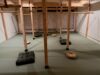
As soon as you enter there is a narrow earthen-floored area and right in front of you is a raised platform.
A space covered in tatami mats spread out before us, and that was the audience seating area. In other words, the audience took off their shoes, stepped up onto the tatami, and faced the stage.
There was a cardboard box placed on the earthen floor, filled with many used plastic bags.
“Please put your shoes in those bags and bring them up with you,” an older woman who appeared to be an usher told me.
As I stepped up to sit on the tatami, the usher said, “One hundred yen for the cushions,” and gave a light tap to the pile of cushions stacked beside her. I handed her two hundred-yen coins, borrowed two cushions, and set down next to you.
This wasn’t the first time I’d seen a play under such a system.
Long ago, at the Suzumoto Engeijo theater in Ichikawa City, Chiba Prefecture, if you paid a fee, they would lend you a cushion and a tray for cigarettes. In winter, they would also lend you a hand warmer. A hand warmer is a small brazier.
(I wrote about this a few years ago in this “Talking Theater” column as well. It was at this Suzumoto Engeijo that I saw “Hiaburi,” a play written by Izamitaro Suzuki and based on the life of Itoh Seiu. What’s more, I was sitting right next to Itoh Seiu…)
It was ten minutes before one o’clock.
When we entered, there were about thirty people in the audience. Many of them were elderly. Everyone was sitting with their bottoms pressed flat against their zabuton cushions.
As the start time approached, the number grew to about fifty. Just before the curtain rose, the audience had somehow swelled even further. I suppose there were about seventy people in total.
At 1 PM, right on the dot, the gong sounded and an announcement rang out.
The first item on the program was a mini-show.
The second was the play “Kanchigai.”
The third act was the grand show.
As soon as the announcement ended and the curtain rose, the troupe leader, seated in the seiza posture at the front, gave a greeting. Immediately after that, the dance “Sanbaso,” performed by three young dancers, began.
This was not the traditional Kabuki dance “Sanbaso” performed to Nagauta music. While the costumes were somewhat authentic, the song was an arrangement of Nagauta, making it a distinctly modern style Sanbaso. The dancers performed to the sound of a tape or CD played offstage.
Three young actors, their faces beautifully and thickly coated in pure white powder, danced earnestly and with all their might. After dancing for about fifteen minutes, this was the “mini-show.”
Oh dear, writing like this makes the text get longer and longer. That wasn’t part of my plan. Since the entire experience was so moving, I feel compelled to write about every detail. So, I suppose I have no choice.
But Rakka-san. This time, rather than writing something like this, I actually wanted to start right from the beginning by pouring out my feeling, how I was overwhelmed by the consummate artistry of the two elders of this troupe. Yet, before I knew it, it turned out like this. Still, this is a record in its own right.
Ah, it was truly wonderful. Hata Joji and Kanai Yasuo.
Their artistry, which doesn’t even look like art. Artistry steeped in years of experience.
Next time, I’ll dive right in and write about their performance. For my own sake.