← Back to the Nureki Chimuo Archive
The Unfortunate World of Show Business
According to the essay “The History of ‘Tachi-e’” by Hiro Nagai (published by Geisosha/Etoku), the seventh line on the first page reads, “...an unfortunate art form that vanished in just over thirty years since its inception…”
That is exactly right.
Tachi-e is, after all, an unfortunate art form…
It was founded in Tokyo in the 1890s and was loved by children and a small group of enthusiasts until the late Taisho era, but due to the difficulty of its production and operation, there were soon no longer any practitioners.
The production and operation themselves are not particularly difficult.
It can be done with a little know-how, dexterity, and a sense of theatricality.
It’s not so much difficult as it is troublesome.
It takes a lot of effort and time, and for what it’s worth, the rewards are few.
It is an art form that appeared in the 1890s and vanished by the end of the Taisho era.
If the rewards had been greater (if it had brought money or fame), it surely wouldn’t have disappeared so easily.
A neglected art form.
The dictionary defines “neglected as “...unlucky, not having attained a status or circumstances befitting one’s talent or character.”
I see. Well then, perhaps I should try my hand at reviving this art form.
And so, being the contrarian that I am, I decided to give it a shot. That was sixteen years ago.
I am well aware that this is presumptuous.
I have little interest in performing arts that are currently thriving.
On top of being a contrarian, I have a strong desire to show off.
And I am confident in my ability to draw pictures and deliver monologues in the style of kabuki.
Well now, you speak with quite a lot of confidence, don’t you?
If someone were to say that to me, I would reply, “Yes, I do have that kind of confidence.”
I am always an overconfident (that is to say, reckless) person.
However, it was a form of performing art that I could not have challenged without that level of confidence and recklessness.
Even so, sixteen years ago, during that time when my regular work was extremely busy, why on earth did I decide to take on the troublesome task of creating tachi-e.
I asked myself what kind of mood I was in back then, but I already know the answer.
I’ve always loved theater.
Regardless of complicated reasoning or theatrical theory, I simply love theater.
Whenever I picture actors on stage in their costumes and recite kabuki lines out loud, I’m always entranced and get into a wonderful, almost intoxicated mood.
You could say that my love of theater is something like my fate (probably inherited from my father and mother).
It has been glued to my back since birth, and no matter how hard I try to shake it off, it won’t go away.
I suspect this fate will never leave me until the day I die.
But if I may add a personal note, my love of theater is somewhat twisted.
No matter how much I love it, I hesitate to fully immerse myself in the world of theater. That is, to actually become an actor or a theater professional.
I am simply a coward.
I lack the boldness to fully commit to becoming a professional.
That is because I know how harsh the professional theater world can be.
First of all, there are financial struggles. I am afraid of poverty.
I know that the training, effort, and patience required to master a true art form are no small feat.
My physical and mental strength simply couldn’t withstand that kind of hardship.
I hate undergoing grueling training.
I want to take it easy as much as possible and bask in a good mood (I know it’s selfish, but that’s how I really feel).
I am a cowardly person.
If we were to revive an art form that died out long ago, people would be surprised.
Some might even look at me with respect.
Perhaps because I have a strong sense of inferiority, I like being respected by others. I hate being looked down upon.
And another reason that made me take on the challenge of tachi-e, now that I think about it, this reason might have been the stronger one.
I wrote that it was the busiest time of my regular job.
During that time, when I was constantly tying up naked women with rope every single day, writing manuscripts from morning until night and from night until morning under four or five different pen names for those kinds of magazines, the more physically and mentally exhausted I became, the more I may have felt a deep hunger in the depths of my heart.
Back then, sixteen years ago, the image of SM in publications had already become narrowly defined and rigidly fixed within a set mold.
It’s easier, as a money-making venture, to establish an image and fix it in a single direction.
In my real life, I, too, was contributing to that easier path. It’s easier this way to earn an income.
But, “no, no,” I kept murmuring in the corner of my heart.
SM had to be something freer, more diverse, unconventional, and interesting.
A sense of hunger had arisen in a part of my heart.
Wasn’t it that sense of hunger that drove me toward tachi-e when it spread?
If I had felt fully satisfied with my daily work, I surely wouldn’t have had the leisure to let my heart be captivated by tachi-e amidst all that busyness.
Somehow, the conversation has strayed off course.
I must get back on track.
In any case, I became obsessed with creating tachi-e, that underappreciated art form.
It was an enjoyable task.
It was a dream. If it weren’t fun, I wouldn’t bother with the hassle of making dolls.
On the stage of paper dolls lay a world of stories that was free and unrestrained.
The paper dolls I created came to life and moved exactly as I imagined and desired.
There was my own SM world, one that expanded endlessly and exactly as I wished, something I could never find in the SM work I did to earn a living.
As someone who loves theater, the SM world I prefer is fundamentally based on aestheticism, fantasy, and romance, and is rich in narrative. SM that lacks a sense of narrative is not the kind of SM I like.
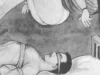
(Several of the dolls I created during this period for my tachi-e, including “Oshichi the Greengrocer” and “O-Tomi the Slashed,” are currently on loan to the Sex Industry Museum. There are also paper dolls of men to be paired with them, a woman bound by officials after committing a crime, a woman undergoing torture by being hung upside down, a female prisoner being paraded on a horse, and a female prisoner tied to a stake. Though the dolls are crude, they surely embody the passion of SM. I hope to someday stage these two tachi-e plays, “Oshichi the Greengrocer” and “O-Tomi the Slashed” at the Sex Industry Museum and put on a performance. Of course, I wrote all the scripts myself. I also created “The Well-Known Suzukamori,” which will be performed six times over two days at a nearby prefectural history museum, around the same time. This one features nearly twenty figures.)
Here, I would like to include an excerpt from the aforementioned text by Mr. Keio Nagai.
“...The delivery of the lines was a high-pitched, recitative style that blended elements of traditional theater (namely kabuki), storytelling, rakugo, and even film narration, with sound effects such as taiko drums and clappers added to the mix. This can be considered the prototype for the narrative style of later single-panel kamishibai. However, the lines spoken by each character were given even greater emphasis than in kamishibai because the standing paper dolls were independent figures, one for each character.”
The fact that the dolls’ lines played such an important role was what satisfied my sense of self-worth.
I’m quite good at delivering lines in the kabuki style. To brag a little, I’ve actually been sincerely praised by a famous kabuki actor, a true master of the art.
Next, the manipulation of the puppets.
For me, this is even harder than delivering the lines.
What’s more, you’re supposed to move the puppets while speaking the lines.
However, with the arrival of Miss M, the problem of puppet manipulation was solved.
I took charge of the opening recitation, the lines, and the clappers, while Miss M specialized in operating the puppet.
At the time, I was serializing a novel depicting the world of circus performers in a magazine called “Moonlight.”
Miss M read that novel avidly. In other words, she was a devoted reader.
She was also a woman with a very strong interest in street performances and sideshow acts. The depth of her affection for those kinds of performances and the performers often left me in awe.
Had it not been for the arrival of Miss M to operate the puppets, my tachi-e would likely have ended at the stage of simply making puppets by attaching paper to bamboo skewers.
Although tachi-e are supposed to be a solo act, thanks to her, albeit in an unconventional way, they were able to achieve intricate movements and acting.
Here, I would like to quote another excerpt from Mr. Keio Nagai’s writing.
“...To transform the puppet, one simply uses the thumb and index finger to spin a thin bamboo skewer 180 degrees. Though the action is simple, if the rotation stops midway or goes too far, the effect is completely lost. In other words, the ‘pause’ created by the subtle movement of the fingertips was the greatest highlight of the still images. Furthermore, it was the pauses between lines of dialogue that guided the rhythmic transitions in the characters’ movements. For still illustrations, the pauses between lines were more important than in later forms like kamishibai or film narration. The screen transitions accompanying the dialogue, those fleeting moments of <pause> were precisely what made the still illustrations so fascinating.”
This passage by Mr. Nagai accurately captures the challenges of animating characters in tachi-e and the difficulty of timing dialogue.
A single person must perform this difficult art of puppetry and dialogue simultaneously.
It is simply impossible.
This is precisely why tachi-e have come to be regarded as a neglected art form. In other words, unlike kamishibai, it was not something that could be done by a single person or just by anyone.
So I decided to entrust the manipulation of the puppets to Miss M and concentrate solely on the dialogue myself.
If it’s just the dialogue, it’s easy, and since I don’t have to worry about anything else, it feels good.
My tachi-e became pure pleasure for me.
Once again, I would like to quote Mr. Nagai’s writing.
“...The dramatic characteristic of the ‘tachi-e’ performances was that scenes were constructed not through flat, narrative explanations of the story, but through the interplay of lines delivered by each individual performer. Therefore, the performers of these tachi-e shows were required to master kabuki-style delivery techniques, as well as possess dexterity in their fingertips. Though they were merely street-corner candy sellers and minor entertainers, these men were passionate about kabuki and understood the subtleties of the art. They took great pride in freely directing the actors within the small proscenium and in orchestrating the microcosm of the theater. The fact that they were called ‘kabuki-ya’ by children and performed their stand-up plays dressed in striped kimonos and white tabi socks was a clear reflection of their confidence.”
And, since this is something Nureki Chimuo would do, starting with “The Well-Known Suzukamori,” the kyogen plays naturally take on a distinctly local flavor, featuring works like “Oshichi the Greengrocer” and “O-Tomi the Slashed.”