← Back to the Nureki Chimuo Archive
Okon, the Beggar Woman Suffering from Syphilis
Based on the rakugo story “Sano Jirozaemon,” the kabuki play “Kago Tsurube: Sato no Eizame” was created, and it turned out to be quite entertaining.
Thanks to the individual ingenuity of the actors, it became a wildly popular play and is considered one of the masterpieces of the genre.
When I was fifteen or sixteen, I often performed the Hyogo-ya and En-kiri scenes from this “Kago Tsurube” at banquets, imitating the voice of the first Nakamura Kichiemon.
This is the famous line spoken by Jirozaemon as he is overcome with grief. “...Oiran, that’s well, a bit too much, isn’t it…. The number of lovers changes every night. As a servant of Ukikawa Take, I don’t know if her heart has changed, perhaps today’s flower is better than yesterday’s, but outwardly, she’s set to finalize the matter of my redemption tonight. Last night, I didn’t even sleep at the inn, impatiently awaiting the long autumn night. I came here to admire the chrysanthemums and taste the dew of the red-light district, and to feel the dew on my skin. But to my surprise, she was cold and unfriendly. Well, being a country bumpkin like Jirozaemon, I don’t hold a grudge, and I suppose it can’t be helped that she turned me down, but why didn’t she just tell me that from the start? Every time I come to Edo, I’m rumored to be with someone from Sano in Yoshiwara, and once I’m up on the second floor, I’m even called out by my peers, the courtesans and their attendants. Am I supposed to just sit back and watch? You should have thought about how things work here and understood my situation…”
Ah, I’ve finally written down a line that isn’t even worth transcribing here.
This is probably why I’m such a theater and kabuki fanatic. I really am frivolous.
As for why I had the chance to attend such banquets when I was fifteen or sixteen, it was because in 1944 and the first half of 1945, that is, toward the end of the Pacific War, people around me were being drafted into the battlefield one after another, and farewell parties were held frequently for that reason.
At a farewell party where everyone was prepared to die, “A courtesan? Well, that’s a bit out of place, isn’t it?” I don’t think that would have been appropriate, but that was the extent of my art. Beyond that, I performed three or four dodoitsu poems.
When I strained my throat to imitate the voice of the late Kichiemon, the audience would applaud and cheer, and as a child, I felt quite proud of myself.
Sixty years ago, anyone would often perform Kabuki style voice impressions or dodoitsu as party entertainment. Dodoitsu can also contain quite explicit erotic content.
That aside, the story of “Sano Jirozaemon” featured in the “Encyclopedia of Rakugo Works,” as mentioned earlier, unfolds in a manner reminiscent of “The Arabian Nights,” with the narrative branching out in countless directions like the twigs of a tree, making it impossible to bring to a conclusive end.
It’s truly fascinating to read, but since it’s so long, I simply can’t present it here.
The life of the pitiful Edo-style courtesan Okon, who suffers from syphilis and is killed by Jirobei on the banks of the Toda River, is truly fascinating and full of twists and turns, possessing a strangely vivid quality that makes it worthy of being a novel in its own right.
Furthermore, there is a samurai named Takesuke Tsuzuki who first appears wielding the demon sword Kagotsurube. This character also has a wild past, and there is a separate story based on that past told as a kodan.
The script for the Kabuki play “Kago Tsurube: Hanamachi Suisei,” based on this rakugo story, is included in Volume 17 of Tokyo Sogen-sha’s “Masterpiece Kabuki Collection: Edo Sewa Kyogen Collection, Part 3.” According to this, the prologue begins abruptly with the “Nakano-cho First Encounter Scene.”
Then, the oogiri consists of: “The Scene at Tachibana-ya in Nakano-cho” “The Scene at Hyogo-ya in Edo” “The Scene of the Arrest at the Great Gate” The “oogiri” refers to the final scene.
However, in the script by the author, Kawakaku Shinichi III, there is a scene where the female beggar O-Sei is brutally murdered on the banks of the Toda River for Jirobei’s sake, as Koji Toita writes in his commentary for the “Masterpieces of Kabuki” collection.
In the rakugo version, the character is Okon, but in the Kabuki version, she is O-sei.
Koji Toita’s commentary is concise yet captures the essence of the story, making the complex plot easy to understand. It is clear and straightforward.
To compare it with the story as told in the kodan, I will transcribe it here.
Jirozaemon’s father, Sano Jirobei, married a courtesan, but abandoned her when she fell ill. That woman, named O-Sei, has since fallen into poverty is now a beggar.
The story begins with O-Sei happens to meet Jirobei at an inn in Warabi, whereupon he takes her to Todagawa-hara and brutally murders her.
Jirobei had two sons, Kanbei and Jirozaemon. The elder was a farmer, and the younger a silk merchant. Jirobei, cursed by O-sei, was afflicted by the same virus and died in agony. (Excerpt)
Now, let me explain how this sword, the Muramasa known as “Kago Tsurube,” which gives the story its title, came into Jirozaemon’s possession.
Takesuke Tsuzuki, who had defeated Yaegaki Monta in a spear tournament held in the Honda domain and thus restored his honor, was ambushed by Monta at the edge of the riding ground and struck him down with his own sword.
After that, he broke off his engagement to Chiyo, the daughter of a senior councilor, and set out on a journey of wandering. In Chigane Matsubara, in the province of Yasu, he rescued Jirozaemon, who was being threatened by a gang of ruffians. As a result of this encounter, he stayed at Jirozaemon’s house where he fell ill.
He is eventually killed by the villains who came to settle the score from the incident at Chigane Matsubara, but just before his death, he presents Jurozaemon with a sword as a token of gratitude for the hospitality he received.
In the fourth act of the original play, “The Scene at the Sano Residence: The Presentation of the Heirloom,” Takesuke says:
“This sword is a single blade from a set of heirlooms that my father, Takebe, received on his deathbed. The Tsuzuki family is not a hereditary retainer of the Honda clan. Rather, we were once vassals of the Ishida clan, which met its end at Sawayama in Omi Province. Therefore, although we do not possess the Muramasa sword, which is forbidden by your household, fortunately, this blade is unsigned. It is said to cut through even water without spilling a drop, and for this reason, it has been passed down through our family for generations under the name ‘Kago Tsurube.’ As a token of gratitude for your care over the past year, I have passed it on to Lord Jurozaemon. If you cherish it as a talisman and keep it sheathed, never drawing it, throughout your life, it will not bring you any ill fortune. However, when the time comes to draw it, it will inevitably cause harm to you, and it will not be sheathed until blood is drawn. Recognize it as a cursed blade, and take care not to handle it carelessly.”
When Jirozaemon traveled to Edo on business, he fell for a woman named Yatsuhashi in Yoshiwara. After frequenting her establishment, he was eventually rebuffed. Determined to kill her, he returned to his home province, falsely claiming he would serve as a samurai in the Western Provinces. He bequeathed his fortune to his older brother and arranged for his porter, Jiroku, to marry his niece, Oshizu.
He sets out carrying a sword he had sharpened in Takesaki, but a monk named Kugetsu, who had happened to be present when Jirobei killed Osei at Toda River, observes Jirozaemon and prophesies that he will meet his end before long.
In short, this story revolves around an unfortunate incident occurring as retribution for the father’s evil deeds, and the ominous sword is intertwined with this. The fact that Jirozaemon became a man disfigured by pockmarks is also presented as a matter of karma. (The rest is omitted.)
“Kago Tsurube,” which is frequently performed at venues such as the Kabuki-za (currently under renovation), the Shimbashi Enbujo, and the National Theater, begins with the “Nakano-cho First Encounter” scene. Therefore, nothing is known about the events preceding it.
However, reading this commentary by Koji Toita makes it clear that this play is a terrifying tale of fate involving a cursed sword known as “Kago Tsurube.”
I read Mr. Toita’s commentary several decades ago, and at the time, I thought, “What a grotesque and fascinating tale of fate this is.”
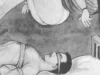
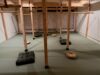
That memory came flooding back when I came across the tachi-e in a room within the massive archive in the basement of the Prefectural Museum.
In other words, the doll of the pitiful female beggar is Okon (O-Sei in Kabuki), the traveling samurai is Takesuke Tsuzuki (or Jirobei), and the traveling monk is Kugetsu, who witnessed Okon’s murder.
The blood-soaked female ghost is, of course, the manifestation of Okon’s vengeful spirit.
Given that the location is the riverbank at Toda, everything falls into place.
In other words, my acchitei kocchi master.
The true identity of the Osaka chivalrous rogue “Gorobei the Brawler,” who caused trouble for the master.
Couldn’t it be that this too, was something that had been stuck at the very bottom of my distant, distant memory, and which, having found a trigger, suddenly came back to life.
When I think about it that way, it all makes sense, and I even went so far as to ask the master about it. I’m truly sorry for the trouble I caused you.
It seems that when there is an interesting original story, the content changes little by little every time the performers change or depending on the circumstances of the troupe staging it. Over the long years, even if the general outline of the story remains the same, it can end up taking on quite a different form.
Personally, whenever I’ve performed a play based on an original work, I’ve taken quite a few liberties with the adaptation.
The “Goshite Suzukamori” from tachi-e, which will be performed six times at the History Museum this time, is precisely that kind of production.
The final scene, in which blood-soaked severed heads rain down upon Shirai Gonpachi, who has killed many people, and he is tormented by their vengeful spirits, is entirely my own creation.
I even considered reimagining the much older “Kago Tsurube” story, featuring characters like Sano Jirozaemon and the courtesan Yatsuhashi, as a new tachi-e production, with “The Murder of the Female Beggar Okon” serving as the climax.
If we establish that the unfortunate, syphilitic beggar woman, who is killed by her former husband Jirobe, was actually the mother who gave birth to Jirozaemon, the story takes on an even darker, more grim tone.
Okon appears as a terrifying ghost before her former husband, who killed her, and the child she bore him.
The image of a ghost writhing in agony, torn between her hatred for her husband and her love for her child, a tangled web of love and hate, strikes me as quite powerful.
(Though I feel like I saw a similar story quite a while ago in “The Peeping Mechanism.”)
I get the feeling that no matter how much humans pretend to be peaceful and harmless, the moment you look behind the scenes, a terrifying karma seems to be swirling there.
I have a desire to depict that karma to the very end.
When it comes to this, it will result in a tale of fate and karma that is entirely different from, and far more tragic and grim, than “Kago Tsurube,” which is known to many theater lovers for its climactic scene where Sano Jirozaemon and Yatsuhashi cut ties, “A courtesan, well, that’s a bit… out of line, isn’t it…”
Perhaps “Gorobei the Brawler” too, having undergone a similar evolution over the long years, performed by various troupes here and there, gradually transformed into the twisted, gloomy tragedy of a chivalrous hero lamenting his scarred body.
Ah, and one more thing.
There must have been a large audience in every era that supported such plays.
After all, theater exists because of its audience.
It is conceivable that, after being solemnly refined over many years by numerous theater companies, a complex, absurd flavor of sorts was exuded and emanated from that play. It was a stage production with a truly mysterious charm.
Or perhaps, thanks to “Hanafubuki” that day, she and I were able to witness a rare and precious play that one rarely gets to see.