← Back to the Nureki Chimuo Archive
Kago Tsurube’s Standing Illustrations
To my Acchitei Master (An Apology and a Request).
I apologize for the trouble I caused by, as usual, acting on a whim and getting carried away, even going so far as to ask questions of you, my busy master, regarding a figure like “Gorobei the Brawler,” who is not widely known.
I hope to see you soon so I can apologize in person.
However, yesterday, I once again came up against my peculiar memory.
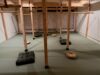
Yesterday, I spent the entire day in a storage room deep underground at a certain public museum at a prefecture near Tokyo (it was an impressive room, just like a nuclear fallout shelter).
It was a “job” I was asked to do by a curator at another public history museum, to research materials related to tachi-e (standing illustrations) created during the Meiji era.
I was accompanied by Mr. K, the curator, and the museum’s photographer.
A woman named M-san, who operates the tachi-e figures, also joined us.
M-san is not only skilled at manipulating the puppet but also possesses a deep understanding of tachi-e, a now extinct form of street performance, making her a highly capable individual.
She occasionally serves as my assistant when I perform tachi-e.
The five of us shut ourselves away in a deep underground storage room and, from 10:30 AM to 5:30 PM, came face to face with over a thousand tachi-e figures that were active from the Meiji through the Taisho eras.
Every tachi-e has a story.
Unless they appear within that story and move about, tachi-e are nothing more than flat puppets made of paper and bamboo skewers.
For some reason, absolutely nothing remains, no records of the story’s title, the names of the roles the paper puppets played, or the plot itself.
All that remains are the puppets themselves and the stages where they once moved.
My role was to look at the puppets alone and deduce their stories and the names of the plays they performed.
The tachie-e, packed into old cloth bags, were stored inside large boxes made of heavy-duty moisture proof material.
The paper puppets of the tachi-e are attached to bamboo skewers (the very common kind used for oden or yakitori).
They were no more than fifteen or sixteen centimeters tall.
Characters are depicted on both the front and back, with the designs varying slightly on each side.
For example, the front depicts a samurai with his hand on the hilt of his sword.
When you flip it over to the back, the samurai has drawn the sword and is raising it to strike.
From the ancient cloth bag, so faded that its original color was unrecognizable (clearly a handmade item from the Meiji era), a bundle emerged with the characters “sa no (佐の)” written in ink with a brush.
There were over a dozen of these “sa no” cloth bags, each marked with a number.
This indicates that the play “sa no” consists of over a dozen acts or scenes.
The moment I saw it, I exclaimed, “Ah, this is it!”
Being the very picture of frivolity, a trait my master knows all too well, I said, “Perhaps this is… (pausing dramatically)... this might be a puppet from the play ‘Sano Jirozaemon,’ that is, ‘Kago Tsuru-be Sato no Eizame.’”
Then, from among the dozen or so cloth bags containing the “Sano” dolls, I asked them to open the one they thought contained the scene from the climax.
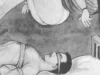
Sure enough, out came a doll of Sano Jirozaemon, sword raised, striking a dramatic pose atop the roof of a brothel, surrounded by officials from the police force. It was the climax of “The Slaughter of a Hundred Men in Yoshiwara.”
Jirozaemon’s doll is easily recognizable because of the birthmark on his face. There was also a doll of the courtesan Yatsuhashi.
“I knew it. This ‘sa no’ refers to Sano Jirozaemon, and all the dolls in this bag are from “Kago Tsurube!” I said this with a slight air of superiority.
However, the “sa no” cloth bag also contained quite a few characters I didn’t recognize.
First, a samurai in traveling attire. Then, a female beggar who looked downright hideous.
And the traveling samurai who slashed that pitiful female beggar to death.
A rather suspicious traveling monk.
And there were also several poses of a sinister female ghost.
I had never once seen the Kabuki play “Kago Tsurube,” in which such characters appear.
Even though I’ve never heard or seen it in either rakugo or rokkoku, why did I say, “Ah, I knew it, this is the story of ‘Kago Tsurube?”
Even though I’ve never seen or heard the scenes featuring the female beggar, the traveling samurai, the traveling monk, or the female ghost, why did I know immediately that this was the story of “Sano Jirozaemon?”
Even though I didn’t know the story of “Gorobei the Brawler,” a tale of a chivalrous outlaw set in Osaka, I had the frivolous habit of jumping the gun and saying “This is an interesting play,” and that habit reared its head here as well.
Just by looking at the characters with “sa no” written in ink and the small puppet of a traveling samurai slaying a female beggar, how did I know this was “Kago Tsurube?”
What on earth is going on inside my head?
it up.
That night (that is, last night), after returning home and resting a bit, I immediately looked
Everything is a learning experience.
The book “Encyclopedia of Kodan Works” by my respected teacher, Hideaki Yoshizawa.
It is a truly invaluable book, packed to the brim across three thick volumes, with records of the human condition, where good and evil intertwine and joy and sorrow mingle, chronicling the lives of common people who lived and caused a stir from Japan’s ancient times through the end of the Meiji era. It captures the unfathomable lust and greed of men and women of all ages, their vivid ways of life, and their tumultuous stories.
I picked up the middle volume and opened it to the “Sa” page.
There it was.
It was there.
“Sano Jirozaemon”
Okubo Jirozaemon, a wealthy landowner from Hasabe Village in the Sano region of Yashu, was attacked by a bandit on the Kumagaya earthen embankment, just past Fukiage, while on his way to collect debts.
He was rescued by Tsuzuki Takesuke, who had been pursuing him from behind. Takesuke was a ronin who had formerly served Honda Tadayasu of Yamato Koriyama. Takesuke had won a duel against Yaegaki Mizuho, a favorite of his lord, and had been expelled from the domain. He had left Edo and was on his way to Shiga in Omi Province.
Takesuke accepted the invitation to become a guest at Jirozaemon’s house in Sano, and while teaching him swordsmanship and jujutsu, he fell ill and died.
At that time, he presented the Muramasa sword passed down from his grandfather, a blade with gold inlay bestowed by Fukushima Masanori and inscribed with the name “Kago Tsurube,” and left a final wish. “As this is a cursed sword, enshrine it in the temple along with my remains.”
He then gave Jirozaemon a sword made by Yusada. However, Jirozaemon did not entrust it to the temple but instead kept it as his personal sword for his travels. This ultimately led to Jirozaemon’s downfall. (Note by Nureki: In short, Sano Jirozaemon inherited the cursed sword Muramasa (Kago Tsurube), which a ronin named Tsuzuki Takesuke had bequeathed as his final possession on his deathbed. Keeping this cursed sword by his side would lead, several years later, to the great tragedy known as Jirozaemon’s “The Slaughter of a Hundred Men in Yoshiwara.” There is also a story, told as a single rakugo performance, about Tsuzuki Takesuke before he became a ronin. Much like “The Arabian Nights,” the story branches out from a single trunk into twigs and leaves, and while each detail is vivid and fascinating, I have no choice but to omit them here.) Now, let us go back in time to the Shotuku era. In Hasebe Village, Sano, in the province of Yashu, there lived a virtuous physician named Komatsubara Sansai, who had two sons. The elder was named Jirokichi, and the younger was named Yuseki.
The elder brother was a dissolute rogue who went to Edo and changed his name to Jirobei. There, he became involved with Okon, the concubine of Shibue Ukon, the steward of the Saijo Domain in Iyo.
Later, he became involved in a suspicious relationship with Onaru, the wife of Kisoji, a gambler from Kiryu.
After Kisoji’s death, he married Onaru. When they had a child, he named him after his former name, Jirokichi. Persuaded by Jirokichi when the boy turned seven, Jirobei reformed his ways. He made a living selling small goods and gradually became a man of means. His younger brother, Yuseki, who had taken over the family medical practice, was also doing well (Note by Nureki: Professor Yoshizawa’s writing is truly free-spirited and unrestrained. At times, it suddenly shifts into the style of a traditional storytelling performance. There are also sections that have been boldly omitted. To make the text easier to understand, I have taken the liberty of organizing it somewhat. I hope you will forgive me for this.) One year, when Jirobei was returning from Edo,
“...he decided to travel as far as Warabi that very day, so he made immediate preparations and set out from Sano Mata (Note: Jirobei’s regular lodging, Sano-ya-Mataemon’s palace). Passing through Suginokita, with the Kanda Myojin Shrine on his right, he climbed from Yushima to Hongo-dai, emerged onto Morikawa-cho from in front of the Kaga residence, turned left at Takasakiya and then right, reached Itabashi from Sugamo (omitted), and proceeded step by step until he arrived at the riverbank of Toda…”
Suddenly appearing before him was a female beggar suffering from syphilis, the wretched end of Okon, whom he had abandoned long ago.
At a loss, Jirobei kicked Okon into the Toda River and bludgeoned her to death with a flood-control stake.
The following year, on his return from Edo, he found himself once again on the banks of the Toda River.
On the same day of the same month as the previous year (October 11), the boatman had buried the murdered beggar woman beside the Jizo statue, at the base of a willow tree. Since then, rumors had spread of ghosts appearing and balls of fire rolling about.
That night, Jirobei stayed at Kyoya Kichibe’s inn in Warabi-juku, moaning, “Uhn, uhn, Okon, forgive me…”
Jirobei never recovered. Repenting his past misdeeds to Ishi and Jirokichi, he threw himself into the well.
By “past misdeeds,” he meant the murders of Okon and Onaru.
Forty-nine days later, Jirokichi changed his name to Jirozaemon and inherited his parents’ home.
(From here on, this is another note by Nureki.)
Now that we’ve reached this point, it finally seems we can identify the characters appearing in the first scene of “sa no” in the tachi-e.
In other words, the travelling samurai in the bamboo-skewer doll was either Takeshi Tsuzuki or Jirobei Sano.
And the pitiful female beggar who is brutally murdered was a woman named Okon, who had syphilis and had originally been the concubine of a samurai from the Saijo Domain in Iyo.
Jirobei had an affair with Okon and then ruthlessly cast her aside.
Several years later, Okon, now a beggar woman suffering from syphilis, spotted Jirobei while he was traveling and clung to him, but Jirobei killed her, treating her as nothing more than a nuisance.
Okon became a ghost and appeared before Jirobei.
It seems Jirobei killed not only Okon, but also a woman named Onaru.
It is a truly grim and harrowing tale.
In the Meiji period, or perhaps even earlier, such details would likely have been described in great detail and performed on the storytelling stage.
And yet, the characters from the Kabuki play “Kago Tsurube: Hanamachi Suisei,” which I know well, have not yet made an appearance in this rakugo story.