← Back to the Nureki Chimuo Archive
The Meaning of Chikushozuka
We watched a rare full-length kyogen play, the sort rarely staged these days, from 11:30 AM until nearly 4 PM. Afterward, we walked along the vibrant, fresh-green Uchibori-dori, from Hayabusa-cho to Miyakezaka and from Sakuradamon to Hibiya Park, all the way to Matsumoto-ro inside the park, passionately discussing the play we had just seen.
“I just can’t quite wrap my head around it. It doesn’t sit right with me. Hey, was that play really supposed to end like that? Is that really how it’s supposed to be?” Rakka-san said.
“Hmm…” I replied vaguely. I was grinning to myself.
“I never expected it to end so brightly and cheerfully, with six young festival participants, each holding an umbrella emblazoned with the ‘Yamizaki-ya’ name, spinning those umbrellas around so flashily, I feel like something’s missing. It was such an interesting play up until that point.”
Though her exact words were different, she said something to this effect as we walked side by side, her voice tinged with a hint of indignation.
“That’s just fine. To leave the audience with a pleasant, joyful aftertaste and send them out of the theater, you need a bright, lively finale like that. Those dashing young festival-goers are actually law enforcement officers, and O-Tomi is destined to be arrested eventually,” I said, defending the play from the performers’ perspective.
off.
Men and women in shorts kept passing us one after another from behind, then running
They were energetic people jogging around the Imperial Palace. We, shut away inside the theater, were of course enjoying ourselves, but surely these people running around in the sunshine were also basking in their own pleasure.
ago.
I created a “standing illustration” of the Kawatake Mokuami play I just saw over a decade
(Explaining this “standing illustration” would take too long right now, so I’ll explain it later.)
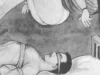
In the “standing illustration” I created, the puppet of “O-Tomi, the Slain” is captured by officials, placed on a bareback horse while still bound, paraded through the streets, and finally executed on a stake.
(While I’m at it, I should mention that these puppets are currently on loan to the Sex Industry Museum. Any member of the museum can view them.)
Hey, Rakka-san.
After reading the director’s notes for this play by Kawakake Mokuami in the script, you muttered, “This director’s words are strange. They’re condescending, and I just can’t read them with a sense of ease. It leaves a bad taste in my mouth.”
Hearing that, I grunted “hmm” and grinned silently, but as it turned out, I came to realize after the play ended that your muttering was actually correct.
Hey, Rakka-san.
You were truly perceptive to read the director’s text before the curtain rose and intuitively grasp the quality of the production.
Unnervingly sharp.
I have no choice but to say, “I take my hat off to you.”
Regarding this play by Zensho, written during the decadent period of the Bakumatsu era, Toshio Kawakake-san wrote the following in his “Complete Collection of Kabuki Masterpieces”: As I mentioned at the beginning, the highlights are the brutal torture scenes, the blackmail scenes, and murder scenes. However, unlike “Kirare Yozo,” the unique decadent beauty of stories featuring poisonous women and wicked old women lies in the fact that the women’s allure and sensuality are constantly interwoven throughout. The scene where O-Tomi is tortured to death at Akama’s concubine’s residence was apparently staged quite graphically at the time. For example, when Anzo hoists the trunk containing O-Tomi’s dismembered body onto his back, “a mechanism causes blood made
from real suou (a type of dye) to seep out of the wicker basket and flow out in a steady stream.” However, when O-Tomi, having been so grievously wounded, reunited with Yosaburo at the Ichitsuka residence, she hid her face with her sleeve, ashamed to be seen, saying, “Oh, how embarrassing,” and it is said that Tanosuke was unparalleled in his portrayal of this very moment.
Looking up “suou” in the dictionary, one finds “A deciduous shrub of the legume family. Native to India and Malaya. The heartwood is shaved to extract a red dye from its pigment.”
In old rakugo and ballad performances, when a person becomes covered in blood, it is described as “thrashing about with their whole body dyed in suou.”
And so on. I (Nureki) have also used this expression several times in my novels.
There was no scene where blood dripped from the cracks in the trunk as Anzo hoisted it onto his back after stuffing O-Tomi’s dismembered body inside. However, this time there was a dramatic touch. As the blood-soaked O-Tomi writhed in agony, trying to escape, and clawed at the sliding doors with both hands, her handprints remained smeared red on the wood, lending the scene a touch of cruelty.
The scene preceding that, where O-Tomi, bound behind her back with a red sash, is hacked to pieces by several men, seemed to be staged quite effectively.
(After all, she sustains seventy-five stab wounds all over her body. It really is a cruel story.)
A few years ago, when Sojuro Sawamura played “O-Tomi” at the same theater, this scene was not explicitly included.
In this production as well, it wasn’t the kind of brutal, drawn-out torture depicted in the script, but rather a matter of being poked here and there with the tip of a dagger. It didn’t quite reach the level of being “gruesome,” but it certainly had a certain atmosphere to it.
More than anything else, just as in “Kiare Yozo,” O-Tomi and Yozaburo naturally have a physical relationship in this play as well, and it is because of this that the brutal stabbing takes place at Akama’s concubine’s residence. Yet, in reality, these two are brother and sister.
The final scene of this production, “The Scene at Kitsunezaki’s Animal Grave,” symbolizes this incestuous relationship. That is, the “animal realm,” but the audience is not explicitly told this.
Perhaps this is because the performance is taking place at a major national theater.
I suspect that the ambiguity in the director’s expression, and the sense of unease Rakka-san felt upon reading the script and scratching her head, stem from this very point. What do you think?
In the near future, I intend to present a version of “Kirare O-Tomi” that is even more decadent and carries a more repulsive aura than these existing adaptations, using the “standing illustrations” I created myself. I have written this passage to serve as a prelude to that endeavor. P.S.
Rakka-san, who read this “Talking Theater” right away, called me.
I wrote that when O-Tomi’s affair with Yozaburo was exposed and she was hacked to pieces, a blood-soaked handprint was left on the sliding door (or perhaps the wall), but Rakka-san suggest that the handprint might not have been O-Tomi’s, but rather that of Akama Genzaemon’s henchmen.
She argues that O-Tomi had already fainted by then and was not in a state where she could press both hands against the sliding door or wall.
“I wonder if that’s right.”
I don’t have a clear memory of it.
Now that she mentions it, I think that might have been the case.
I remember very well how delicious the Hayashi rice and curry rice were at Matsumoto-ro in Hibiya Park, but I’ve forgotten the subtle movements of the onnagata on stage.
The reason I know the taste of both Hayashi rice and curry rice is that whenever I go into a restaurant with Rakka-san, we always order two different dishes and share them, eating half of each.
Yes, thank you for the meal.