← Back to the Nureki Chimuo Archive
“Bloody Flower Karuta” and “Tsubomi: Demon-Slaying Sword”
Akio Otakuro-sama.
I have indeed received the package containing the various materials.
Thank you very much.
I am deeply grateful for your kind letter to me, and for your thoughtful and intimate essay about me and those around me during my time at “Raina” and “Suspense Magazine.”
The volume of “Bloody Flower Karuta” from the “New Handsome Constable Series Vol. 8,” a rental manga published by Hibari Shobo and written specifically for Haruo Kano, is now a rare and valuable book that is quite difficult to obtain. It appears to be a work from before 1964 (Showa 39). It is a picture story from about fifty years ago.
Additionally, the materials you kindly clipped from the manga magazine “Comic Break” (published by Nihon Bungei-sha), a special issue of “Weekly Manga Goraku,” featuring the first six chapters of “Tsubomi Zanma Ken” serialized by Kanda Yu, are also period-themed manga, much like Haruo Kano’s work.
As mentioned in Otakuro-san’s letter to me, “Tsubomi Zanma Ken” features charmingly depicted young women in loincloths on every page, making it an ambitious and interesting work.
Still, it’s remarkable how well Otakuro-san remembers the contents of my six paperback books published by Kawade Shobo Shinsha.
Both Haruo Kano, who draws soulful bondage scenes, and the beautiful girls in loincloths appearing in Sukekazu Gurote-san’s illustrated stories are introduced within my books.
I’m truly happy that you’ve taken such an interest. Thank you.
Looking at the “Bloody Flower Karuta” by Haruo Kano you sent, I recall the time long ago when Mino Murako and I visited Kano-san’s home in Machiya, Arakawa Ward.
“This rental bookstore author, Haruo Kano, I’ve never met him, but I’m sure he shares our tastes. He knows his SM. Let’s meet him directly and ask him to draw for ‘Uramado.’”
“Yeah, I feel like he’d be a kindred spirit too.”
So I got into the spirit of it too. We took the Keisei train from Ueno, got off at the station called Machiya, and wandered through the narrow alleys, deep into the back alleys, until we finally found Kano-san’s house.
But Kano-san stood firm, chest puffed out and declared, “I’m sorry, but I owe a debt of gratitude to Hibari Shobo. I can’t draw for another magazine.” Like some old warrior, he refused, and in the end he didn’t draw for Uramado.
Recalling Kano-san’s appearance that day, my mind simultaneously revisits those days of pure SM immersion with Minomura Ko.
Those days were spent enduring the relentless, spiteful oppression of those in power who shunned SM, and thus the unforgettable, intensely concentrated days of pleasure shared with Minomura Ko…
Because almost everyone around us was an enemy, it was an era where Minomura Ko and I had to clasp hands tightly together just to survive.
To put it bluntly, even now most of the people around me are like “enemies.”
To be even more blunt, they’re “enemies” wearing the faces of allies.
They approach me saying things like, “I’m a person who shares the same inclinations as you,” but in reality, they are not allies. They may seem similar, but they are fundamentally different. I’ve become extremely cautious. I never lower my guard around people like this.
Otakuro-san, who remembered those few lines I wrote long ago about “Fundoshi Bishoujo” and went to the trouble of cutting out and compiling several comic magazines to send me this time, he is undoubtedly an ally.
Seeing the “Bloody Flower Karuta” by the great artist Haruo Kano that Otakuro-san sent me, it really is good. It’s interesting.
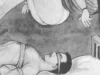
Within a single picture story, there are only a few bondage scenes. Yet, within those small, paneled spaces, the four or five scenes of torment possess an indescribable charm and emotional depth.
The bound woman, of course, remains fully clothed in her kimono, restrained with her hands bound in a takate kote using a shigoki (a type of rope).
The position of her wrists, looped high across her back is unbearably good. It’s sensual from an SM perspective.
Kano Sensei clearly poured his heart into drawing these scenes.
That passion becomes an intense emotion that resonates with the viewer. You can see the meticulous care taken with the woman’s expression, rendered with such detail that even each individual eyelash is carefully drawn.
Her large eyes, glistening with tears, are filled with a plump, moist resentment that is utterly endearing.
Hmm, I’ve seen this mood somewhere before. It feels familiar, vividly familiar. Then it hit me. It bears a striking resemblance to the atmosphere when Rakka-san was bound by me.
(Though Rakka-san, whenever I bind her, invariably loses half her consciousness, her body going limp, her eyes closing. So while the facial shape differs slightly from the wide-eyed beauty in Master Kano’s painting, the overall atmosphere, the eroticism radiating from her entire body through the ropes, is identical.)
Minomura Ko and I spent the whole day visiting Kano Sensei. On the train ride back, we discussed this.
“There’s definitely a masochistic obsession within Kano-san, specifically with bondage. He himself isn’t the least bit aware of it. It’s fascinating that he paints these emotionally charged rope paintings without any conscious awareness.”
I completely agreed with Minomura Ko’s observation.
No matter how consciously an artist tries to paint for enthusiasts, if they lack that heart, their work will never truly capture the essence of SM.
Conversely, some artists create illustrations that delight enthusiasts without ever realizing it themselves.
The same principle applies to writing, specifically to novels.
(Back when I edited SM magazines, three or four artists or writers would pitch their work to the editorial office every month. Talking with them really brought this point home.)
To put it another way, in commercial SM, no matter how enthusiastically or roughly the ropes are applied, if the person holding them lacks that heart, the bondage won’t convey the sensuality or pleasure of SM.
(This becomes clear when you look at the photographs by Minomura Ko published in Uramado. These are photos where Minomura Ko bound the women himself and then pressed the shutter. They use just a single rope for a light bind, yet they possess a truly rich, sensual SM flavor and a wonderful atmosphere.)
The other historical manga Otakuro-san sent me was “Tsubomi: Demon-Slaying Sword.”
To be perfectly honest, I think the artistic technique here is several levels more sophisticated than that of Master Kano. I believe the artist is young, but the artwork is quite skilled.
Above all, it feels modern. Fresh. The lines depicting the female form are slender, flowing freely, and dynamic.
The lines used by Master Kano to depict the female form are somehow more relaxed and heavy. The number of poses is also limited.
“Tsubomi: Demon-Slaying Sword,” published in 2009, is naturally more contemporary than Master Kano’s work from fifty years ago. It is boldly erotic throughout, as if saying, “Here it is, and here it is again.”
The heroines drawn by Kanda Yu quickly strip down to just a loincloth and engage in fierce combat with their enemies.
The depictions of the loincloth from various angles are sensual, and even from a general perspective it’s a sexy and enjoyable picture story.
It’s rare to see the figure of a beautiful girl in a loincloth appear so frequently and from such stimulating angles within a picture story, making it thoroughly valuable as reference material.
It’s only natural that Otakuro-san felt compelled to carefully cut these out and send them to me.
The enemies attacking the heroine are all supernatural beings, snake women, spider women, tengu, all using sinister magic.
The tengu man uses his tall, long nose as a weapon, thrusting it into the beautiful girl’s crotch over her fundoshi.
Naturally, the heroine’s limbs are bound, leading to a succession of scenes where she faces imminent danger.
These bondage scenes are also depicted with meticulous detail, sensuality, and skill. Scenes likely to delight the general reader unfold one after another, proving Kanda Yu to be quite the storyteller.
If you say this is SM too, well it certainly is. But to be harsh, I feel it lacks a certain “flavor.”
Perhaps it’s that I wish the depiction of the loincloth had just a bit more of that nuanced depth, that kind of obsessive attention to detail you’d expect from a true enthusiast.
I wish the loincloth itself had a bit more qualitative three-dimensionality.
If I’m being greedy, I would have liked an explanation or depiction of the psychology behind why this heroine always wears a loincloth.
If that were done, I guarantee this would become a fan-oriented picture story worthy of a very high score.
Of course, even as it is, it undoubtedly serves as excellent reference material for “beautiful girls in fundoshi.”
Once again, my sincere thanks. Thank you very much.
After treasuring and appreciating it thoroughly, I will entrust it to the Sex Industry Museum alongside Master Artist Haruo Kano’s “Bloody Flower Karuta.”