← Back to the Nureki Chimuo Archive
Letter of Gratitude to My Teacher
To my Acchitei5 Master:
I am writing in response to your kind letter. Thank you very much.
Along with your letter, you also sent me the substantial explanatory pamphlet for the “Namiki Sosuke Exhibition” at the Waseda University Theater Museum, beautiful postcards featuring theatrical prints of the first, second, and third generations of Toyokuni, Shizuo Yamakawa’s new publication for Kodansha, “People of the Far Side” (Human Stories from the Third Floor of the Kabuki-za), and the regional magazine “Shimotsuke no Kokoro,” which is truly splendid and magnificent. Thank you so very much for sending me all these things.
The regional magazine is truly remarkable, both for the richness of its content and its value as a resource. Frankly, I was astonished.
The reason you sent me such a magazine was because, within this “Shimotsuke no Kokoro,” there was an article about my beloved “Katabami-za.”
In the serialized column “Shimotsuke Theater Chronicles” by Shimizu Ichiro, a traditional performing arts researcher, there is a description of the play “Utsunomiya Tsuri Tenjo.” Within that piece, the names of the Tokyo theater “Kotobuki-za” and the “Katabami-za,” which once performed this play, appear.
me.
My acchitei master deliberately placed a bookmark on that very page before sending it to
What a thoughtful gesture. As always, I am deeply grateful and moved.
5
Acchitei is short for acchitei kocchi, which means amateur rakugo performer.
I read it immediately. Shimizu Ichiro must be accomplished as a local historian too, as he provided a detailed and careful explanation of the “Utsunomiya Tsuri Tenjo” play, which I found very educational.
The Tsuritenjo storytelling, plays, and films were quite popular from the Taisho era through the Showa era, and I was familiar with them, but I had never seen them performed as kabuki.
(The Katabami-za company favored selecting such rare plays and performed them quite skillfully, which is likely why they still come up in conversation among theater lovers today.)
The introduction mentioned that Shimizu Ichiro was born in 1934. Though four years my junior, he seems to have seen and remembered many older works. I am deeply impressed.
The Toho film “Iemitsu and Hikosaburo” (screenplay by Hideo Oguni, directed by Masahiro Makino) that Shimizu Ichiro wrote about, I saw it myself at the Yurakuza Theater in Hibiya right after its release in 1942. It featured the popular stars of the time, Roppa Furukawa and Kazuo Hasegawa. Even though the Pacific War had already begun, the theater displayed large, flashy caricature posters for the film, promoting it lavishly. I remember it vividly from my childhood.
Being a Roppa film, it was a lighthearted period comedy filled with cheerful music and songs.
But strangely, the crucial “Tsurutenjo” scene is faint in my memory. I even wonder if it was even in the film at all.
Later, I saw another film starring Roppa and Hasegawa Kazuo, the famous storyteller’s tale of a renowned doctor and actor, “Otoko no Hanamichi,” also at the Yurakuza.
This was, of course, the classic story of “The Famous Doctor and the Famous Actor.” It was a tale of gratitude and friendship between Hasegawa Kazuo’s Kagaya and Roppa’s eye doctor, Habu Genseki.
While the master storyteller at the other teahouse is for more knowledgeable than I, I recently revisited and learned from the detailed explanation in my revered teacher Yoshizawa Hideaki’s book, “Encyclopedia of Storytelling Works,” about this “Famous Doctor and Famous Actor” tale. In the storytelling version, the doctor’s name is Nakarai Gentaro, later known as Nakarai Hogen.
(Thank you for inviting me to Dr. Yoshizawa Hideaki’s lecture a week from now. I will certainly attend. Furthermore, I am deeply honored to hear that after the lecture a month later, I will be invited to Dr. Yoshizawa’s residence. I will definitely be there.)
By the way, I just suddenly remembered.
My “Talking Theater” here is currently taking a breather at the point where my younger self joined the theater troupe “Tobu.” But the very first job I was given at “Tobu” was, believe it or not, to appear as an extra in a movie starring this very same Roppa.
It was a Toho film right after the war, and I distinctly remember the title being something like “If My Song Had Wings.”
It was a film where Roppa co-starred with a popular boy soprano singer of the time named Kagami Ichiro.
Five or six boys were selected from “Tobu,” and we appeared as “school friends” interacting with the lead actor, Ichiro Kagami.
The filming location was Toho’s Kinuta Studio.
While waiting for the shoot, Roppa sat solidly in his own special chair. With the calm, gentle face of a star, he emitted that characteristic “Foh, foh, foh” laugh while chatting with the staff.
Kagami Ichiro was clinging to Roppa’s body, playfully showing off to us extras from “Tobu.”
I digressed. My apologies.
I also saw the 1956 Shintoho film “The Strange Tale of Utsunomiya’s Floating Ceiling” in Asakusa.
I generally enjoy these eerie tales, so I never miss them.
Whenever I see “suspended ceiling” stories in period films or TV shows, I always find something odd about them.
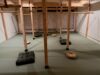
I just can’t quite grasp the mechanism behind the “suspended ceiling” devices supposedly built to assassinate the shogun.
These massive wooden gears, set up and meshed together in the attic, start grinding, creaking, and groaning loudly when the moment comes.
The mechanism is that when the complexly meshed gears start turning all at once, something somewhere starts moving, the ceiling falls, and the people underneath are crushed. But I just don’t get it.
First of all, if gears made such loud, grinding, clattering noises when they moved, the people below would hear it and know danger was imminent.
Well, no matter what movie you watch, the gears always stop at the last possible moment, and the lord escapes unharmed.
(This kind of scene also frequently appears in TV shows like Mito Komon.)
It’s genuinely funny how, despite these simple wooden giant gears making such a tremendous noise as they turn, the mechanism for the ceiling collapsing remains completely baffling. It’s fun. I like it.
The craftsmen and carpenters trapped inside the castle, building the gears, are either killed after completion or nearly killed to keep the rebels’ secret.
There was also a story where the carpenter’s foreman had a beautiful daughter, and she and a young samurai among the rebels were lovers. What could happen?
Well, it’s quite dramatic in many ways.
If the goal was to eliminate Shogun Iemitsu and his inner circle, I can’t help but think it would have been simpler and more reliable to slip poison into their soup bowls at dinner, rather than going to all this trouble making such conspicuous tools that are easy to expose.
This story of “The Strange Tale of Utsunomiya’s Floating Ceiling” is also detailed in Professor Hideaki Yoshizawa’s “Encyclopedia of Storytelling Works.” It’s genuinely funny how, despite these simple wooden giant gears making such a tremendous noise as they turn, the mechanism for the ceiling collapsing remains completely baffling. It’s fun. I like it.
The craftsmen and carpenters trapped inside the castle, building the gears, are either killed after completion or nearly killed to keep the rebels’ secret.
There was also a story where the carpenter’s foreman had a beautiful daughter, and she and a young samurai among the rebels were lovers. What could happen?
Well, it’s quite dramatic in many ways.
If the goal was to eliminate Shogun Iemitsu and his inner circle, I can’t help but think it would have been simpler and more reliable to slip poison into their soup bowls at dinner, rather than going to all this trouble making such conspicuous tools that are easy to expose.
I’ve gone off on a tangent again. “The Loyal Subjects of Chushingura” “Sugawara Denju Tenarai Kagami” “Yoshitsune and the Thousand Cherry Trees”
When it comes to the author of these works, I immediately think of Takeda Izumo, but it turns out that the original and crucial scenes within these masterpieces were written by Namiki Sosuke.
I learned this fact from the pamphlet about the Waseda University Theater Museum that my teacher gave me.
Apparently, the eighth act (the fourth act in Bunraku) of my absolute favorite play, “Sugawara Denju Tenarai Kagami,” titled “Terakoya,” is essentially close to the form written by Namiki Sosuke.
In this “Talking Theater,” I got carried away and transcribed the “Iroha Okuri” narration, but that was actually a famous scene created by Namiki Sosuke.
In this pamphlet, Mikiko Uchiyama-san, who wrote about the collaborative joruri works of Takeda Izumo, Miyoshi Shoraku, and Namiki Sosuke, was apparently the teacher of my acchitei master.
Shizuo Yamakawa’s book “The People of the Grand Stage” (The Third Floor of the Kabuki-za: Tales of Humanity) is truly fascinating.
It’s so thrilling it makes your whole body tingle. It’s frustrating, but it’s fascinating.
I knew that reading it would make me writhe in frustration, so I had decided not to read it.
But I just couldn’t resist.
And sure enough, after reading it, I writhed.
I feel jealousy and an envy so strong I could kill him for his position, but it’s still fascinating.
It’s fascinating enough to bring tears to my eyes.
I’m envious, so envious it makes me dizzy, yet at the same time, a warm feeling envelops my entire body.
So this is the world of intoxication and blissful ecstasy.
It’s a dazzling world beyond my reach.
I’m a lazy person who hates effort, poor in everything, and sulky, so I just watch with my fingers in my mouth, tears welling up.
Thank you.
I am truly grateful for your unchanging consideration towards someone like me.
I am always, always thankful for your constant thoughtfulness.