← Back to the Nureki Chimuo Archive
Wandering and Scattered Charm
I finished the manuscript for “Nozaki Village Was Cold” and immediately faxed it to R-san. Soon after, her reply arrived.
“Sensei, the ‘Brief Biography of Nagata Mikihiko’ section at the end of this manuscript is already included elsewhere. You’ve already written it in the ninety-third installment, ‘I Love Touring!’” she told me over the phone.
She always reviews my manuscripts immediately. I’m truly grateful for her.
“What?!” I was stunned.
Then, I immediately went back and reread it.
When I send manuscripts by fax, the handwritten draft remains in my possession. That’s the best thing about this fax machine.
Indeed, at the end of “I Love Touring!” there was a “Brief Biography of Nagata Mikihiko.” It was something I had transcribed myself.
What I published this time was a further abridged version of that “Brief Biography.”
But I realized that my desire to include that “Brief Biography” had grown deeper and more urgent than it had been last time.
It was precisely because it had become so deep and urgent that, carried away by the momentum, I forgot I’d introduced it once before and published it again.
It wasn’t a deliberate blunder. It just happened naturally as I wrote, riding the flow of the text and pouring my heart into it.
Writing with passion, specifically, meant things like, “My taste for the lowly felt almost like a masochistic sensation.” That sort of thing.
Perhaps I should have written not “close to a masochistic sensation,” but that it was masochism itself.
But I hesitated, thinking that stating it so definitively might be too much of a leap.
So I softened the expression.
Regarding the blunder of having Nagata Mikihiko appear twice in this “Talking Theater,” I consulted R-san, asking, “What should I do?”
“When text from a webpage is published over time like this, readers might not mind much. But readers who pick up a book and read it continuously might think, ‘Oh, there he is again,’ don’t you think?” R-san said.
I pondered and pondered, “What should I do? Should I delete one? But reading them both, they’re both the natural flow of my feelings, or the result of my heightened mood. To be honest, I don’t want to delete either one,” I said.
And so, I reread the novels written by Nagata Mikihiko from the late Meiji to the early Taisho periods, “Decline,” “The Story of Sensho,” and “Zero (Mio).”
Reading all three in succession, that same crushing, profoundly poignant, oppressive sense of desolation overwhelmed my mind and body, plunging me into the exact same masochistic mood I’d felt when I first read them at fifteen or sixteen.
This masochism wasn’t the simplistic kind involving direct, overt dynamics like the typical “mistress and slave” dynamic (though deep down, there might be such sexual connections). It felt like a fundamental, all-encompassing masochism, enveloping my entire being from head to toe.
The above is my explanation for posting “A Brief Biography of Nagata Mikihiko” twice.
For now, I have no intention of deleting one of the duplicates or rewriting the surrounding text.
However, if R-san were to say, “You really should rewrite it,” I would heed that advice when compiling it into a single book.
Because I believe R-san is the finest reader and most precise critic of this “Talking Theater.”
“To put it simply, I think it’s fine as it is. Your feelings are expressed very naturally, and I believe readers will accept it straightforwardly without any sense of discomfort,” R-san stated decisively at the end.
When I think about it, the stage performances and lives of traveling actors of this era and type are preserved only in writing.
They are not preserved in photographs, paintings, or of course, film.
(Reading this novel, it seems traveling actors of this era also performed different plays every night, meaning they did kabuki on a daily rotation. So perhaps the fact that today’s “popular theater” performs different plays every single night is a tradition after all.)
It is precisely because it is writing, precisely because it is a world expressed through fiction, that it could sing the romanticism of people wandering in miserable circumstances, imbued with poetic sentiment, while concealing a profound scent of masochism at its core.
Oh, somehow we’ve gone off on a tangent again.
Where did it start? What triggered it?
Ah, yes, it was the story of O-Some from “Nozaki Village,” who must perform on a poor, desolate stage, carrying her own boat with her own hands. That’s how far we’ve strayed from the tale.
In 1946 (Showa 21), the New Year’s performance at the Shirahige Theater featured the following play as the second act.
1. Keian Taiheki (The Keian Chronicle of Peace) by Maruhashi Chuya. The Scene at the Moat.
Maruhashi Chuya … Onoe Takenosuke Matsudaira Izumigami … Ichikawa Fukunosuke Archer: Fujishiro … Kataoka Tobei Teahouse Woman … Bando Reiko Attendant One … Umezawa Hideo Attendant Two … Arisawa Kotaro Attendant Three … Ichikawa Fukujiro
2. The Black-Handed Group: The Round-Up From Nakano-cho to Retribution. Three Acts
Hanakawado Sukeroku … Bando Takejaku
Agemaki … Ichikawa Fukunosuke Shriatama … Onoe Otojo Shiraki Uri/Shibei … Sawamura Tetsuzaburo Torii Shinsaemon … Kataoka Tobei Disciple 1 … Hideo Umezawa Disciple 2 … Kotaro Arisawa Disciple 3 … Ichikawa Fukujiro
3. The Love Suicide at Amijima. The Riverbank Scene.
Kamiya Jibei … Bando Takejaku Koharu … Ichikawa Fukunosuke Konaya Magoemon … Onoe Takenosuke Zenroku … Sawamura Tetsuzaburo Tahei … Kataoka Tobei
Marubashi Chuya was originally slated to play the role of Takejaku, the lead actor. However, since Takejaku was performing the important roles of Sukeroke in the second act and Kamiya in the third act, the role of Tadayoshi was likely given to Takenosuke instead.
The role of Kansuke, the sake warmer at the moat scene, has been changed to a tea shop woman. This is likely because Tetsuzaburo, who previously played Kansuke, has an important role in the next act, so actress Reiko took his place instead.
I played the same role as before. The attendant number three, wearing a stuffed animal costume as the dog barking at Chuya. This time, it was only the moat scene. There was no arrest scene.
The performance of “Kawasho (Riverbank)” by the duo of Takejaku and Fukunosuke was a truly moving stage.
It seemed as though their passionate acting covered up the crudeness of the costumes and set.
No, rather than passionate acting, it appeared to me that the actors of this troupe simply loved performing so much they couldn’t contain themselves.
Well, it is their profession, so you might say it’s only natural. But on that cold, harsh stage, it seemed to me they were performing with more than just professionalism. They were performing with passion.
I had discovered the appeal of traditional Kamigata theater a few weeks earlier through Takejaku and Fukunosuke’s performance of “Koi Hikyaku: Yamato Orai - Fuin Giri,” but the
excellence of this “Kawasho” was shocking, moving me even more deeply than “Umezawa Chubei.”
Takenosuke’s performance as Koya Magoemon, too, was superb, rich in human warmth and perfectly suited to the actor’s gentle nature.
Looking back now, among the plays performed by the Takejaku troupe, this “Kawasho” was the absolute masterpiece. To add, the second best was “Terakoya,” and the third was “Umezawa Chubei. The Seal Breaker.”
The “Kawasho” performed at the Shirahige Theater ran a total of nine times: one evening performance on weekdays, and two performances each (matinee and evening) on Saturdays and Sundays.
The following run at the Tsurukame Theater also featured this “Kawasho,” meaning I saw this play a total of eighteen times.
And each time, I watched it intently from beginning to end, without even blinking. I was utterly captivated by the charm of this play and simply couldn’t stop watching it.
The protagonist, Kamiya Jibei, has a wife and two children with her, yet he falls for Koharu, a courtesan employed by Kinokuniya in Sonezaki Shinchi.
It was a deeply poignant play about two lovers who, having fallen deeply for each other, ultimately end in a double suicide. Looking back now, it’s impossible for a seventeen year old boy to truly grasp such a desperate, tragic adult love story, yet somehow, I understood it.
I wept for the heartrending feelings of the courtesan Koharu and the pitifulness of their illicit love.
Even as an elementary school student, and despite it being wartime, I was engrossed in reading nothing but such novels. I suppose I was what you’d call precocious.
Captivated by “Kawasho,” I watched the stage every day. It was only natural for a young mind, but I ended up memorizing every line of dialogue spoken by the characters.
And even now, sixty years later, I remember every single word of that dialogue.
I didn’t memorize them intentionally. They simply entered my mind and became etched there.
It truly is a masterpiece. A masterpiece excels in its scenes, structure, and character portrayal.
The emotion stirred by encountering that masterpiece soaked into my seventeen year old brain like rain seeping into parched sand.
Whenever “Kawasho” is performed in the current Grand Kabuki, I always go to see it. The lines flow effortlessly from my mouth, matching the actors on stage. I murmur the lines in my mouth and become intoxicated.
Just the other day, I performed in part of my neighborhood’s theater festival. I struggled to memorize a dozen lines of dialogue. I perform in this festival every year, yet it seems my ability to memorize lines grows worse with each passing year.
The influence of Nagata Mikihiko’s novels about drifting and decline is significant, but facing “Kawasho,” drowning in it, and being moved eighteen times, didn’t that also suggest some direction for how I would live my life afterward?
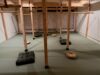
The Shirahige Theater was bleak and impoverished, devoid of the emotional depth or poetic lyricism found in the novel “Decline.” Yet it was also the season when my body and soul were shaken by the impact of “Kawasho,” performed by Takejaku and Fukunosuke.