← Back to the Nureki Chimuo Archive
Nozaki Village was Cold
The year after defeat, in 1946 (Showa 21), during the New Year’s performances at the Tsurukame Theater, I stood on the same stage for the first time with my master, Ichikawa Fukunosuke. Though brief, I exchanged lines with my teacher.
It was the scene set in Nozaki Village from the “New Version of the Song Festival Text.”
Fukunosuke played O-Some, the daughter of a pawnbroker named Aburaya, who had traveled all the way from Osaka to visit her lover, Hisamatsu.
My role was Yoshi, the maid who followed O-Some.
Nakajima-san, Fukunosuke’s attendant, made a special trip to the audience seats to watch my performance.
“Fukujiro-san, you were good. You see, whatever role you play, you fully become that character. Regardless of whether it’s good or bad acting, that’s your strength.”
“Thank you very much.” I bowed my head and thanked him.
But I wondered, what did he mean by “regardless of whether it’s good or bad acting?”
This woman had been Fukunosuke’s attendant since the Honjo Kotobuki Theater days. She carried the dignified air of a veteran attendant. She must have been close to fifty by now.
She meticulously took care of every detail of Fukunosuke’s personal needs, dressing him in stage costumes, assisting with his makeup, and so on.
She was a stern-looking woman with high cheekbones, sunken eyes, and full lips, but she was kind and considerate to me.
It was also Nakajima-san who did the makeup for the role of Yoshi, the maid in Nozaki Village.
First came “Silence (Danmari),” then “Nozaki Village,” and the third play, the closing piece, was “Comedy: The Eighteen Year Old Daughter.” However, I’ve forgotten the content of this play, it’s no longer in my memory.
I was also in the cast, playing the role of “Hosho,” but I don't remember it.
Judging by the title, I suspect it was a rehash of one of Soganoya Goro’s usual plays, but what kind of play it was and what lines I spoke have fallen from my memory.
Though labeled a “comedy,” it must have been a rather dull, unimpressive play.
After the New Year’s run at the Tsurukame Theater ended, the Bando Takejaku troupe took those three plays exactly as they were and moved them to the Shirahige Theater.
Here at the Shirahige Theater in Mukojima, it was still the New Year’s season.
My notes only list the three plays under the cast section, it simply says “same as before.”
There’s no mention of when the performances ran from or to. The record is thin. So what I write ends up being mostly “reminiscences.” There’s no helping it now.
That winter, I recall, was especially cold.
It might be hard to believe now, but in those days, there were no heating or cooling systems.
Even when the auditorium was packed, the human body heat did nothing to ease the cold.
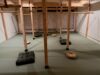
Both the stage and the audience area were frozen solid by the midwinter cold. The floor beneath the audience seats was concrete. The cold seeped in, starting from my toes, up through my ankles, and all the way to my knees.
Audience members who lived nearby brought cushions from home. They placed them on the chairs, folded their legs, and watched the play seated in seiza.
This wasn’t just because it was a small theater in the backwater of Mukoshima that lacked heating.
It was the year after the defeat. Back then, no movie theater or playhouse had the luxury of heating.
At the newsreel theater in the basement of the Nikkatsu in front of Yurakucho Station, there were no chairs. I watched the movies standing up. I wasn’t alone. All the customers watched the movies standing up.
There were no chairs in the audience seating.
You might find it hard to believe, but it’s true.
The north wind whistled through the vacant lot, scorched by American air raids.
Leaving the Shirahige Theater, on the walk to Minami-Senju Station on the Joban Line, all you could see were two huge gas tanks.
Just a few months earlier, the bodies of men, women, and children, charred and mangled, lay piled up and scattered across this very ground.
In this area, only the section centered around the Shirahige Theater had miraculously survived the fire.
The slightly modified cinema hut was also terribly drafty.
When the north wind blew, the corrugated iron roof would peel up and creak loudly.
In the margins of my diary from that time, I wrote a poem-like passage about the stage on that bitterly cold day.
Nozaki Village
It’s a bitterly cold day O-Some, who came from Osaka to see Hisamatsu Finally got to see the man she longed for Yet she narrowed her eyes like a fox And trembled on stage
O-Mitsu, betrayed by Hisamatsu Weeps with her back to the audience Early-blooming plum branches sway from the eaves The north wind blows, rattling the hut’s roof On cold days, everyone is unhappy
O-Mitsu, the daughter of Kusaku, a farmer in Nozaki Village, and Hisamatsu had been betrothed since childhood and were destined to become husband and wife.
However, Hisamatsu became close to O-Some, the daughter of the pawnbroker where he worked in Osaka. Hisamatsu and O-Some had grown so deeply attached that they vowed to commit double suicide if their love could not be fulfilled.
Upon learning this, O-Mitsu resolved to give up her feelings for Hisamatsu. She decided to cut her topknot and become a nun.
Persuaded by their parents, they decided to return to Osaka for the time being. O-Some traveled by boat, while Hiramatsu rode in a palanquin.
Here comes the climactic scene. The boat carrying O-Some moves from the left side of the stage to the hanamichi.
Meanwhile, Hisamatsu in his palanquin moves to the temporary hanamichi on the right side of the stage. From the audience’s perspective, the actors dramatically part ways, exiting to opposite sides of the stage. It’s a scene both sorrowful and splendid.
This becomes the famous lively accompaniment piece “Nozaki no Okuri” on the Gidayu shamisen, and I absolutely adore this scene.
However, this is the lavish, splendid production seen on grand stages like the Kabuki-za. On the small stage of the former movie theater in Mukojima, it simply couldn’t be done that way.
In the grand production, after the stage rotates from the scene at Hisamatsu’s house, it immediately becomes the scene on the earthen embankment behind it, from which the boat departs. But the Shirahige Theater lacks the equipment for a revolving stage.
To condense two scenes into one, the boat must depart from in front of Hiramatsu’s house.
O-Some and her mother O-Tsune boarded the boat, steered by the boatman with his pole, and retreated down the hanamichi. But that boat was nothing more than a thin plywood board with a crude painting on it.
O-Some and O-Tsune board the boat, sit down, and then grasp the edge of this single plywood boat with their own hands.
Basically, they must support the edge of the boat with their own hands to keep it from tipping over.
The boat’s bottom rests directly on the stage floor.
Since it’s just a single, long, narrow plank for a boat, it would tip over without being supported by hand.
The boat moves forward in sync with the Gidayu music and the boatman’s movements as he stands and maneuvers the pole.
O-Some and O-Tsune, seated inside, must move the boat while remaining seated, shifting their entire bodies sideways in time with the music.
Keeping their upper bodies still, they subtly support the boat’s edge while gradually shifting their hips and feet sideways, making it appear as if the boat is moving forward.
It’s a simple and crude mechanism, so it’s completely visible from the audience seats.
(Now, with advanced mechanisms like sensors, a single boat glides freely across seas and rivers constructed on stage.)
Even without the real thing present, acting as if it exists is undoubtedly part of an actor’s craft. Yet, at the climax of a tragedy, the poverty of such a crude, small-scale production, a mere “small play,” made me sad. It seemed unbearably pitiful.
The one who was truly sad, more so than a novice actor like me, was surely Fukunosuke, who played O-Some.
Hisamatsu’s exit scene should have been a grand one too, leaving the stage in a palanquin from the temporary hanamichi built on the upstage side. But here, he merely moved his body while standing, making dance-like gestures to the rhythm of the Gidayu shamisen, taking half-hearted steps one by one until he hid himself behind the wing curtain.
Even to my seventeen year old eyes, it was a poor production.
Still, Onoe Otojo as Hisamatsu, Onoe Takenosuke as her father, Hisakatsu, and Bando Takejaku as the leading lady O-Mitsu all poured their hearts into this scene, elevating its emotional intensity with earnest, passionate performances.
Drawn in by the actors’ earnest artistry, I don’t recall any hint of the audience mocking the crude boat’s movements.
Their performance was undoubtedly passionate, yet the biting cold in the unheated hut was severe. Enduring it, O-Some’s face had grown stiff, her eyes narrowed and upturned like a fox’s.
I remember Fukunosuke’s face, frozen stiff from the cold at that moment, as if it were yesterday.
The cramped dressing room had barely enough space to fit a single brazier.
In winter, the feel of lukewarm white powder brushes against the face is cold.
Even now, when I think of the other side of the Sumida River, I have this sense that it’s a place so cold, O-Somoe’s face would freeze and resemble a fox.
The Shirahige Theater is probably nothing but a shadow now, but I’ve made a promise to walk with R-San to the place where I once felt that way. We’ll get off at JR Minami-Senju Station, turn left at Namida Bridge, cross Shirahige Bridge, and go there.
R-San says some vestiges of that era might still linger, but over sixty years have passed. I feel like not a single fragment remains.
Why is it that, while I never want to taste that cold, that misery, that pain again, it has also become a nostalgic memory, causing me to reminisce like this from time to time?
From the age of fifteen or sixteen, I enjoyed reading the novels of Kubota Mantaro, but at the same time, I repeatedly read and cherished novels like Nagata Mikihiko’s “Decline,” “The Story of Ogi Noboru,” and “Mio.”
It wasn’t so much reading as devouring. I was utterly immersed in the world of these novels.
Reading them would make my whole body tingle.
And I dreamed that someday, I too would become like the protagonists of these novels.
It’s the tale of a man who grew weary of life in Tokyo, set out traveling alone, met a group of wretched traveling actors in Hokkaido, and eventually became one of them.
The figures of these poor, lonely, unfortunate traveling actors, who had turned their backs on ordinary life, were depicted with poetic feeling.
From a young age, I had a sort of “taste for the fallen,” an inclination close to masochism. Immersing myself in this novel only seemed to strengthen that tendency.
Regarding the writer Nagata Mikihiko, the following brief biography is recorded in Volume 33 of the “Meiji-Taisho Literary Collection” published by Shunyo-do in 1928, under “Nagata Mikihiko and Nogami Yayoi.”
A Brief Biography of Professor Mikihiko Nagata
Born on March 1, 1887, in Kudan Nakasaka, Kojimachi Ward, Tokyo City. (Omitted) He entered the English Literature Department at Waseda University, devoting himself to the study
of English, French and Russian literature. Beginning in 1909, he embarked on a nomadic life, eventually joining a troupe of traveling actors in Hokkaido. Upon returning, he submitted his breakthrough work, “Decline,” to Chuo Kuron, instantly gaining literary fame. Later, he again lived in exile in the Keihan region, producing eighty-nine volumes of works over the following seventeen years.
Though fate played a part in the chaotic period immediately following the war, I believe it was the influence of this novel, “Decline,” that led me to become a disciple of Ichikawa Fukunosuke and to shiver with cold in a shabby, burnt-out hut in Mukojima.
But when I actually experienced it, I found myself trembling in a daily life even harsher, more desolate, and more hopeless than the world depicted in the novel.
Yet, the troupe leader, Bando Takejaku, my master Ichikawa Fukunosuke, and all the other actors, they all performed every day with a tenacious, wholehearted dedication. They all loved the theater.
No, one could also say they had nothing else to do but perform.
No matter how poorly equipped or impoverished the hut, if they put on a show and even a few customers came, they could stave off hunger.
In the uncertain world immediately after defeat, when tomorrow’s fate was unknown, simply staving off hunger was what mattered most.
After losing the war, the terrifying planes dropping bombs over our heads no longer flew. People shouted that peace had come, yet it was an anxious time, unsure if true peace had truly arrived. Perhaps that is precisely why their performances possessed such single-minded devotion and passion, continuing to move me to this day.