Uramado

January 1962

← Back to magazine archive
Cover of Uramado, January 1962

Issue Details

PDF pages
4

Summary

The January 1962 Uramado material consists of a compact photographic feature titled Rope Mood, 縄のムード, credited on its opening page to photographer Yoshida Hisashi. Rather than presenting prose, fiction, correspondence, or editorial commentary, the feature uses four black-and-white pages to explore rope bondage through a succession of intimate domestic images.

Read full summary Close full summary

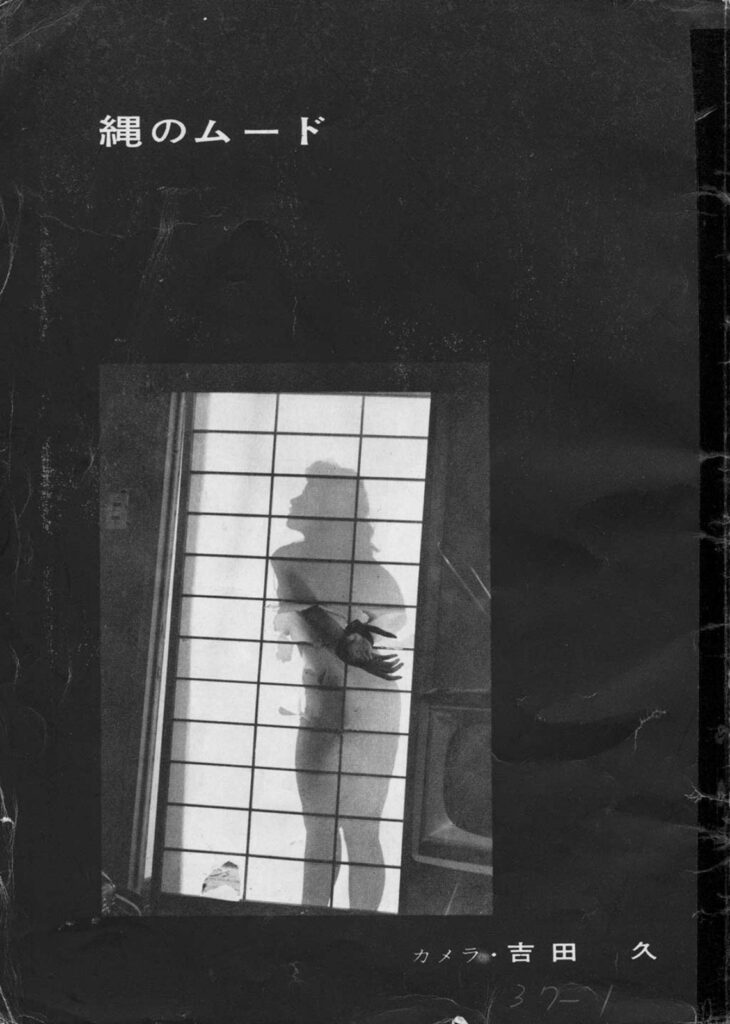
The opening page is constructed around concealment and silhouette. A bound woman is photographed behind a shoji screen so that her figure, restrained arms, and profile appear partly as shadow. The large area of black surrounding the smaller illuminated photograph gives the page an unusually restrained graphic design and makes the relationship between rope, body, and obscured visibility central to the composition.

The second page contrasts two photographic distances. A large close-up isolates the lower body and underwear, while a smaller inset shows the model standing beside curtains with her wrists secured overhead. The juxtaposition moves between fragmentary erotic detail and a more legible full-body bondage position. The third page shifts to the bed, where the woman lies partially unclothed with rope crossing the upper torso and wrists restrained. The framing places her expression and the rope lines across the body at the center of the photograph.

The concluding page presents the most elaborate rope arrangement. The model lies on the floor with multiple rope turns crossing the chest and upper body, producing a comparatively dense geometric pattern. Across the four pages, Rope Mood avoids a technical or instructional presentation of tying. Its emphasis is instead photographic atmosphere: shadow, domestic interiors, partial concealment, changes of camera distance, bodily exposure, and the visual contrast between rope and skin. The feature is consequently significant as an example of Uramado treating kinbaku as an autonomous photographic aesthetic rather than merely an illustration accompanying prose.

Loading PDF…

Highlights

  • Rope Mood opens with a bound woman photographed behind a shoji screen, using silhouette, shadow, and partial visibility to make concealment itself part of the bondage image. (PDF p. 1).
  • The opening page credits the photography to Yoshida Hisashi, written 吉田久, making this one of the relatively uncommon Uramado bondage portfolios with a visible camera credit. (PDF p. 1).
  • The second page juxtaposes an intimate close-up of the model's lower body with a smaller full-body photograph showing her wrists restrained overhead beside a curtain. (PDF p. 2).
  • The third page moves the scene to a bed and emphasizes the model's expression together with rope crossing the upper torso and restrained wrists. (PDF p. 3).
  • The final photograph presents the densest rope configuration of the feature, with multiple lines crossing the chest and upper body while the model lies on the floor. (PDF p. 4).