Article Summary
Miyahara Shizuo describes Itō Seiu's career as a genre painter and specialist in punishment imagery, then focuses on Seiu's staged photographic experiments with yuki-zeme, or snow torture, conducted from the Taishō into the early Shōwa period. Drawing on Seiu's own account, Miyahara records the practical circumstances of the shoots, the models' consent, the use of rope, snow, sake, and outdoor exposure, and the severe physiological effects of cold. Historically, the article is significant because it treats Seiu's bondage and punishment photography not merely as erotic spectacle but as deliberate visual experimentation inspired partly by kabuki torture scenes and intended to test how actual bodily suffering appeared before the camera. It also preserves Seiu's striking observation that prolonged cold eventually erased theatrical beauty and expressive femininity, producing rigidity and a loss of what he considered pictorial beauty.
Translation
Seiu’s Snow Torture
Miyahara Shizuo
It has now been seven years since Itō Seiu collapsed. Ever since then, down to the present day at the age of eighty, he has continued to convalesce quietly. For Seiu, who has so many admirers throughout the country, one can only imagine how frustrating these seven blank years must have been.
Of the seventy-four years before illness struck him down, he had spent at least sixty in intimate company with the brush, and his work across the three eras of Meiji, Taishō, and Shōwa was nothing if not prodigious.
When one speaks of Seiu, there is surely no one who does not know him as a researcher of torture and as the foremost painter of punishment scenes. Yet Seiu’s original vocation was that of a genre painter who established a distinctive school of his own, depicting the everyday customs of ordinary people from the Edo, Meiji, and Taishō periods in every direction. In particular, he remembered the scenery and customs of Tokyo from the late Meiji through the early Taishō period with astonishing accuracy, and the genre scenes from those years that came from his brush evoke powerful nostalgia among older people.
Gas lamps glowing in Ginza, horse-drawn streetcars running through the streets: through Seiu’s pictures I myself have been able to conjure up the customs of Meiji. His later work, “Fūzoku Yashi,” is among the most outstanding pictorial encyclopedias of Edo and Meiji customs.
A Harrowing Photo Session
Seiu did not become deeply absorbed in the study of torture until later in life. Judging even from photographs in my own private collection, I think it must have been when he was in his thirties. It was in his forties that he began most energetically presenting paintings and photographs to the public, and among these, the photographs of snow torture were especially prized.
What stirred Seiu’s desire to photograph snow torture was his interest in snow-torture scenes in kabuki, such as “Chūjō-hime Snow Torture” and “Urazato no Akegarasu.” He began to want to probe such torture paintings and theatrical scenes more deeply and realize them in actual life.
Seiu therefore used three women as models, two of them, the first and last, being his wives, and conducted this experiment on more than ten occasions over the roughly ten years from 1921 to around 1930. The following is excerpted from Seiu’s own account of what took place.
Although I call it an experiment, the person being tortured of course participated with full knowledge of what was being done, and the principal purpose was photography rather than torture itself. Consequently, if one is looking for evidence in the victim’s facial expression, that evidence is weakened. Still, the fact that a nude woman was bound in the snow, made to tread on it, and exposed to the cold for a long period was, for me as well, unquestionably an experiment undertaken for research.
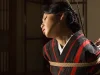
The first snow-torture session was carried out at my home. One morning after a heavy snowfall of more than thirty centimeters, I took advantage of the opportunity, had my wife’s hair dressed in the Shimada style, waited for dawn, and summoned a photographer.
I gave my wife sake to drink, and from around nine in the morning we photographed for a little over two hours, taking fourteen or fifteen exposures.
At first she wore only a long under-kimono. We buried her in the snow, and the photographs taken while shoveling snow over her body were extraordinarily powerful in effect.
As the number of photographs increased, my wife’s lips began to convulse. Her lips trembled, her eyes became bloodshot, and her pupils seemed to stare fixedly at a single point. The color of her cheeks became not so much blue as tinged somewhat black.
Her body grew rigid, and the skin into which the ropes bit had turned purple. When we brought her from the garden into the tatami room, her feet had completely lost sensation and she could not walk. When I untied the ropes and tried to warm her at the brazier, she said, “It hurts.” She had entered a frostbite-like condition.
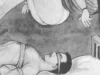
Photograph of “Snow Torture,” staged by Itō Seiu
It Hurts More to Do the Torturing
“Are you all right?”
“I’m all right. I can still stand it.”
“Then let’s keep going until you start to feel faint.”
“Yes, all right.”
We placed a brazier near her waist and gradually warmed her feet, then took her back out into the garden and continued photographing. But as I looked through the lens, constantly wondering whether she would faint at any moment or recover, the nervous strain was tremendous. It was then that I first realized that torturing could be more painful than being tortured.
As more time passed, my wife’s face became expressionless. There was none of the gloss or beauty one sees in a theatrical performance.
People ordinarily imagine that the longer a torture continues, the deeper the expression of pain grows on a woman’s face. In snow torture, however, the determination not to succumb to the cold grows stronger and stronger. The body stiffens, the flexibility characteristic of a woman disappears, and the figure becomes rough-hewn and masculine. Feet that had turned inward begin to turn outward. In this way, pictorial beauty is gradually lost.
One can only bow one’s head before the earnestness with which Seiu pursued these experiments. Even so, it is sad to think that we may never again see records of experiments like these.
In closing, I pray that Seiu will recover completely as soon as possible, and I look forward to the day when he will once again wield his vigorous brush.
Translation Notes
The visible article title on PDF page 52 is 晴雨さんの雪責め, literally "Seiu's Snow Torture" or "Seiu's Snow Torment." The supplied catalog title "Seiu's Photographic Punishments" has been retained in article_title, while the translated article heading follows the printed title. 責め (seme) is translated contextually as "torture" or "torment," and 雪責め (yuki-zeme) as "snow torture." The section heading 凄絶の撮影 is rendered "A Harrowing Photo Session." The phrase 伊藤晴雨作 in the photograph caption indicates a work or staging by Itō Seiu; it does not necessarily establish that Seiu himself operated the camera, so the translation uses "staged by Itō Seiu." 中将姫雪責め and 浦里の明烏 are references to theatrical snow-torture scenes that Seiu says stimulated his interest in recreating such imagery photographically. 島田 refers to the Shimada style of women's coiffure. 火鉢 is translated as "brazier." The title of Seiu's later work appears in print as 「風俗野誌」; the reading and bibliographic normalization of this title should be checked against a reliable Seiu bibliography.
Uncertain readings:
- PDF page 53: the printed title of Seiu's later work appears to read 「風俗野誌」; the scan is legible enough to suggest this reading, but bibliographic confirmation is recommended.
- PDF page 54: the dialogue phrase 「気がおくなるまで」 is visually difficult and may represent an older or nonstandard expression meaning approximately "until you begin to feel faint/lose your composure"; the English translation is contextual.
- PDF page 53: the sentence ending 「全然、研究的なものであったことは事実である」 is syntactically unusual in modern Japanese; it has been translated conservatively as an experiment undertaken for research.