Article Summary
Itō Seiu presents fifteen rope-restraint configurations for women, combining historical claims about Edo-period arrest and punishment techniques with observations from his own experiments and an explicit aesthetic theory of female bondage. The article is historically significant as an early postwar statement of Seiu's attempt to distinguish women's tying from male hojojutsu-derived restraint, especially because he repeatedly links anatomical difference, visual form, pain, and the idea of a specifically female 'cruel beauty.' It also illustrates the uneasy overlap in early SM writing between antiquarian discussion, staged experimentation, erotic play, punitive fantasy, and practical instruction. Notably, Seiu sometimes warns of nerve injury, unconsciousness, suffocation, joint damage, and death, while elsewhere describing deliberately painful methods in matter-of-fact terms.
Translation
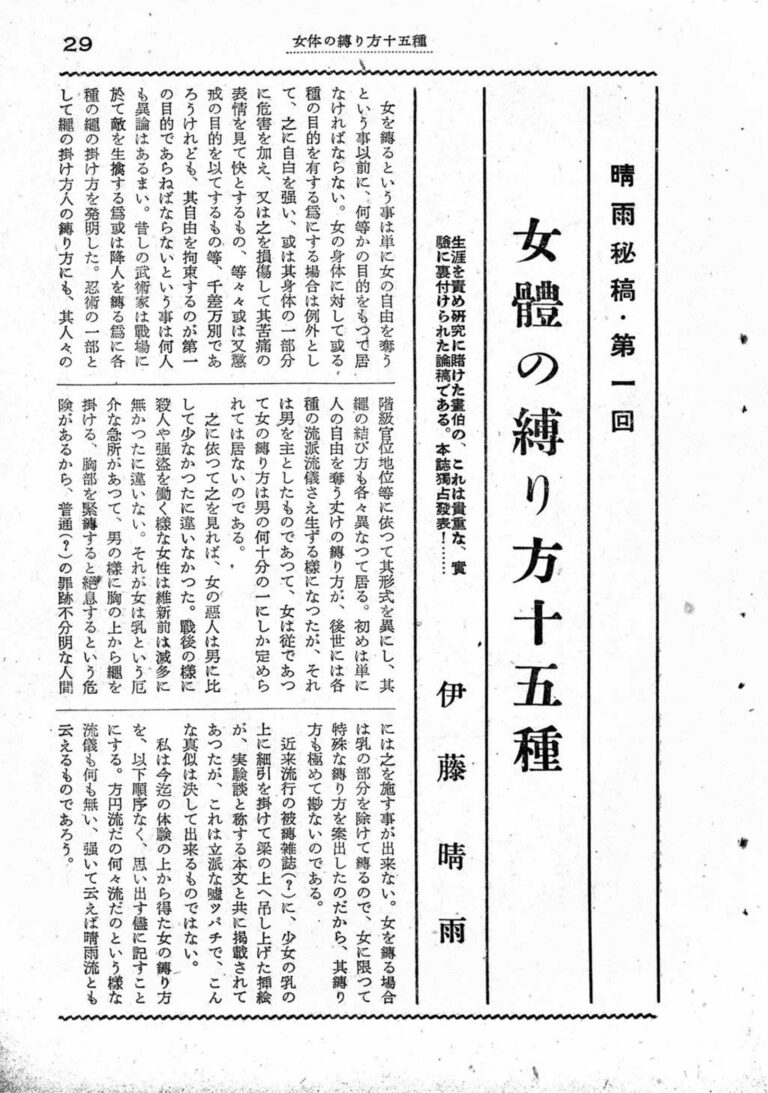
Seiu’s Secret Manuscript, Part One
Fifteen Ways to Tie the Female Body
This is a valuable essay by Itō Seiu, who devoted his life to the study of torment, and it is grounded in experiment. Published exclusively in this magazine.
Itō Seiu
To tie a woman is not merely to deprive her of freedom. Before anything else there must be some purpose behind it. Cases in which one has some particular objective regarding a woman’s body are exceptions, but there are countless possibilities: imposing something upon her, inflicting injury on some part of her body, damaging it and taking pleasure in the expression of pain, or doing it for punishment. Whatever the case, there can surely be no disagreement that the first purpose of tying is to restrict freedom. In former times martial artists invented many methods of applying rope in order to capture enemies alive on the battlefield. As part of the arts associated with ninjutsu, the forms of rope restraint and the ways of tying a person differed according to rank, office, and social position, and the knots themselves likewise varied. What began simply as ways of depriving a person of freedom later developed into numerous schools and ritualized forms. These systems, however, were principally designed for men; women were secondary, and the number of prescribed methods for tying women was only a fraction of those for men.
From this one might suppose that there were fewer female criminals than male ones. Before the Meiji Restoration, women who committed murder or robbery, as in the postwar period, must have been exceedingly rare. Women also have the troublesome vulnerable area of the breasts. Unlike a man, if rope is passed across the upper chest and the chest is tightly bound, there is a danger of suffocation. For that reason such treatment cannot simply be applied in the same way. When a woman is tied, the breast area must be avoided. Special methods therefore had to be devised specifically for women, and those methods have peculiar characteristics of their own.
I shall set down, in no particular order, the ways of tying women that I have learned through my own experience. There is no such thing here as the Man’en school or this-or-that formal school. If one insists on giving it a name, perhaps it could be called the Seiu school.
1. Rapid Binding Method
Quickly take both hands behind the back and tie the two thumbs together with a thin but strong cord, like shamisen string, tight enough that it bites into the fingers. Then take the remaining cord and run it toward the woman’s throat, or bind it tightly enough to bite into the little finger. Instead of the little finger, it may be attached to the wrist. The thumbs lose sensation, while the tips of the fingers turn purple and lose feeling. It is safer not to use this method very much. If it is used for prolonged binding play, it is dangerous because it can cause injuries severe enough to damage the flesh of the hands and fingers. It must not be used for more than an hour. The tightness should be only enough that the woman cannot free her hands. If this method is continued for too long, the cord bites into the flesh and cannot readily be removed, so injury to the fingers is unavoidable. It is a method said to have been used by Edo-period police runners when making arrests.
2. Wrapping Round and Round
This must be done quickly. In practical terms, when tying a woman who is trying to escape, the difference in physical strength between the two parties matters. When applying the rope, one must not indulge in sentimentality toward the woman. One must not take the other person’s suffering into consideration. A woman’s skin is more sensitive than a man’s, so she may cry out when tied rather harshly, but after a while the nerves become dulled. It is therefore useless to listen literally to her cries and loosen the restraint. In general, when tying a woman, unless one makes one’s heart merciless, one’s strength will slacken and one will not truly be able to bind her. One must constantly keep this in mind. Of course, when both parties are treating it as play, that is another matter. But for someone like me, who uses women as experimental subjects in physiological studies of restraint, sympathy is forbidden. There is almost no method other than to use one’s full strength. There is no secret technique beyond rapidly winding the rope around and around and quickly securing both hands. In the end, there is no substitute for practice.
3. Rapid Binding
The primary aim is simply to secure both wrists. The difficult part is the knack of twisting both arms up quickly. Once the wrists have been tied, rapidly pass the remaining rope between the upper arms and the back, repeat this two or three times, and then tighten it as firmly as possible. The woman’s chest will suddenly be compressed and the rope will begin to bite somewhat into the flesh. Without pausing, apply the rope around the abdomen, make two or three quick turns, and bring it back to the wrists. This must be done very quickly or there is a danger that the woman will escape. Playful situations are another matter, but in a serious situation one must anticipate resistance. Special caution is needed, for example, when apprehending a female thief. One must never forget to avoid binding across the breasts. Needless to say, her hands are tied behind her back.
4. Single-Leg Binding
First pin the woman down face-first. Twist one arm, usually the right, up behind her back and secure the wrist. Next, very quickly tie the left ankle. In this case, the rope’s loop or running eye, the ‘snake mouth’ shown in the illustration, must be left projecting slightly on the wrist side. Pass the rope securing the ankle through this loop and tighten it, so that the woman’s body takes on a bent shape. Use the remaining rope to bind the leg, or take another rope and pass it around the left lower leg and thigh, tightening it hard around the thigh. A relatively new, thin rope is most effective. After passing the rope, bind the thigh and lower leg with full force, then work the rope upward in successive turns and cinch it tightly at the groin. If the turns around the thigh are too close together, there will not be enough rope, so it is better to wind them more widely. The rope can then be brought to the neck and used to secure the left hand once more. Finally, taking hold of the right leg and dragging the woman’s body about is said to make the torment fully effective.
5. The Same, Reversed
There is a method exactly opposite to the preceding one, in which the woman’s body is bound and a stick is placed between the knee and thigh for torment. Another variation is to suspend the woman’s body upside down as it is. This is interesting, although it is not practiced now. It was probably one of the interrogation or torture methods used by Edo-period police runners at guardhouses before the Meiji Restoration. If a prisoner would not confess, a ‘wooden horse’ might be applied and she could be kept restrained for days. Hoda refers to a form of leg restraint or fetter.
6. ‘Inserted Neck’
This is a provisional name of my own. Put the right wrist between the thighs near the left leg and bind it firmly there. Take the remaining rope around the woman’s neck, then around her back, bring her left wrist behind her, secure it, and wind the end of the rope around her waist. Her neck remains tilted to the left, while the wrist is trapped between the thighs and the pain caused by the rope gradually becomes severe. After more than an hour the shoulder begins to hurt. If weight is added over the thigh, the pain in the wrist extends into the upper arm and shoulder. If a stick is inserted between the thighs, the object of the torment is easily achieved and the woman cries out in pain. If still more torment is desired, additional rope can be used to tighten the body further, sometimes to the point of fainting.
7. A Form of Ebi-zeme
This is approximately the same as a rope method used in Edo-period places of punishment. Seat the woman with her legs folded, bind the legs in two or three places, then pass rope around the shoulders and thighs and secure it. Bring the head as close to the feet as possible. The back becomes rounded and bends like a shrimp. It is said to be called ebi-zeme, ‘shrimp torment,’ because the body turns red like a shrimp. If the redness later turns white, the condition becomes life-threatening and the rope must be removed. I have never carried an experiment this far, so I cannot say more with certainty. In any case, the method forces the woman’s body into a forward bend and exposes certain parts of the body. Experimenting with it would therefore require a woman with whom one is especially intimate. If it were conducted experimentally for research, I doubt she could endure it for more than ten minutes. In one of my own trials, the subject suffered bodily injury lasting several days.
8. Stick Binding
This can be experimented with without injury. If the activity is somewhat playful, it may be extended into board torment in summer, or into certain kinds of torment that do not damage the skin and leave no marks. It is therefore, in my view, one of the least harmful yet most effective forms of restraint in such situations as jealousy between women in same-sex relationships. Its possible applications are extremely broad. One can use it, for example, to leave the subject outdoors in the cold, or in summer to subject her to mosquitoes, or to smoke. Many varieties of torment can be developed from it, so its applications are virtually unlimited. The tying itself varies according to taste. One common form is to stretch both arms out horizontally, place a pole across the back, bind the pole to the body in several places with short ropes, bind only the ankles, and leave the woman lying or rolling on the ground, or attach her to a standing tree. It is said to have been used as a form of private punishment known as ‘no-arashi.’
9. Looking Through the Thighs
This is close to a form of punitive torment said to have been used at the government office of the Sado gold mines. It is a binding method that requires extraordinary endurance. First take both hands behind the back and bind them there. Bring the rope end over the shoulder and tighten the body in a manner resembling ebi-zeme. Then pass the rope between the thighs, take it back to the wrists, and secure it. The remaining rope is then suspended from a beam and pulled upward. The method requires a great deal of work and is dangerous, so it is difficult to experiment with. According to legend, Dakki no Ohyaku was subjected to this torment twice, and it was so severe that even that notorious femme fatale could not endure it.
10. Heron
This is another provisional name, chosen because the shape resembles a heron. The woman’s hands are tied behind her back in the ordinary way, but the wrists should be bound as high as possible. Extend the rope and bend either the right or left ankle forward, winding rope around the leg in a spiral. With another rope, fasten a thick pole to the woman’s standing leg, then pass the pole between the two hands and secure it as shown in the illustration. The lower end of the pole is buried in the ground. The woman’s body bends forward into something like a T-shape and resembles a heron. To cause further suffering, a heavy stone may be placed on her back. It is said that prolonged use can cause unconsciousness, but I have not conducted this experiment.
11. Both Hands Raised
This too is merely a provisional name. Raise both wrists and bind them, then place a pole between the wrists so that the hands cannot be lowered. That is all. Other people then take turns tickling the woman’s armpits. When the suffering becomes intense she writhes, so her legs may also be bound to a log to deprive her of freedom of movement.
This was used to inflict maximum suffering without physically injuring the woman’s body. If she is tormented without sleep or rest, it is said that her mind becomes clouded and she will confess. It was later used as a form of torment called utsu-zeme. The tying itself is extremely simple, but the punishment depends on duration and therefore takes a long time.
12. Thigh-Spreading
Tie both hands behind the back, then use the remaining rope to force the legs as far apart as possible. Place a log between the ankles and bind the spread legs to it. When used as punishment this can become a particularly cruel form of play, so I will avoid describing it in detail here. The important point is that, in seeking transformations of the female body, a taste for novelty must not lead one to force the human form into unnatural contortions. To do so is to profane the art of binding. There is a limit to the cruel beauty of the female body, and the study of tying should proceed only with awareness of that boundary.
13. Tied Monkey
This is also a provisional name derived from the shape. Both hands and both feet are gathered together and bound into one bundle, like a tied monkey, with the head pointing downward. It is more painful than it looks. The same form can be adapted to the type of torment suggested by the illustration. In actual practice, however, if it is used directly for suspension, the joints of the hands can be damaged. I therefore note that this method should not be attempted by inexperienced people.
14. Inverted Suspension
In reality this is seldom possible, and because it may endanger life it should not ordinarily be attempted except in special circumstances. If one absolutely must create such a pose for photography or for a film set, it is safer to use a cloth suspension harness. This consists of wrapping cloth several times around the torso, passing hemp rope through it to make a loop, and passing the main suspension rope through that loop to raise the body. Such devices are used in provincial theater when an actor must temporarily ‘fly’ above the stage. They are extremely convenient, but not something an amateur can readily improvise.
15. Suspension
It is impossible simply to tie both hands behind the back and suspend a woman in the picturesque manner seen in illustrations for popular novels. A woman’s loincloth does not obligingly flip into a pleasing shape, nor do long kimono sleeves move gracefully just because she is hanging. In reality, a suspended woman’s body rarely makes an attractive form. As noted above, rope cannot simply be placed across the breasts, which further complicates the silhouette. The legs tend merely to hang and the body rotates. Even if the woman’s obi is used to support her, the body tends to hang rigidly and the result is not aesthetically pleasing. In practice the arms are bound behind in a takatekote-like position, rope is placed around the torso, and the body is suspended from a beam. This method requires considerable judgment and moderation, and one must never forget that it involves danger.
Translation Notes
The printed title is 女體の縛り方十五種, literally 'Fifteen Types of Ways of Tying the Female Body.' The translation uses the requested title 'Fifteen Ways to Tie the Female Body.' The orthography is pre-reform or deliberately old-fashioned in places, including forms such as 女體, 之, 居る, and 可く. '岡ッ引' refers to an Edo-period police assistant or runner. '海老責' (ebi-zeme) is a historical punishment in which the body is forced into a tightly flexed posture likened to a shrimp. '高手小手' is retained conceptually in the final section as a high hands-behind-the-back binding position; the modern kinbaku term takatekote is related but later usage is not always identical to Seiu's historical wording. '木馬' literally means 'wooden horse' and here refers to a punitive or restraining device rather than a child's toy. 'ホダ' is glossed by Seiu himself as a leg restraint or fetter. '妲妃のお百' (Dakki no Ohyaku) was a notorious female villain/femme-fatale figure of Edo popular culture. The term printed as 布蓮雀 in the inverted-suspension section appears to designate a cloth suspension support or harness used in stage flying; the exact historical reading and terminology should be checked against Seiu's other writings. The article's safety statements are internally inconsistent: Seiu sometimes warns against prolonged compression or dangerous suspension, but elsewhere describes severe restraint and torment as experimental or punitive practice. The translation preserves that contradiction rather than normalizing it.
Uncertain readings:
- PDF page 23: the phrase around '普通の罪跡不分明な人間' is difficult to read in the scan; the transcription reflects the most plausible reading but should be checked against a higher-resolution source.
- PDF page 23: '其縛り方も極めて妙ないのである' is visually unclear and may contain a different adjective or inflection.
- PDF page 25: the technical rope term 蛇口 is clearly printed, but Seiu's precise intended meaning is a rope eye/loop rather than the modern everyday meaning 'faucet.'
- PDF page 25: the phrase rendered '人中の所でグッと締め上げる' is not fully clear in the scan; the printed anatomical/location term may be different.
- PDF page 26: the heading and wording around 'ホダとは足枷の事を云う' are readable, but the preceding relation between 木馬 and ホダ may require historical terminology review.
- PDF page 27: the sentence about 妲妃のお百 contains one difficult phrase before '毒婦'; it has been transcribed as 稀代の毒婦 from context and visible letterforms.
- PDF page 29: 布蓮雀 is the apparent printed term for a cloth suspension device; the reading, etymology, and exact historical term are uncertain.
Missing or illegible text:
- PDF pages 23–29: no entire paragraph is missing, but several individual characters in the low-contrast scan are partially degraded; these are identified in uncertain_readings rather than silently supplied.